
Lieferung heute & morgen

Qualitätsgarantie

Willkommens-Angebote freischalten: KOSTENLOSE Lieferung | Bis zu 80 % RABATT | Kostenlose 30-Tage-JoyPlus-Testphase
App herunterladen
A well-maintained garden requires precision tools. Cutting shrubs, roses, or small branches with unsuitable or dull shears can not only damage the plants but also lead to rapid hand fatigue. Choosing the right pruning shears is therefore crucial for clean cuts and efficient work. This guide presents objective criteria for selection and showcases a range of tools designed for various gardening tasks.
To find the right model for your needs, several fundamental characteristics should be considered. These features determine durability, cutting quality, and user comfort.
The quality of the blades is the most important criterion. Models with blades made of hardened steel offer excellent edge retention and stability. An additional non-stick surface is advantageous as it reduces the adhesion of plant sap and dirt. This not only simplifies cleaning but also ensures consistently smooth cuts, which minimises stress on the plant.
Gardening can be demanding on the hands. An ergonomic handle that fits comfortably in your hand reduces strain and prevents fatigue. Pay attention to the size and material of the handles to ensure they match your hand size. An integrated safety lock is also an important feature. It allows the blades to be securely locked in the closed position for safe storage.
Not every pair of shears is suitable for every task. Classic pruning shears are ideal for green wood and shoots up to about 15 mm in diameter. For delicate plants like roses, precise rose shears are recommended. If, however, thicker branches need to be cut, loppers or tree shears with longer handles are necessary. These provide greater force transmission through leverage. A gardening shear set can be a practical solution to be prepared for various tasks.
Here you will find a compilation of tools that are suitable for different gardening jobs, based on their functionality and material properties.

What makes it stand out: This two-piece set of BLACK+DECKER gardening tools combines a long-handled lopper with a handy pair of pruning shears, covering a wide range of cutting tasks. The 53.3 cm lopper allows you to cut branches up to 38 mm in diameter at greater heights without needing a ladder. The smaller pruning shears are designed for precision work on thinner branches and stems up to 13 mm.
Benefits:
Who it's for: This set is ideal for garden owners looking for a comprehensive solution for trimming shrubs, hedges, and small trees, who need both precision for small plants and reach for higher branches.
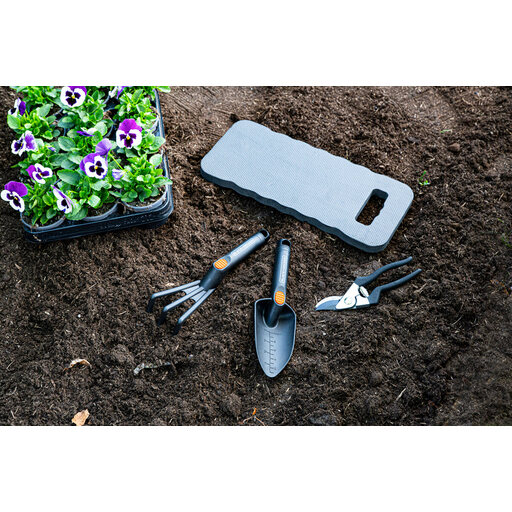
What makes it stand out: This garden tool set provides the essential equipment for various gardening tasks. It includes pruning shears with a cutting capacity of 13 mm, a cultivator for loosening soil, a trowel with a millimetre scale for precise planting, and a kneeling pad for more comfort during ground-level activities.
Benefits:
Who it's for: This set is aimed at hobby gardeners and beginners who are looking for a solid starter kit for general garden maintenance. It combines the most important tools for bed and plant care in one package.
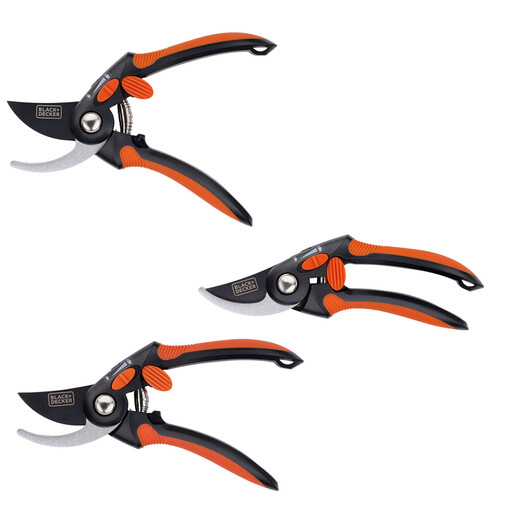
What makes it stand out: These individual pruning shears focus on the core functions: clean cuts and comfortable handling. The hardened steel blades are non-stick coated, which minimises friction and simplifies cleaning. The highly ergonomic handle is designed to reduce hand fatigue during extended use.
Benefits:
Who it's for: This tool is an excellent choice for anyone needing reliable and durable pruning shears for everyday cutting tasks, such as trimming roses, perennials, and thinner branches on shrubs and trees.
If you haven't found the right tool for your specific needs yet or are looking for models with different features, you can find more products in our range.
Discover additional models in our category for black shears.
Bypass shears work like regular scissors: two sharp blades glide past each other. They produce a very clean, precise cut and are particularly well-suited for fresh, living wood, as they do not crush the plant. Anvil shears have one sharp blade that closes onto a flat metal surface (the anvil). They are better for hard or dead wood as they exert more force, but they can cause bruising on fresh shoots.
For a long service life, pruning shears should be cleaned after each use. Remove plant sap and dirt with a cloth or brush. For stubborn resin residue, rubbing alcohol can help. Dry the shears well to prevent rust. The blades and joint should be regularly lubricated with a drop of oil (e.g., machine oil) to keep them moving smoothly. Sharpen the blades as needed with a suitable sharpening tool.
For branches with a diameter of more than 2 cm, conventional pruning shears are usually no longer sufficient. For this, loppers (also called tree shears) are the better choice. Their long handles create leverage, which allows for significantly greater cutting force. For very thick branches, a pruning saw is required.