
Lieferung heute & morgen

Qualitätsgarantie

Willkommens-Angebote freischalten: KOSTENLOSE Lieferung | Bis zu 80 % RABATT | Kostenlose 30-Tage-JoyPlus-Testphase
App herunterladen
A good putty knife is essential for achieving smooth walls and clean repairs. However, the market is flooded with tools that overpromise and underdeliver. As your Joybuy Product Recommendation Officer, I'll separate the facts from the marketing hype and show you what truly matters, ensuring your next project is a success and your tools last for more than just one season.
Many DIY enthusiasts and even some professionals choose the wrong tool, only to be frustrated by the results later. You should be aware of these three pitfalls to avoid making a poor investment:
To avoid the problems mentioned above, you should pay attention to three key features before buying. These characteristics define the quality and intended use of a putty knife.
The most important criterion for longevity is the blade material. While simple carbon steel rusts quickly, a stainless steel putty knife is the recommended choice. Look for specifications like 420-grade stainless steel. This type of steel offers a good balance of corrosion resistance and hardness, making it ideal for use with fillers and subsequent cleaning with water. A polished surface also simplifies cleaning and ensures less material sticks to the blade.
The flexibility of the blade determines its application:
An ergonomic handle isn't a luxury; it's a necessity for precise and sustained work. Handles made from a combination of materials, such as polypropylene (PP) for stability and thermoplastic rubber (TPR) for grip (soft-grip), provide comfort and prevent slipping, even with wet hands. A well-balanced handle gives you the control needed to precisely manage the pressure and angle of the blade.
Based on these objective criteria, we have compiled a selection of products suitable for different users and projects.
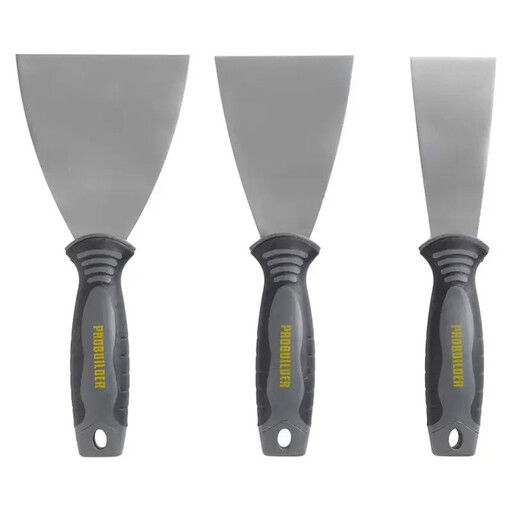
Why it's a good fit: This putty knife set is ideal for DIYers looking for a solid starter kit for occasional repairs and small projects. With the three most common widths (50, 75, 100 mm), you're equipped for most standard tasks without a large investment.
The stainless steel blades minimise the risk of rust compared to cheap carbon steel alternatives. The soft-grip handle also offers better comfort than simple hard plastic grips.
Provides a functional basic kit with three widths at an excellent price-performance ratio.
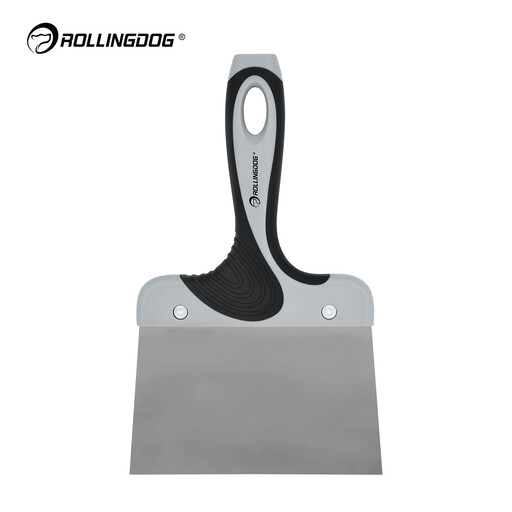
Why it's a good fit: For professionals and ambitious DIYers who need a reliable tool for smoothing joints and surfaces in drywall finishing. The 14 cm width is a great compromise between efficiency and control.
The polished blade made of 420-grade stainless steel offers high corrosion resistance. The flexible blade is specifically designed for a smooth finish, avoiding the "wrong flexibility" trap. The ergonomic rubber grip prevents fatigue.
A durable, corrosion-resistant blade and an ergonomic handle for precise, fatigue-free work on larger areas.
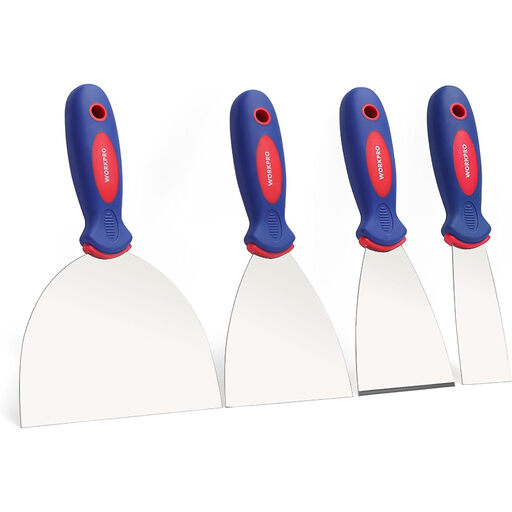
Why it's a good fit: This set is designed for users who regularly perform a variety of filling and scraping tasks. With four widths (38, 76, 100, 150 mm), it covers a huge range of applications, from detail work to smoothing large surfaces.
This set cleverly solves the "wrong flexibility" problem: it includes both flexible knives for finishing and an explicitly stiff 75 mm knife for filling. The mirror-polished stainless steel blades offer good rust protection.
A comprehensive set with four widths and varying degrees of flexibility, providing the right knife for almost any task.
We have compiled a complete, up-to-date list of products that fully meet these strict selection criteria and applicable standards.
Clean the knife with water immediately after use, before the filler hardens. A brush can help with stubborn residue. Always dry the blade and handle completely after cleaning to maintain the stainless steel's corrosion resistance and preserve the handle.
As a rule of thumb: For small cracks and holes, narrow knives (up to 50 mm) are suitable. For filling joints in drywall or for medium-sized repairs, widths from 75 mm to 150 mm are ideal. For smoothing entire walls to a high-level finish (Q3/Q4 quality), wide taping knives or special smoothing trowels (250 mm and up) are used.
Use a stiff filling knife to forcefully pack deep holes, joints, or cracks with material. The knife won't bend, ensuring good compaction. A flexible putty knife is then used to smooth the surface, feather the edges seamlessly, and create a fine, even top layer.