
Lieferung heute & morgen

Qualitätsgarantie

Willkommens-Angebote freischalten: KOSTENLOSE Lieferung | Bis zu 80 % RABATT | Kostenlose 30-Tage-JoyPlus-Testphase
App herunterladen
Finding the right Rainbow PLA Filament can be a challenge. Many users want vibrant, seamless color transitions for their 3D prints, but the results heavily depend on the filament's quality and composition. An inconsistent PLA color gradient or dull colors can compromise an otherwise successful project.
This guide is designed to provide you with some direction. We will introduce a selection of multi-color filaments and explain the key features to look for when making your choice. Our goal is to provide an objective basis for your purchasing decision, ensuring your printed objects achieve the exact aesthetic impact you envision.
Before you decide on a product, a few technical aspects are relevant. These criteria will help you find the right filament for your specific project and 3D printer.
The most distinctive feature of rainbow filament is its color change. The length of the filament strand required for a full color cycle varies by manufacturer and product.
Therefore, consider what type of objects you primarily intend to print to choose the appropriate gradient length.
In addition to the color gradient, the finish plays a crucial role in the visual impact. Most colorful PLA filament is available in two main variants:
Every rainbow 3D printer filament has specific processing requirements. Before purchasing, check the manufacturer's recommended printing temperatures for the nozzle and heated bed. Typical values for PLA are in the range of 190–220 °C for the nozzle and 50–60 °C for the heated bed. Correct settings are crucial to avoid issues like clogging, poor adhesion (warping), or messy surfaces.
Here, we present a few options from the CaiLab Filament range that stand out for their different color palettes and finishes.
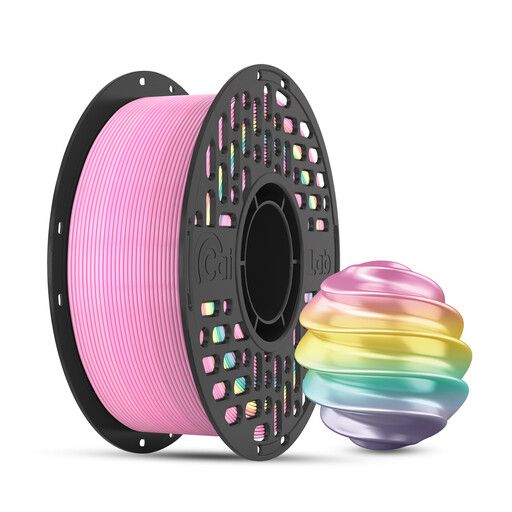
Why It Stands Out This filament combines a classic, bold rainbow color gradient with a pronounced silk gloss. The colors are rich, and the transition is designed so that a visible color change occurs even on medium-sized objects.
Advantages
Who Is It For? Users who want to print decorative objects with a vibrant and glossy finish. It's a great choice for vases, figurines, and other display pieces where aesthetics are the main focus.
View Details for CaiLab Silk Rainbow #11
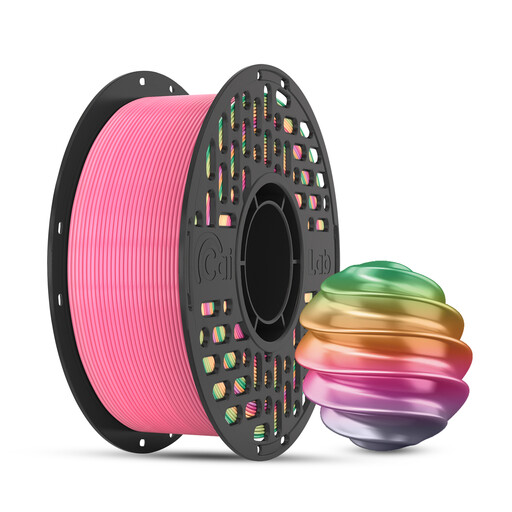
Why It Stands Out The "Silk Candy" variant deviates from the traditional rainbow spectrum, offering a palette of soft pastel tones. The color gradient is reminiscent of candy and gives prints a unique, more subtle aesthetic.
Advantages
Who Is It For? Designers and hobbyists looking for an alternative to the classic, bold rainbow colors. Ideal for projects that require a soft and playful look, such as children's toys (not suitable for small children), enclosures, or personalized gifts.
View Details for CaiLab Silk Candy
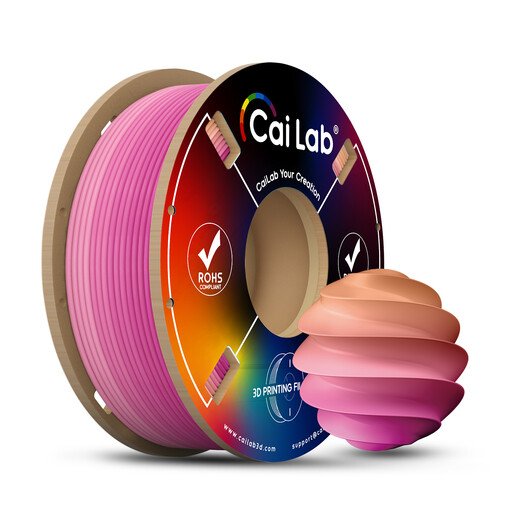
Why It Stands Out This variant is a standard PLA filament without a silk effect. It offers a clean color gradient with a more matte surface. This can be advantageous when a high gloss is undesirable or when the object requires greater mechanical stability than typical silk filaments.
Advantages
Who Is It For? Users who want to combine the functionality of standard PLA with the aesthetics of a rainbow color gradient. It is well-suited for functional prototypes, organizers, or tools that should still have an appealing look.
View Details for CAILAB Rainbow #7
The products featured here are just a sample of the available options. If you are looking for other color gradients or specific material properties, you can find more variants in our full category.
? Discover the Entire Selection of Rainbow PLA Filament
The color change is directly linked to the amount of filament consumed. You can control the effect by adjusting the size of the object or its infill density. A larger object or one with higher infill will use more material, resulting in more color changes in the final print. For small objects, it can be helpful to print several at once to achieve a visible color gradient across the entire batch.
Rainbow filament is typically produced through a process called co-extrusion. In this process, multiple colored plastic strands are brought together and fused into a single 1.75 mm or 2.85 mm filament strand. The speed at which the individual colors are fed determines the length and sequence of the color gradient on the spool.
Rainbow Silk PLA contains elastomers and other additives to create its glossy effect. According to many manufacturers, these additives can slightly reduce layer adhesion and overall tensile strength compared to pure, unmodified PLA. For decorative applications, the strength is typically more than sufficient. For mechanically stressed functional parts, standard PLA is often the more reliable choice.