
Lieferung heute & morgen

Qualitätsgarantie

Willkommens-Angebote freischalten: KOSTENLOSE Lieferung | Bis zu 80 % RABATT | Kostenlose 30-Tage-JoyPlus-Testphase
App herunterladen
Published: 07/04/2026 | By: Joybuy Product Recommendation Officer
Preparing for a long trip with an RV or a large rig requires careful planning, with driving safety as the top priority. Correct tire pressure is a crucial factor. It not only affects handling and fuel consumption but also minimises the risk of tire damage. A sudden loss of pressure at high speed can have serious consequences.
A Tire Pressure Monitoring System (TPMS) provides continuous tire pressure monitoring for your RV and warns the driver of any deviations. Retrofitting a system is a sensible measure, especially for vehicles not equipped with one from the factory.
This article serves as a guide. We will introduce different system types, explain important selection criteria, and present a selection of retrofit systems based on objective features to make your decision easier.
The choice of the right system depends on your vehicle type, vehicle length, and personal requirements. Here are three key points you should consider.
Retrofit systems use either external or internal sensors.
For most users looking for a simple and flexible solution, external sensors are the more practical choice.
RVs, rigs with trailers, or trucks are significantly longer than standard cars. The distance between the rearmost sensors and the receiver in the cockpit can affect signal quality.
Look for systems designed for long vehicles. Many models, especially TPMS for trucks or tire pressure monitoring systems for trailers, come with a signal booster (repeater). This is usually placed in the middle of the vehicle and ensures stable and reliable data transmission, even over distances of 15 meters (approx. 50 feet) and more.
Ensure the system offers enough sensors for your vehicle. A standard RV needs four sensors. If you are towing a trailer with one or two axles, you will need more accordingly. Some systems are offered as a set with 6 TPMS sensors or can be expanded to up to 24 tires, which also makes them attractive for fleet managers.
Equally important is the pressure range (in Bar or PSI) that the system can monitor. Heavy-duty RVs and trucks require significantly higher tire pressure than cars. Check whether the maximum monitoring pressure of the TPMS is suitable for your tires' specifications.
Based on the criteria mentioned, we have compiled a selection of systems that are suitable for various applications due to their technical features.
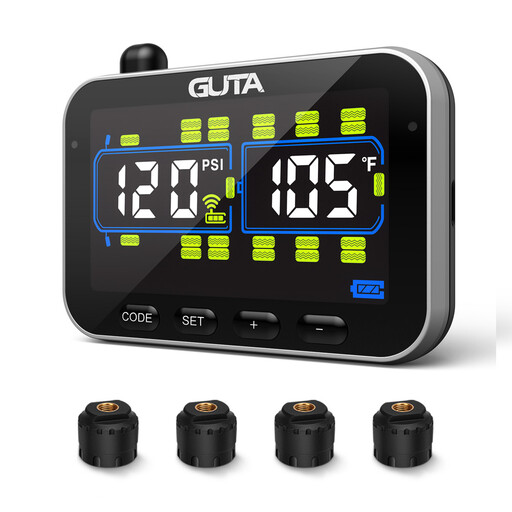
Why it stands out: This system from GUTA is specifically designed for use in RVs and trailers. With a very wide monitoring range of 0 to 14 BAR (0–203 PSI), it is also suitable for heavy vehicles with high tire pressure. The large color display and the six different alarm modes ensure comprehensive monitoring.
Pros:
Who is it for? Ideal for owners of standard RVs, campers, and trailers (up to approx. 20 feet in length) who are looking for a reliable and easy-to-install TPMS for their RV with a wide pressure monitoring range.
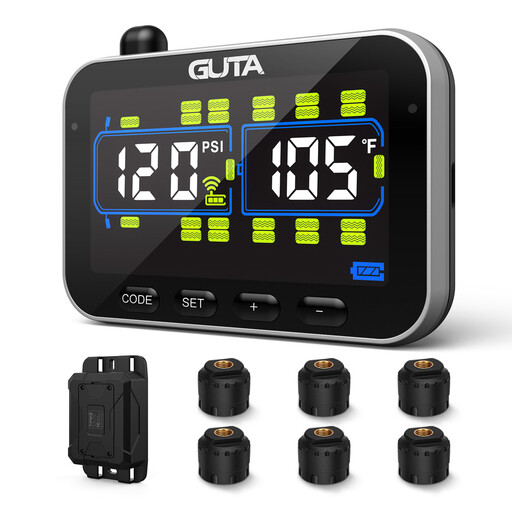
Why it stands out: This set is the extended version of the GUTA system and is aimed at owners of longer vehicles or rigs. It includes 6 sensors and a signal booster (repeater) to ensure stable communication even with vehicle lengths of up to 15 meters (approx. 50 feet).
Pros:
Who is it for? The first choice for drivers of large RVs, rigs with a caravan or trailer, and truck drivers who need a robust solution for tire pressure monitoring over long distances.
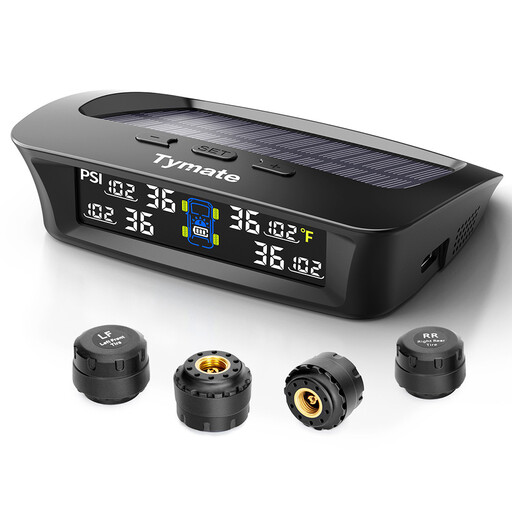
Why it stands out: The Tymate system is a compact and practical solution, particularly suitable for lighter RVs, vans, and cars. The monitoring range of 0 to 8 BAR (0–116 PSI) is designed for vehicles with lower tire pressure. According to the product name, the display can be solar-charged, which reduces cable clutter in the cockpit.
Pros:
Who is it for? A great option for owners of smaller RVs, camper vans, or SUVs (vehicle length up to approx. 20 feet) who are looking for a straightforward and cost-effective system for basic safety monitoring.
The models presented here cover common use cases. If you haven't found the right fit for your specific needs—be it a different number of sensors or additional features—you can find more solutions in our broader product category.
️ Discover more models in the Alarm Security System category
1. Can a TPMS be retrofitted on any RV? Yes, as a rule, a TPMS can be retrofitted on an RV. Systems with external sensors are universally applicable and can be screwed onto the standard valves (Schrader valves) of most vehicles. It is recommended to install them on metal valves to improve stability, especially at higher speeds.
2. What is the difference between internal and external tire pressure sensors?External sensors are screwed onto the outside of the valve and are very easy to install. Internal sensors are attached to the rim inside the tire, which requires tire mounting. Internal sensors are better protected from external elements, while external sensors are more convenient for maintenance (e.g., battery replacement).
3. How accurate are retrofit tire pressure monitoring systems? Modern retrofit systems offer high accuracy. Most manufacturers specify a measurement tolerance of less than 0.1 BAR (approx. 1.5 PSI). This precision is perfectly sufficient for detecting safety-relevant pressure deviations and helps to identify slow leaks early on.