
Lieferung heute & morgen

Qualitätsgarantie
App herunterladen
Kategorien
A Santoku knife is a versatile Japanese chef's knife whose name derives from the "three virtues" (Santoku): slicing, dicing, and mincing. It is characterized by its wide blade with a straight cutting edge and a rounded spine that tapers to the tip. This design makes it an effective all-purpose knife in the kitchen, especially suitable for processing vegetables, fish, and boneless meat. Selecting the right model depends on specific technical parameters and the user's individual needs.
A Santoku's performance is defined by the interplay of its blade material, edge, handle ergonomics, and blade length. An informed decision is based on an analysis of these criteria.
The steel used is crucial for the blade's sharpness, edge retention, and corrosion resistance. Common materials include stainless steels, often with a high carbon content that allows for greater hardness. Hardness is measured on the Rockwell scale (HRC). Values between 55 and 58 HRC offer a good balance of sharpness and flexibility, while higher values can mean longer edge retention but also greater brittleness.
The wide blade of the Santoku provides ample space for the knuckles of the guiding hand, increasing control during cutting. A common feature is the Santoku knife with a Granton edge. These are oval indentations along the blade. These hollows create small air pockets between the blade and the food, which reduces friction and minimises the sticking of thin slices, such as cucumbers or potatoes.
The handle should provide a secure and comfortable grip. Materials range from durable plastics like polypropylene or thermoplastic elastomers (TPE) to traditional wooden handles. The construction is also relevant. A "full-tang" design, where the blade's steel runs through the entire handle, ensures excellent balance and stability, making it a feature of many professional chef's knives.
Santoku knives are typically available with blade lengths between 14 cm and 18 cm. Shorter blades are more nimble and suitable for smaller cutting tasks. Longer blades offer more efficiency when cutting larger items like cabbages or when processing larger quantities.
Based on technical specifications and functional design, here are three models that cater to different user profiles.
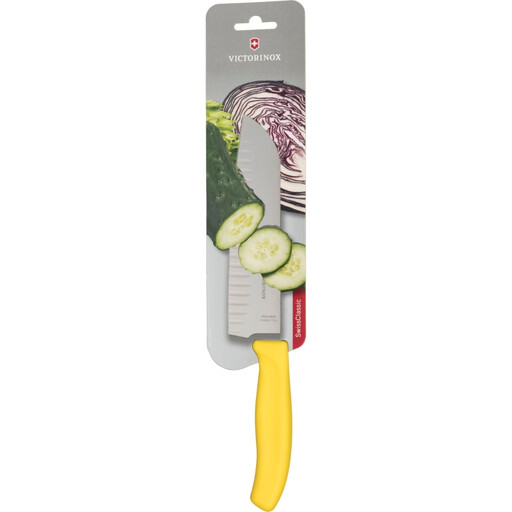
Why We Recommend This Product The Victorinox Swiss Classic Santoku stands out for its low weight of 103 grams and its practical design. The thermoplastic elastomer (TPE) handle offers a secure grip, and the stainless steel blade is designed for everyday use. Being dishwasher-safe enhances its practicality in the daily kitchen routine.
Pros
Who It's For This model is a functional choice for home cooks and for everyday family use, where ease of handling, low maintenance, and a reliable sharp kitchen knife are priorities.
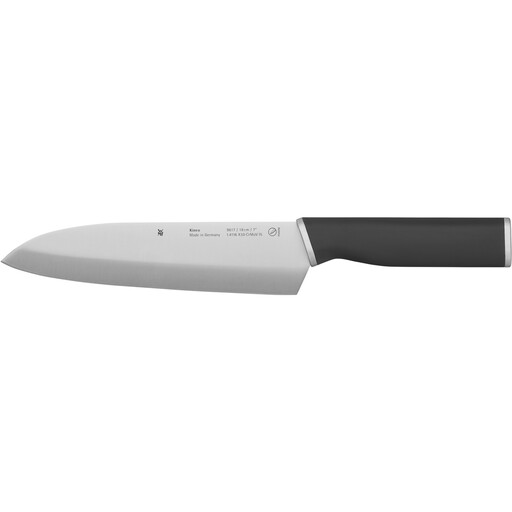
Why We Recommend This Product The WMF KINEO Santoku combines modern design with specific blade technology. According to WMF, its "Performance Cut" technology ensures long-lasting sharpness. The specially hardened blade steel, with a hardness of 55-58 HRC, offers high corrosion resistance and stability. The kinetic design of the handle is engineered for comfortable and balanced handling.
Pros
Who It's For Users looking for a knife for vegetables and fish with a focus on edge retention and modern design will find a suitable tool here. It is aimed at ambitious home users who appreciate technical features.
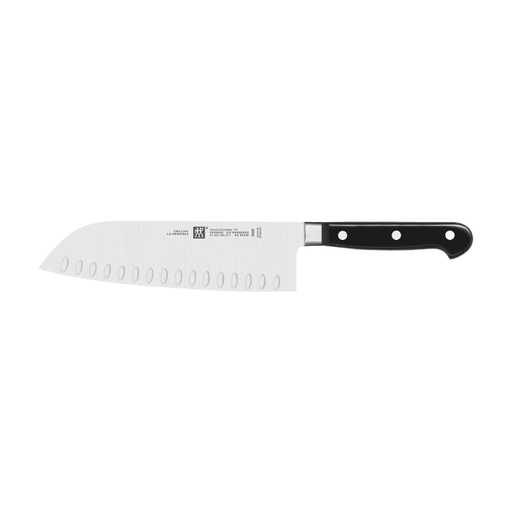
Why We Recommend This Product This Santoku knife from the Professional 'S' series by Zwilling is made in Germany and features a full-tang construction. This ensures excellent balance and durability. The high-carbon stainless steel blade and Granton edge enable precise, low-friction cuts.
Pros
Who It's For This model is designed for ambitious home cooks and users seeking a professional-grade chef's knife with a classic design, excellent balance, and high-quality materials for precise cutting tasks.
If the featured models do not fully meet your specific requirements, or if you wish to compare a wider selection of blade lengths, handle materials, and designs, you can find a broader overview in our main category. There, you can filter various options and identify the perfect tool for your kitchen.
Explore our full range of Santoku kitchen knives here.
1. What is the difference between a Santoku knife and a European chef's knife? The main difference lies in the blade shape. A European chef's knife has a curved blade that allows for a rocking cutting motion. A Santoku knife has a straighter edge and a wider blade, making it ideal for quick, straight chopping and slicing motions from top to bottom.
2. What is a Santoku knife with a Granton edge good for? The Granton edge consists of small, oval indentations on the blade. These create air pockets between the blade and the food being cut. This reduces friction and effectively prevents thin, moist slices (e.g., of cucumber, potato, or salmon) from sticking, which allows for smoother, cleaner cutting.
3. How do you care for and sharpen a Santoku knife? It is recommended to clean high-quality knives by hand with warm water and a mild detergent immediately after use, and to dry them right away. Cleaning in a dishwasher can damage the blade and handle. For sharpening, honing steels (for daily edge maintenance) or whetstones (for re-sharpening the edge) are suitable. The sharpening angle should match the one recommended by the manufacturer, which for Japanese knives is often around 15 degrees per side.