
Lieferung heute & morgen

Qualitätsgarantie
App herunterladen
Kategorien
The Santoku knife, a Japanese chef's knife, is renowned for its characteristic shape and versatility. The name "Santoku" translates to "knife of the three virtues," referring to its proficiency in slicing fish, meat, and vegetables. Unlike the curved blade of a European chef's knife, the Santoku features a wider, shorter blade with a straighter edge and a downturned tip. This geometry favours a chopping and pulling motion rather than a rocking cut. As an all-purpose kitchen knife, it is designed for a multitude of tasks, from fine dicing to thin slicing.
Choosing the right Santoku knife depends on objective parameters that determine the tool's performance, handling, and durability.
The blade material is crucial for its sharpness, edge retention, and corrosion resistance.
The most common lengths for a Santoku knife are between 17 cm and 18 cm.
The handle affects the knife's balance, safety, and comfort during use.
A seamless transition between the blade and handle is a hallmark of a hygienic and durable construction.
The following models have been selected based on their technical specifications and functional design.
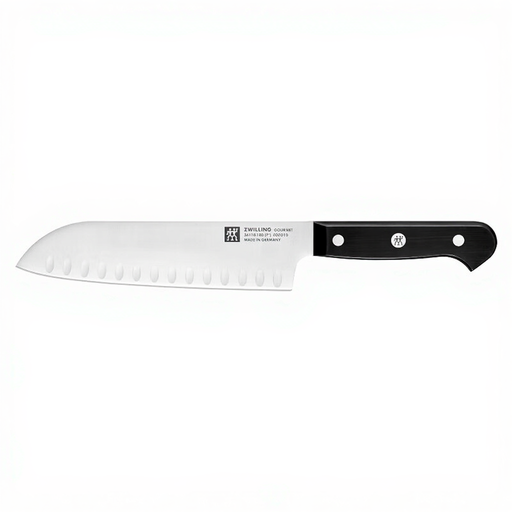
Why we recommend this product: This knife combines German manufacturing precision from Solingen with the Japanese blade shape. The blade, crafted from ice-hardened FRIODUR special formula steel, offers remarkable corrosion resistance and long-lasting sharpness. The V-Edge grind, at an approximate 15° angle per side, enables precise cuts.
Pros:
Best for: Users seeking a low-maintenance and durable professional chef's knife for daily use who value the manufacturing quality of a product from Solingen.
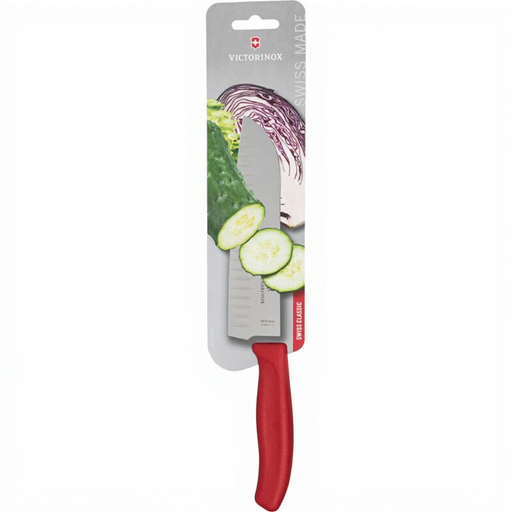
Why we recommend this product: The Victorinox Santoku knife stands out for its low weight (103 g) and functional design. Its hollow-edge blade reduces food from sticking, while the thermoplastic elastomer handle ensures safe and comfortable handling. Being dishwasher-safe makes it an exceptionally practical tool for the everyday kitchen.
Pros:
Best for: Home cooks who prefer a lightweight, straightforward, and functional all-purpose knife for daily preparation of vegetables and other foods.
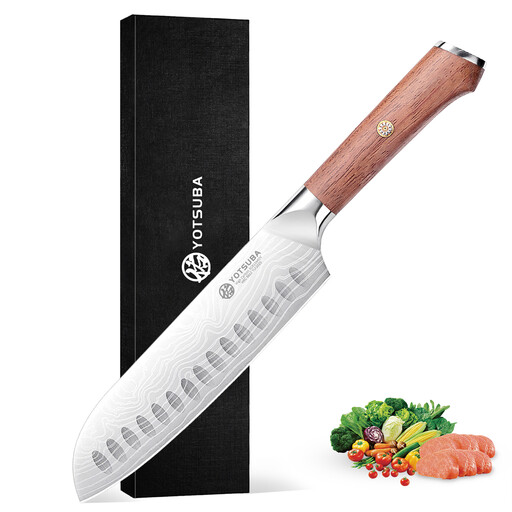
Why we recommend this product: This knife is a testament to traditional craftsmanship. The hand-forged high-carbon steel blade, with a Rockwell hardness of 56 and a 14-degree cutting angle, is designed for superior sharpness. The hollow-ground edge design helps to reduce cutting resistance. Its rosewood handle is moisture-absorbent and provides excellent grip.
Pros:
Best for: Ambitious home chefs who appreciate a knife with traditional features, like a hand-forged blade and a wooden handle, and are prepared for the maintenance it requires.
The selection of Santoku knives is wide and varied, including models with different steel types, handle shapes, and designs. For a comprehensive overview of other lengths, materials, and manufacturers, you can find additional models in our Santoku Knives category.
1. What is the functional difference between a Santoku knife and a European chef's knife? The main difference lies in the blade shape and the resulting cutting technique. The European chef's knife has a curved blade that supports a rocking motion. The Santoku knife has a straighter edge and a downturned tip, which favours a chopping or pulling motion. It is often lighter and shorter, making it more manoeuvrable for precise work.
2. What is the purpose of a hollow edge on a Santoku knife? The hollow edge consists of oval indentations along the blade. When slicing, these indentations create small air pockets between the blade and the food. These air pockets reduce friction and adhesion, preventing food—especially moist or starchy items like potatoes, cucumbers, or cheese—from sticking to the blade.
3. Is a Santoku knife suitable for all cutting tasks in the kitchen? As an all-purpose knife, the Santoku is designed for the three main tasks: slicing meat, fish, and vegetables. It excels at dicing onions, chopping herbs, and making thin slices. For highly specialised tasks, such as filleting fish (where a flexible filleting knife is better suited) or chopping through bones (which requires a cleaver), more specialised tools exist.