
Lieferung heute & morgen

Qualitätsgarantie

Willkommens-Angebote freischalten: KOSTENLOSE Lieferung | Bis zu 80 % RABATT | Kostenlose 30-Tage-JoyPlus-Testphase
App herunterladen
By your Joybuy Product Recommendation Officer, July 4, 2026
An unsightly gap between laminate and tile, a trip hazard where the carpet meets another floor, or an exposed expansion joint in the hallway—these are common issues in many homes. They not only spoil the look of your space but can also pose a safety risk. A self-adhesive transition strip offers a practical and straightforward solution.
This article serves as your guide. We'll introduce different types of strips and provide objective criteria to help you find the perfect profile for your project. The goal is to achieve a clean, secure, and drill-free floor transition.
Before making a decision, there are a few key factors to consider. The right choice depends on your flooring type, the width of the gap, and your aesthetic preferences.
Self-adhesive transition strips are often made from PVC (polyvinyl chloride) or aluminium.
Precisely measure the gap you need to bridge. The strip should be wide enough to completely cover the gap and rest securely on the flooring on both sides. Ensure the profile width is sufficient to cover an expansion joint, which is necessary for floating floors like laminate. Also, measure the required length, such as the width of a doorway. Many strips can be easily cut to size with sturdy scissors or a utility knife.
Aesthetics play a crucial role in achieving a harmonious overall look. A wood-look transition strip can mimic the grain of a laminate or vinyl floor, creating a nearly invisible transition. For transitions between different materials, such as a transition strip for laminate and tile, solid-colour profiles in grey, silver, or black can create a deliberate and modern accent.
Based on the criteria above, we've curated a selection of products that stand out for their material properties and ease of installation.
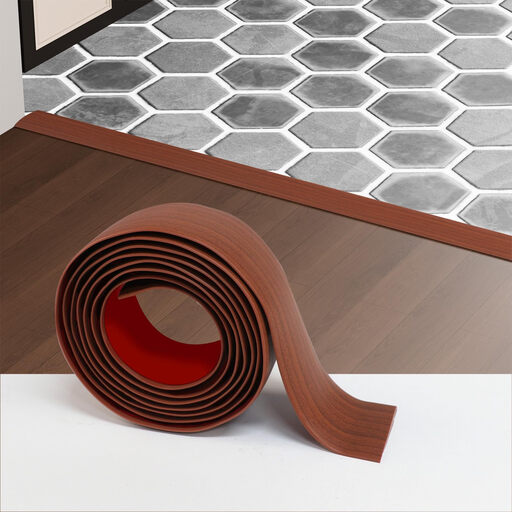
Why it stands out: This flexible vinyl profile from LONGKING is distinguished by its realistic wood grain, which blends well with existing wood or laminate floors. With a length of 122 cm and a width of 4 cm, it is suitable for standard doorways and reliably covers gaps. Installation is as simple as peeling off the protective film and pressing the strip into place.
Pros:
Who is it for? This profile is a great choice for renters and DIY enthusiasts looking for a quick and visually appealing solution for transitions between rooms like the living room, kitchen, or bathroom, especially for wood-look flooring.
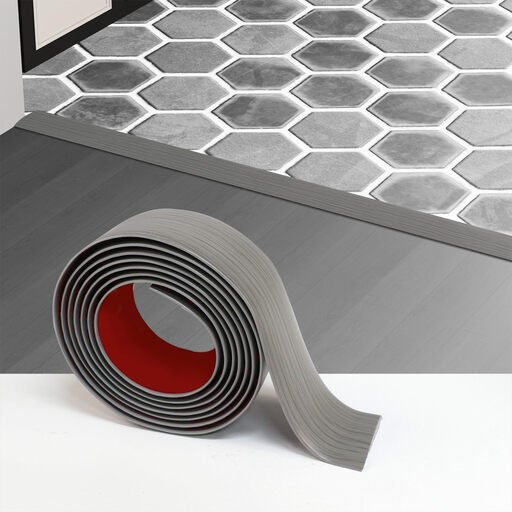
Why it stands out: With an exceptional length of 304 cm, this self-adhesive transition rail from LONGKING allows you to cover long, continuous gaps without any seams. The simple grey tone has a modern look and pairs well with tile, concrete-look floors, or as a neutral contrast to wood flooring. The low profile, at 0.3 cm high, minimises the trip hazard.
Pros:
Who is it for? Ideal for open-plan living areas or long hallways where a continuous transition without visible seams is desired. It is well-suited for projects that require a longer length to avoid cuts and joints.
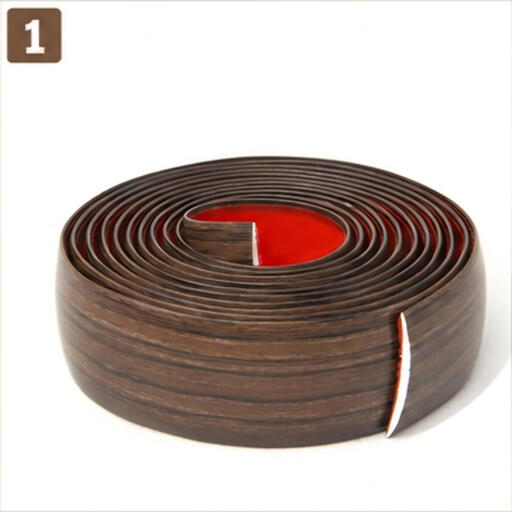
Why it stands out: The profile from Art3d combines functionality with an attractive design. The brown wood grain offers another colour option for wood-look floors. According to the manufacturer, the PVC material is scratch-resistant and abrasion-resistant. A note from the manufacturer: if the profile is bent during shipping, it can be heated with a hairdryer and reshaped, which highlights the material's flexibility.
Pros:
Who is it for? A suitable option for anyone seeking a durable and easy-to-install solution for standard transitions who values a specific, warm wood look.
The profiles featured here are just a sample of the available solutions. Depending on your project requirements, other materials, widths, or fastening systems may be more suitable.
If you're looking for more alternatives or specialised tools for joints and flooring work, you'll find a wider selection in our broader category.
Explore Our Full Range of DIY Grouting Tools
Installation is typically straightforward and requires no special tools.
Removability depends on the adhesive and the surface condition. With most strips, the adhesive can be softened by gently heating it with a hairdryer, which makes removal easier. Any remaining adhesive residue can often be removed afterwards with a suitable cleaning agent. However, caution is advised on delicate surfaces.
A properly installed, self-adhesive floor strip made of high-quality PVC is designed for normal household use and daily foot traffic. The adhesive strength is very high on clean, smooth surfaces. For areas with extremely high traffic, such as in commercial properties or where heavy rolling carts are used, screw-down metal profiles may be a more robust alternative.