
Lieferung heute & morgen

Qualitätsgarantie

Willkommens-Angebote freischalten: KOSTENLOSE Lieferung | Bis zu 80 % RABATT | Kostenlose 30-Tage-JoyPlus-Testphase
App herunterladen
By: Joybuy Product Recommendation OfficerDate: July 04, 2026
Shoes piling up in the entryway is a common problem in many households. Not only does it disrupt the tidy appearance of your hallway, but it can also become a tripping hazard and shorten the lifespan of your shoes. A well-thought-out shoe storage solution is therefore not a matter of luxury, but of practicality.
This article serves as a guide. We will introduce various types of shoe racks and analyze their features to provide you with an informed basis for a decision that suits your specific needs and spatial constraints. The goal is to find a functional and fitting solution for your shoe collection.
Before you decide on a model, there are some fundamental criteria to consider. These will help you narrow down the selection to products that truly fit your home.
The intended location is the most crucial factor. A narrow hallway requires a different solution than a spacious walk-in closet. Carefully measure the available width, depth, and height. For very tight spaces, a narrow shoe rack or a hanging shoe rack that leaves the floor space completely free is ideal. In larger rooms, a wider shoe cabinet or a modular system that offers more storage space can be a sensible choice. Also, consider door swing radiuses and walkways.
Consider how many pairs of shoes you need to store. Plan for a little extra room for future purchases. The type of shoes you own is also relevant. High boots require more vertical space than flat sneakers or sandals. Some rack systems offer adjustable or variably-sized compartments to accommodate different shoe types. A simple shoe organizer might suffice for a few pairs, while families often need a high-capacity solution.
The material influences both durability and aesthetics.
An open rack offers quick access and good ventilation. In contrast, a shoe rack with doors protects shoes from dust and creates an exceptionally tidy look, as the shoes are hidden from view.
Here is a selection of different shoe rack types that meet various requirements for space, capacity, and functionality.
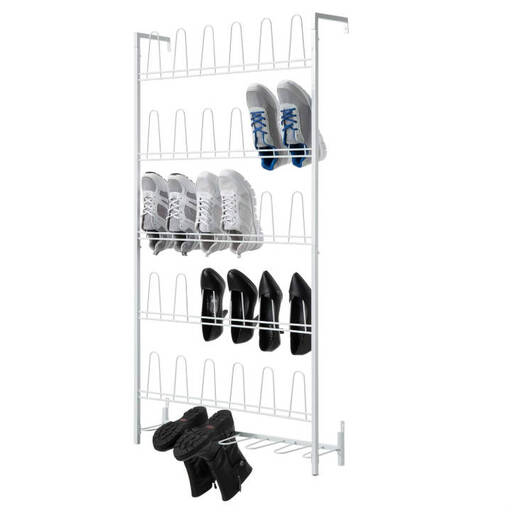
Why It Stands Out: This model utilizes wall space, making it an extremely space-saving solution. The hanging storage keeps the floor completely clear, which simplifies cleaning the area and creates an open, airy atmosphere.
Pros:
Who Is It For? Ideal for individuals with limited floor space in narrow hallways, walk-in closets, or entryways. It's a great choice for anyone looking for an organized yet unconventional storage method.
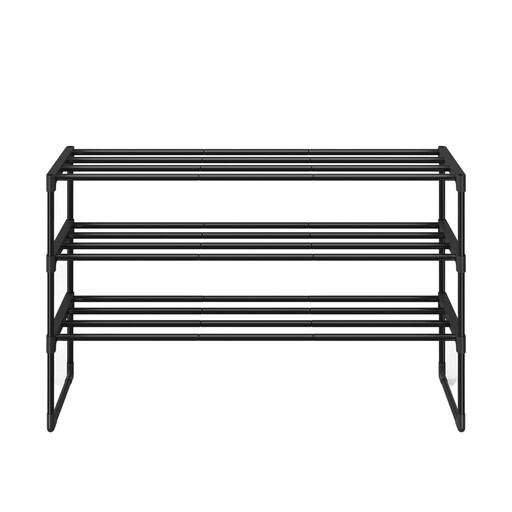
Why It Stands Out: This rack is distinguished by its simplicity and flexibility. The tool-free assembly and narrow profile make it a straightforward and quick-to-deploy solution for shoe storage.
Pros:
Who Is It For? A practical choice for renters, students, or anyone looking for a fast, cost-effective, and adaptable solution for the hallway, bedroom, or closet. Its shallow depth of 30 cm makes it particularly suitable for narrow areas.
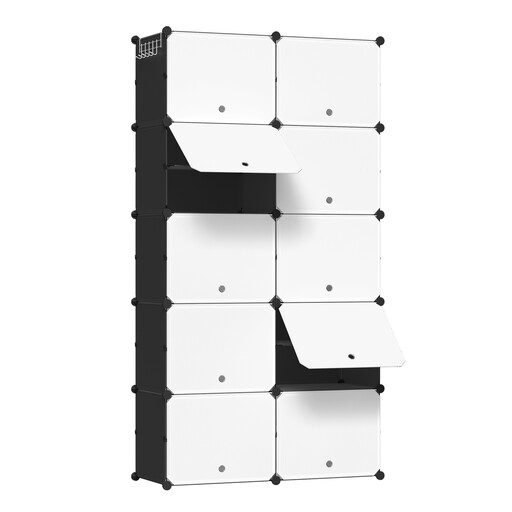
Why It Stands Out: This modular system offers maximum flexibility and a very high capacity. Its closed design with doors creates a tidy, uniform look while protecting shoes from dust.
Pros:
Who Is It For? Perfect for families or shoe enthusiasts with a large collection. Its customizable and enclosed structure makes it a versatile storage solution that can be used not only as a shoe cabinet but also as a bookshelf or for toy storage.
The products featured already cover a wide range of needs. However, if you are looking for other models or need a different size, you can find a broader selection of solutions in our category.
? Discover more Metal Shoe Rack models here.
The space required depends entirely on the model you choose. A narrow, tall rack can have a depth of just 25–30 cm, fitting well into tight hallways. Hanging organizers require no floor space at all. Larger shoe cabinets can be 35 cm or deeper. It is essential to measure the available space accurately before purchasing.
To save space, vertical solutions are ideal. Tall, narrow racks, stackable systems, or organizers mounted on a wall or door make optimal use of vertical space. Modular systems that can be adapted to fit into alcoves or the space under a staircase are also a very efficient method.
A shoe rack is typically an open structure that allows for quick access to shoes and provides good ventilation. A shoe cabinet is a closed piece of furniture, usually with doors or flaps. It protects shoes from dust and keeps them out of sight, which contributes to an exceptionally tidy overall look in the room. The choice depends on personal preference regarding accessibility and aesthetics.