
Lieferung heute & morgen

Qualitätsgarantie

Willkommens-Angebote freischalten: KOSTENLOSE Lieferung | Bis zu 80 % RABATT | Kostenlose 30-Tage-JoyPlus-Testphase
App herunterladen
By the Joybuy Product Recommendation OfficerLast updated: 28 July 2026
A cluttered entryway, overflowing wardrobes, and the daily hunt for the right pair of shoes—it's a familiar problem in many homes. A well-designed shoe storage solution can be the perfect remedy. However, the market is flooded with products that vary wildly in quality and practicality. Before you make a decision, it's crucial to understand the common pitfalls that can quickly turn a supposed helper into a source of frustration.
This guide will show you the three critical factors to consider to find a durable and functional solution, and introduce you to different concepts tailored to various needs.
Many products promise to bring order but fail in practice due to fundamental flaws. Pay close attention to these three pitfalls to avoid making a bad buy:
To make the right choice, you should define your requirements based on three objective parameters.
The choice of system depends on your available space, the number of shoes you own, and your aesthetic preferences.
The longevity of your shoe storage solution is directly linked to its material.
Always check the manufacturer's stated maximum load capacity per tier. A realistic value for a sturdy rack is at least 5 kg per shelf.
Measure the available space precisely: height, width, and depth. In a narrow hallway, plan for a maximum depth of 30-35 cm to avoid obstructing the walkway. Consider how many pairs of shoes you need to store and whether you need space for taller footwear like boots. Some racks allow you to remove tiers to flexibly accommodate different shoe heights.
Here are some product concepts tailored to specific needs and living situations.
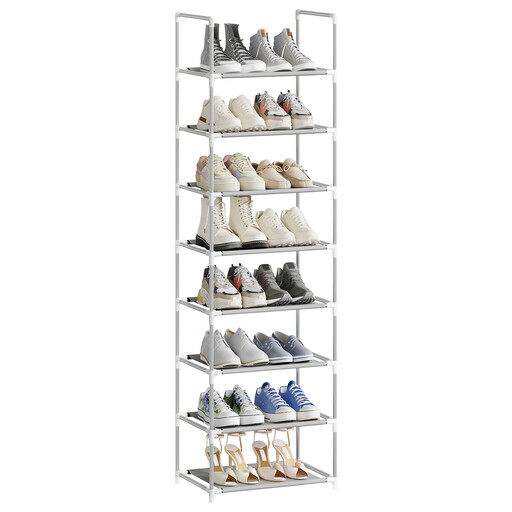
Why it's a great fit: Ideal for those living in homes with limited space. It makes optimal use of vertical space without taking up valuable floor area in the entryway.
The construction of thickened metal tubes and plastic connectors offers greater stability than basic models. With a depth of just 28 cm, it is explicitly designed for tight spaces and avoids blocking walkways.
High capacity (up to 16 pairs of shoes) on a minimal footprint. The tiers are removable to create space for boots.
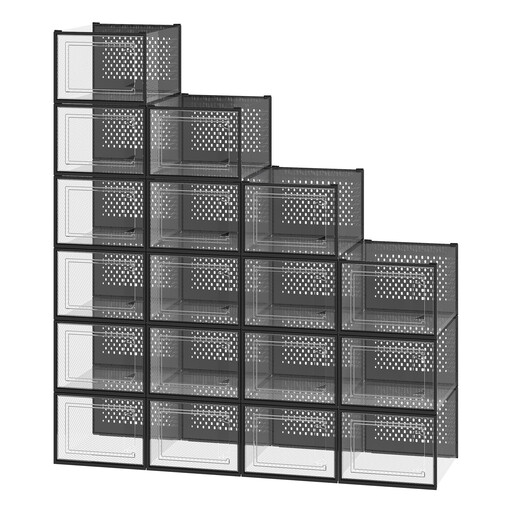
Why it's a great fit: Perfect for anyone who wants to protect, organise, and showcase their shoe collection. Each pair gets its own dedicated, protected space.
The integrated ventilation holes ensure air circulation and prevent odour build-up. Its modular, stackable design allows the storage to be precisely adapted to the available space and shoe size.
Individual protection from dust and dirt for each pair. The transparent front door allows for instant identification of the desired shoe.
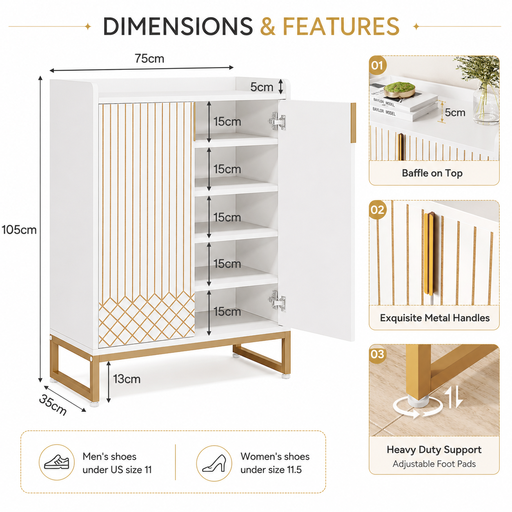
Why it's a great fit: For households where shoe storage should be a fully-fledged piece of furniture that blends seamlessly into the home decor and ensures a permanently tidy look.
The sturdy wood construction with metal legs ensures high stability and durability. As a closed cabinet, it protects shoes from dust and maintains a neat appearance.
The minimalist design with subtle gold accents makes the cabinet a stylish piece of furniture. Shoes are kept completely out of sight, ensuring maximum order in the room.
We have compiled a complete, up-to-date list of products that fully meet these strict selection criteria and relevant safety regulations.
Measure the intended space precisely (height, width, depth). Also, consider the swing radius of any doors (room doors and cabinet doors). For a narrow hallway, models with a depth of less than 30 cm are often the most practical choice. Compare the internal dimensions of the compartments with your largest shoe size to ensure they will fit completely inside.
It depends on your priorities. An open shoe rack offers better ventilation and quicker access to your shoes. A shoe cabinet with doors protects from dust and UV light, and creates a calmer, more organised look. If you value a pristine appearance, a closed system is preferable. For quick daily access, an open rack is more practical.
To store many shoes in a space-saving way, make use of vertical space. Tall, narrow racks or stacked shoe boxes are ideal for this. Modular systems that you can expand as needed offer maximum flexibility to utilise the available space down to the last inch. Removing shelves in racks can also help to use the space more efficiently for different types of shoes.