
Lieferung heute & morgen

Qualitätsgarantie

Willkommens-Angebote freischalten: KOSTENLOSE Lieferung | Bis zu 80 % RABATT | Kostenlose 30-Tage-JoyPlus-Testphase
App herunterladen
A narrow hallway or a tight entryway presents a challenge for many households: where to put shoes without creating tripping hazards or a cluttered look? A slim shoe cabinet is often the perfect solution to create storage space while maintaining a tidy atmosphere. This guide introduces various models and provides practical tips to help you choose the right shoe storage for your entryway.
Before you make a decision, several functional aspects should be considered. A well-thought-out purchase ensures that the new piece of furniture not only fits visually but also practically into your daily life.
The cabinet's construction directly impacts its use and appearance in the room.
A shoe cabinet for the hallway is used daily and should therefore be robust. Models made from MDF or particleboard are common and offer good value for money. Look for sturdy construction and high-quality hardware. For taller, slimmer models, an included anti-tip kit for wall mounting is an important safety feature, especially in households with children or pets.
Measure the available space precisely: width, height, and especially depth are crucial. A space-saving shoe cabinet should not significantly restrict the walkway in the hallway. Also, check the cabinet's stated capacity. The number of shoe pairs it can hold is a guideline that can vary depending on shoe size and type (e.g., boots vs. sneakers). Some models offer adjustable shelves to flexibly accommodate taller footwear like ankle boots.
Here is a selection of slim shoe cabinets that stand out for their different features and are suitable for various needs.
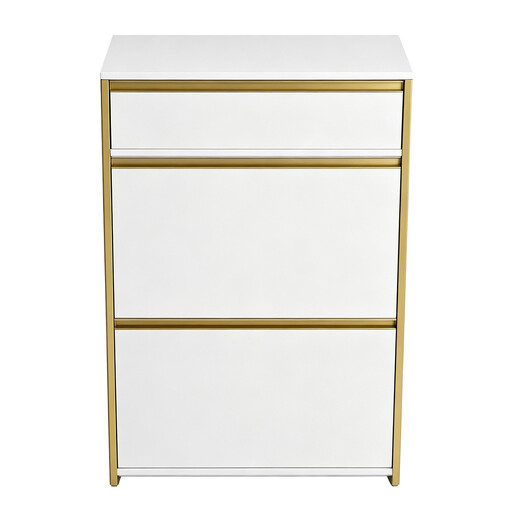
Why It Stands Out: This model combines functionality with a decorative design. The white and gold color scheme and clean lines fit well into modern or subtly luxurious interior styles. It's more than just a shoe cabinet; it also serves as a storage unit and a decorative piece.
Advantages:
Who It's For: For users looking for a stylish and multifunctional storage solution that integrates seamlessly into their home's decor and looks great not only in the hallway but also in the living room or bedroom.
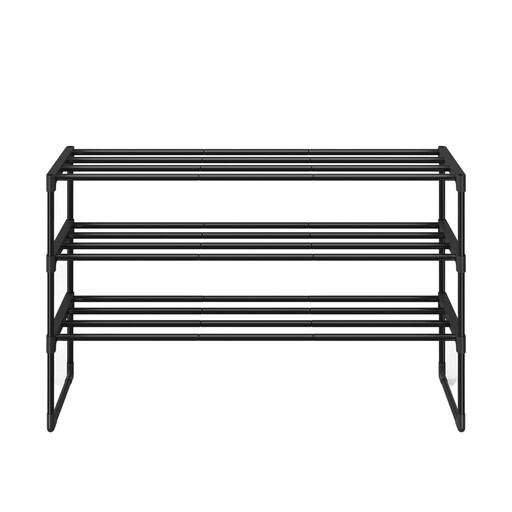
Why It Stands Out: This open rack impresses with its simple and functional design. The metal construction is lightweight yet robust. Its key feature is its stackability, allowing you to expand storage vertically as needed.
Advantages:
Who It's For: Ideal for those who want a straightforward, flexible, and cost-effective solution for shoe storage and value quick access and good ventilation. It fits well in an entryway, closet, or basement.
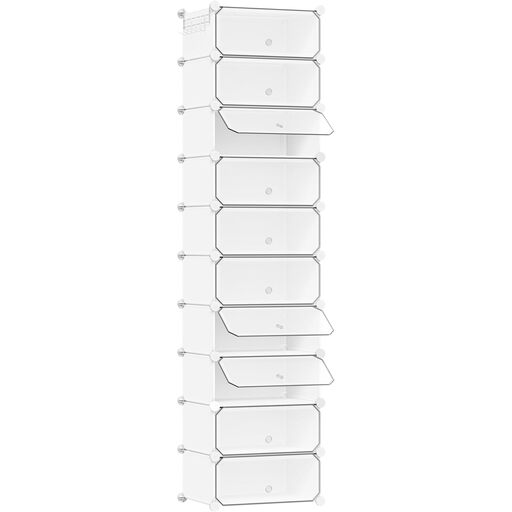
Why It Stands Out: The modular interlocking system from WOLTU offers maximum flexibility. It can be assembled in various shapes depending on the available space and your needs—as a tall tower, a wide sideboard, or in a stepped configuration to fit under the stairs.
Advantages:
Who It's For: For anyone who needs a customizable and expandable storage solution. Especially practical for nooks, spaces under sloped ceilings, or if your storage needs might grow over time.
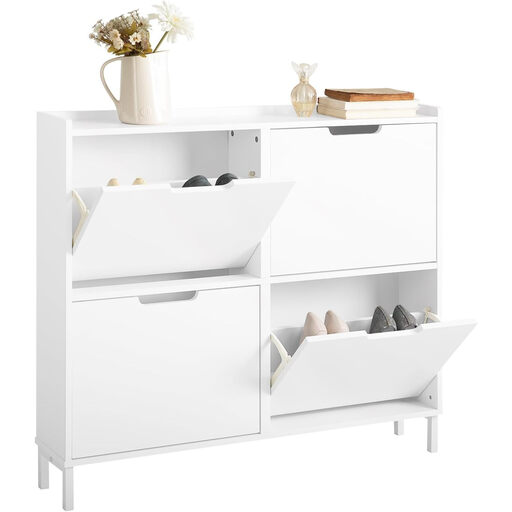
Why It Stands Out: With a depth of only 19 cm, this tip-out shoe cabinet is an extremely space-saving solution. It makes optimal use of the room's height and offers discreet storage for shoes behind four flaps.
Advantages:
Who It's For: Perfect for residents of apartments or houses with very narrow entryways who want to achieve maximum storage on a minimal footprint and prefer a clutter-free aesthetic.
The models presented here already cover many needs. However, if you are looking for other sizes, colors, or designs, it's worth taking a look at our wider selection.
Discover more models in our Self-Assembly Shoe Cabinets category and find the perfect solution for your home.
A slim shoe cabinet usually has a depth between 17 cm and 30 cm. Particularly slim models are often designed as tip-out cabinets, where the depth can be under 20 cm. Classic shoe chests or racks are typically between 25 cm and 30 cm deep.
The capacity varies greatly depending on the model and size. Compact tip-out cabinets often hold 8 to 12 pairs of shoes. Larger models or modular systems can accommodate 20 pairs or more. The exact number also depends on the type and size of the shoes. Product descriptions usually provide a reliable estimate.
This depends on personal priorities. A closed cabinet (e.g., a white shoe chest or a tip-out model) creates a uniform and tidy look and protects shoes from dust. An open rack offers better ventilation and quicker access to shoes but can also look more cluttered.