
Lieferung heute & morgen

Qualitätsgarantie

Willkommens-Angebote freischalten: KOSTENLOSE Lieferung | Bis zu 80 % RABATT | Kostenlose 30-Tage-JoyPlus-Testphase
App herunterladen
The decision to integrate fresh juices into your daily routine is a positive step towards a more conscious diet. But the market for juicers is overwhelming and full of marketing promises that often create more confusion than clarity. Many buyers invest in a device that ends up collecting dust in a cupboard—whether due to complicated cleaning, disappointing juice quality, or because it simply doesn't live up to its promises.
As your Joybuy Product Recommendation Officer, I have analysed the most common pitfalls to help you make an informed decision. This guide focuses on the objective criteria that define a good slow juicer and helps you sidestep the typical marketing traps.
To avoid a bad purchase, you should focus on three core technical features. These determine the juice quality, user-friendliness, and longevity of the device.
The central component of a true slow juicer is the auger. It rotates slowly, grinding fruits and vegetables before pressing them against a sieve. This process gently extracts the juice and produces a drier pulp, indicating higher efficiency.
In contrast, centrifugal juicers shred the produce with a fast-spinning grating disc and fling the juice outwards through a sieve. While this is faster, the high speed can promote oxidation.
A juicer suitable for everyday use must be practical. Two design aspects are crucial here:
A good cold press juicer must also be able to handle hard ingredients like carrots, beetroot, or ginger. A robust motor (often with lower wattage but high torque) and an auger made of durable material (e.g., Ultem) are indicators of longevity. A quiet juicer with a high-quality copper motor suggests a solid build and pleasant operation.
Here are some recommendations tailored to different user profiles that meet the criteria mentioned above.
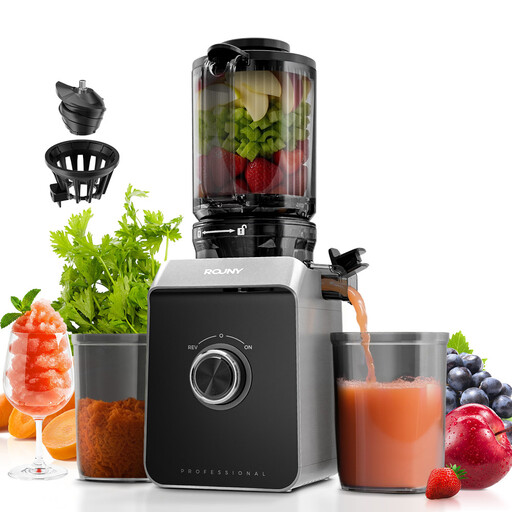
Why This Fits Their Persona: Ideal for users who value maximum nutrient extraction and minimal effort. Perfect for making high-quality juices with no prior experience and for maintaining the habit.
The filter-free design solves the problem of laborious cleaning. As a true cold press juicer with a slow copper motor, it bypasses the trap of "pseudo-cold press" machines that generate heat.
The 130 mm wide feed chute significantly reduces prep time. The added function of making fruit sorbet from frozen fruits offers extra value.

Why This Fits Their Persona: For users who prioritise speed and straightforward operation. Ideal for a quick morning juice without investing much time in preparation and cleaning.
This device is clearly labelled as a centrifugal juicer and doesn't create the false impression of being a slow juicer. Its parts are designed for easy cleaning, thus avoiding the "cleaning nightmare."
The 600W motor ensures very fast juice extraction. The wide 3-inch feed chute is practical for whole fruits and vegetables, minimising preparation time.

Why This Fits Their Persona: For users who want extremely simple operation and, above all, lightning-fast cleaning. The space-saving vertical design fits well in modern kitchens.
This model directly addresses the "cleaning nightmare" with its innovative, filter-free structure. There is no fine sieve that needs to be laboriously scrubbed, which drastically simplifies maintenance.
The fully automatic cold-press technology combined with the filter-free design makes the entire process from preparation to cleaning exceptionally straightforward.
We've compiled a complete, up-to-date list of products that fully meet these strict selection criteria and German safety regulations.
1. How long does fresh juice from a slow juicer last? Thanks to the gentle processing and lower oxidation, juice from a slow juicer can be stored in an airtight container in the refrigerator for up to 48 hours. However, for maximum nutrient content, immediate consumption is recommended.
2. Is a quiet juicer really important? Yes, especially if you plan to use the juicer early in the morning or in a household with children. A quiet juicer like a slow juicer operates at a noise level of about 40-60 decibels, comparable to a normal conversation. Centrifugal juicers, on the other hand, can reach noise levels of over 70 decibels, which is close to a vacuum cleaner.
3. Can a slow juicer also process hard vegetables like carrots or beetroot? Yes, a high-quality slow juicer is designed for this. Its powerful, slow-rotating auger can efficiently process fibrous and hard produce like carrots, celery, or ginger and achieve a high juice yield. Look for a robust construction and high-quality materials for the auger.