
Lieferung heute & morgen

Qualitätsgarantie

Willkommens-Angebote freischalten: KOSTENLOSE Lieferung | Bis zu 80 % RABATT | Kostenlose 30-Tage-JoyPlus-Testphase
App herunterladen
A well-lit outdoor area not only deters unwanted visitors but also enhances safety for you and your family by keeping paths and driveways clearly visible. However, installing conventional outdoor lighting often involves significant effort and expense, requiring cable trenching and electrical connections. A solar-powered motion sensor light offers a practical and cost-effective alternative. These lights harness the sun's energy, are easy to install, and only turn on when needed.
This article serves as your guide. We'll introduce you to various models and explain the key technical features, helping you make an informed decision for the perfect outdoor lighting for your garage, garden, or yard.
The range of available solar lights is vast. To find the right model for your needs, a few technical aspects are crucial.
The brightness of a light is measured in lumens (lm). A higher lumen value means a more powerful light output. For illuminating paths or entryways, 400–600 lumens are often sufficient. To use a light as a solar security light for larger areas like a yard or a wide driveway, models with 1000 lumens or more are recommended. Also, pay attention to the beam angle. A wide angle of 180 degrees or more provides broad, even illumination, while a narrower angle concentrates the light on a specific point.
An outdoor solar light is constantly exposed to the elements. The IP rating indicates how well a device is protected against the ingress of foreign objects and water. The first digit represents protection against solids (e.g., dust), and the second represents protection against water. For outdoor use, a rating of at least IP65 is advisable. This means the light is dust-tight and protected against water jets from any angle, which is sufficient for typical weather conditions.
Many solar-powered LED outdoor floodlights have an integrated solar panel. This design is compact and easy to mount. The downside: the entire unit must be placed in a sunny location. Models with a separate solar panel connected to the light via a cable offer more flexibility. This allows the light itself to be mounted in the shade (e.g., under an eave or carport), while the panel is placed in an optimally sunny spot, such as on the roof or a south-facing wall, to achieve maximum charging performance.
Based on the criteria above, we've compiled a selection of models that stand out for their technical features and functionality.
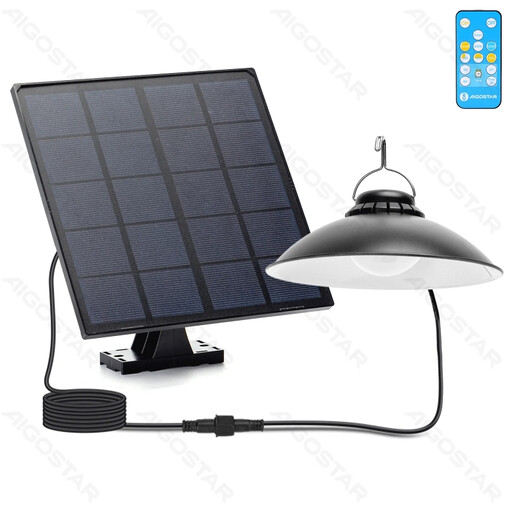
Why this model stands out: The Aigostar LED Chandelier combines the functionality of a solar light with the design of a pendant light. A key feature is its adjustable colour temperature, allowing you to choose between warm white (3000K), neutral white (4000K), and cool white (6500K) light. The separate solar panel comes with a 3-metre cable, enabling flexible installation. This means the light itself can be hung in covered but not directly sunlit areas, such as a gazebo or workshop.
Benefits:
Who is it for? This model is ideal for users seeking a flexible lighting solution for covered outdoor areas like balconies, covered patios, or garden sheds, and who value a customisable lighting ambiance.
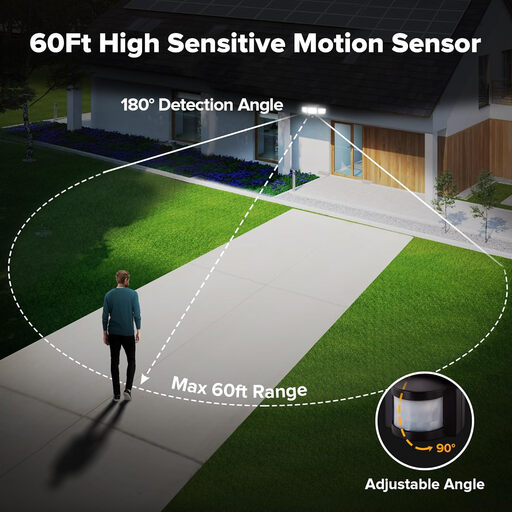
Why this model stands out: This 2-pack from UME is designed for maximum brightness and wide coverage. According to the manufacturer, each floodlight delivers 3000 lumens and features three adjustable heads that provide an illumination angle of up to 270 degrees. The motion sensor has an impressive range of up to 18 metres with a 180-degree detection angle, making it a powerful solar security light for large properties.
Benefits:
Who is it for? Perfect for homeowners who want to reliably and brightly illuminate large areas like yards, long driveways, or the perimeter of a house to maximise security.
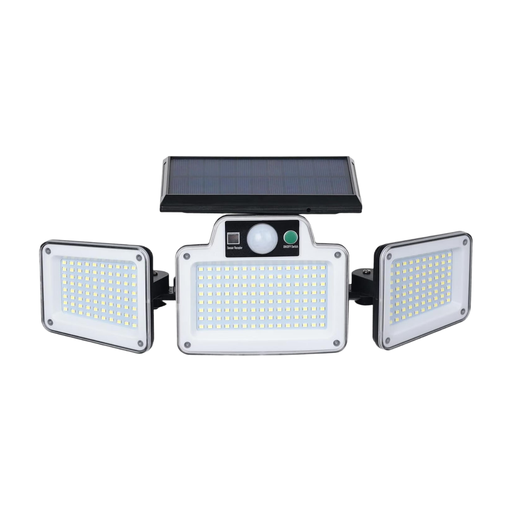
Why this model stands out: The Grifema solar floodlight is distinguished by its convenient operation via a solar floodlight with a remote control and its extra-long connection cable. With a nearly 5-metre (15.5-foot) cable between the panel and the light, this model offers maximum placement freedom. The remote control allows you to set three different modes: a motion-only mode, a dim-to-bright mode upon motion detection, or a constant 30% brightness mode.
Benefits:
Who is it for? Ideal for users who need a highly flexible installation solution because the light's mounting location is far from the sunniest spot for the panel. The remote control offers added convenience for anyone who prefers not to change light settings while standing on a ladder.
The models presented here are just a sample of the available solutions. Depending on your needs, you can also find smaller garden lights with motion sensors for pathways, decorative solar lights, or high-powered solar floodlights.
If you haven't found the right product yet, explore our entire range of solar and battery-powered lights to find the perfect solution for your property.
How long does a solar floodlight stay on after activation? For most models, the light stays on for 15 to 30 seconds after motion is detected. Some devices, especially those with a remote control, allow you to customise this duration.
Do solar lights work on cloudy days or in the winter? Yes, modern solar panels can generate energy even in diffuse light, though less efficiently than in direct sunlight. On short, overcast winter days, charging performance may be reduced, which can lead to a shorter runtime at night. For reliable winter operation, optimal south-facing placement of the panel is crucial.
Where should I install a solar motion sensor light? Install the light at a height of about 2 to 3 metres to ensure good illumination and to deter vandalism. Aim the motion sensor towards the area you want to monitor, such as a driveway, garden path, or entryway. The solar panel should be mounted in a location that receives as much direct sunlight as possible throughout the day.