
Lieferung heute & morgen

Qualitätsgarantie

Willkommens-Angebote freischalten: KOSTENLOSE Lieferung | Bis zu 80 % RABATT | Kostenlose 30-Tage-JoyPlus-Testphase
App herunterladen
Preparing fresh bread, airy cakes, or elaborate tortes can be a rewarding experience. However, manually kneading heavy doughs or whipping creams for hours is often time-consuming and strenuous. A stand mixer can be an invaluable assistant here, automating monotonous and demanding tasks.
Given the vast number of models on the market, making a choice can be overwhelming. This article serves as your guide. It outlines objective criteria for your purchasing decision and presents a selection of appliances to help you find the right stand mixer for baking that meets your needs.
To select the right appliance for your kitchen, it's helpful to understand a few technical specifications and their practical implications.
The motor's power, measured in watts, is an indicator of the appliance's ability to handle various consistencies. While models with lower wattage are sufficient for light batters or whipping cream, higher power is advantageous for regularly processing heavy yeast or bread doughs. A powerful dough mixer ensures the motor isn't overloaded, even with tough mixtures.
A key quality feature is the planetary mixing action. With this system, the mixing attachment not only rotates on its own axis but also moves along the edge of the bowl. This ensures all ingredients are evenly incorporated from bottom to top, leading to more homogenous results.
The capacity of the stand mixer's bowl should be matched to your typical batch sizes. For a single or two-person household, a bowl with a 3 to 4-litre volume is often sufficient. Families or ambitious home bakers who prepare larger quantities of dough will benefit from bowls of 5 litres or more. Stainless steel is a commonly used material here, as it is robust, durable, and easy to clean.
The functionality of a mixing machine is largely determined by its included accessories. Standard attachments usually include:
Some models offer additional features that enhance usability, such as a tilt-head design for easy accessory and bowl changes, or a splash guard to keep your work surface clean. For use in open-plan kitchens, the operating noise level can also be a relevant factor. If you're looking for a quiet stand mixer, you should look for models where the manufacturer provides information on noise reduction, often expressed in decibels (dB).
Here you will find a selection of models that cater to different requirements. The descriptions are based on product data provided by the manufacturer.
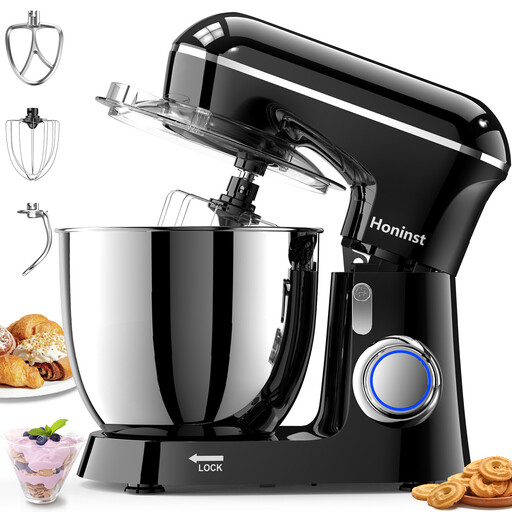
Why it stands out: This model is distinguished by its exceptionally large bowl capacity and a pure copper motor designed for efficient power transfer.
Advantages:
Who it's for: This appliance is an option for home bakers who regularly prepare large batches of dough or other mixtures and value a large bowl capacity.

Why it stands out: The Aucma stand mixer combines a 400-watt AC copper motor with a robust all-metal gearbox, indicating a stable and durable construction.
Advantages:
Who it's for: A great choice for beginners and regular users looking for a reliable and versatile dough mixer for daily use.

Why it stands out: This model from Ariete combines high motor power with a distinctive retro design, making it both a functional helper and a visual highlight in the kitchen.
Advantages:
Who it's for: Ideal for users who are looking for a powerful stand mixer and also appreciate an attractive design.
The decision to buy a stand mixer heavily depends on individual needs. If the models presented don't fully match your expectations or if you're looking for specific accessories like an additional mixing bowl, it's worth taking a look at our wider assortment.
Discover more kitchen aids in our Cake Bowls category and find the perfect addition for your kitchen.
A dough mixer or dough kneading machine is primarily specialized for processing heavy doughs. A modern stand mixer, on the other hand, is a multifunctional appliance that can knead, stir, and whip thanks to various attachments (dough hook, whisk, flat beater). Most of the appliances presented here combine both functions.
The required wattage depends on the intended use. For light batters and creams, 300–500 watts may be sufficient. For regular processing of heavy bread or yeast doughs, models with 1000 watts or more are recommended as they offer more power reserves and put less strain on the motor. The type of motor and the gearbox design also play a role in the actual performance.
A planetary mixing action is a mixing system where the attachment (e.g., the dough hook) rotates on its own axis while simultaneously moving in a circular path around the edge of the bowl. This dual motion ensures that all ingredients, including those at the bottom and sides of the bowl, are captured and thoroughly combined into a homogenous mixture.