
Lieferung heute & morgen

Qualitätsgarantie

Willkommens-Angebote freischalten: KOSTENLOSE Lieferung | Bis zu 80 % RABATT | Kostenlose 30-Tage-JoyPlus-Testphase
App herunterladen
Purchasing a new stand mixer is an investment that can make baking and cooking easier for years to come. However, the market is filled with tempting offers and technical specs that often confuse more than they clarify. Many home bakers and ambitious cooks invest in an appliance that ultimately fails to meet their needs. Before you make a decision, it's crucial to understand the typical pitfalls that often lead to disappointment.
This guide will help you distinguish marketing hype from genuine performance features and make an informed choice. We focus on the three most common purchasing mistakes and show you what really matters.
The 3 Most Common Pitfalls and How to Avoid Them:
To avoid a bad purchase, you should focus on the core technical features that determine the longevity and functionality of your stand mixer.
Motor power is more than just a number on a spec sheet. Pay attention to the following distinctions:
The size of the mixing bowl should match your household and baking habits.
The included attachments and the handling of the appliance determine how much you'll enjoy using it in your daily routine.
Here are some recommendations tailored to different needs and requirements.

Why it's a good fit: Ideal for households seeking a reliable basic machine for occasional baking of cakes or pizza dough. The 5-litre bowl offers a practical size that doesn't take up too much space.
This model counters the instability pitfall with suction cup feet for a firm stance. The integrated overheat protection prevents motor damage under load, which puts the sole focus on high wattage into perspective.
10 speed settings plus a pulse function for precise control; tilt-head design for easy access to the bowl and accessories.
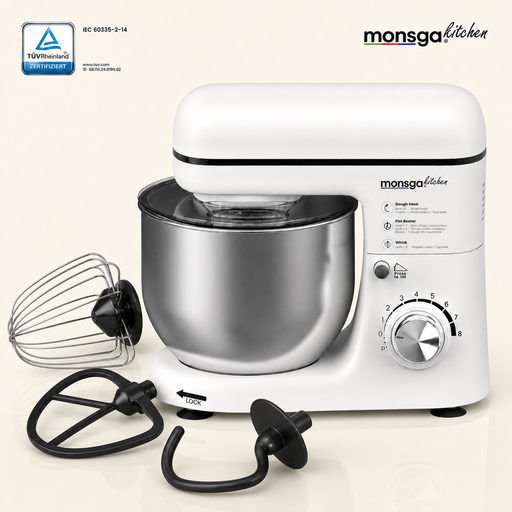
Why it's a good fit: Designed for users who bake regularly and in larger quantities. The 6-litre bowl and 1000-watt motor can handle heavy bread doughs or double cake recipes for family gatherings.
This model directly addresses the impractical accessories pitfall: the dough hook and flat beater are finished with a Teflon non-stick coating, which minimises dough creep and greatly simplifies cleaning.
Large 6-litre capacity; powerful 1000-watt motor; dishwasher-safe accessories for hassle-free cleanup.
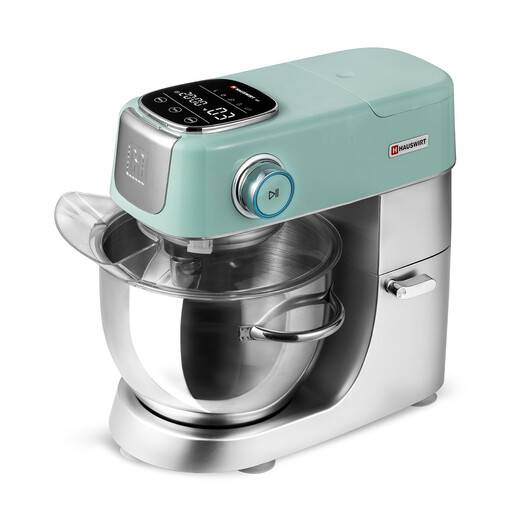
Why it's a good fit: For users who value modern technology, intuitive operation, and an appealing design. The smart functions reduce guesswork and ensure repeatable results.
This model bypasses the raw performance data trap through intelligent control. The preset programs for dough, mixing, etc., optimise speed and time, which is more important than a high wattage number alone.
LED touchscreen with 5 preset menus; 11 speed settings for maximum control; modern design available in various colours.
We have compiled a complete, up-to-date list of products that fully meet these strict selection criteria and German safety regulations.
Wattage alone is not the deciding factor. A high wattage can indicate a less efficient motor that converts a lot of energy into heat instead of torque. More important are the motor type (DC motors often have more torque at low speeds), a robust metal gearbox, and overheat protection. For heavy doughs, a machine with good power transmission is more important than one with a high number on paper.
The motor housing should never be submerged in water but only wiped with a damp cloth. For the accessories, it's important to check the manufacturer's instructions. Many stainless steel mixing bowls, whisks, and coated dough hooks are dishwasher-safe, which significantly simplifies cleaning. Uncoated aluminium parts should be washed by hand, as they can discolour in the dishwasher.
A high noise level can be an indicator of lower-quality construction. Noise is often caused by vibrations in a lightweight housing, plastic gears, or a less efficient AC motor that has to spin fast under high load. Models marketed as a quiet stand mixer often use DC motors and vibration-dampening designs. Look for the decibel rating (dB) in the product details to get an objective comparison value.