
Lieferung heute & morgen

Qualitätsgarantie

Willkommens-Angebote freischalten: KOSTENLOSE Lieferung | Bis zu 80 % RABATT | Kostenlose 30-Tage-JoyPlus-Testphase
App herunterladen
As a Joybuy Product Recommendation Officer, my goal is to provide you with clear, objective information. A good stand mixer can make food preparation significantly easier, from kneading heavy bread doughs to whipping egg whites. But the market is vast, and the choices can be overwhelming. This guide is designed to help you understand the key features and find a model that fits your cooking and baking habits.
Before you make a decision, it's helpful to understand a few basic features. These three points are crucial for an appliance's performance and usability.
Wattage indicates motor power, but it's not the sole factor for a powerful stand mixer. How that power is transferred is also critical. A planetary mixing action is an important standard here. This means the mixing tool not only rotates on its own axis but also travels in a circular path around the edge of the bowl. This ensures all ingredients are evenly incorporated and mixed, which is especially important for achieving consistent results when using it as a dough mixer.
The capacity of the mixing bowl, usually given in litres or quarts, determines how much you can process at once. For occasional baking or small households, bowls with 4 to 5 litres are often sufficient. If you regularly bake for a family or make large batches of dough, you should consider a model with 5.5 litres or more. Also, pay attention to the included and optional accessories. Many models can be expanded into a multifunctional kitchen assistant with additional attachments, such as a stand mixer with a meat grinder.
The housing of a mixer is typically made of metal or plastic. Metal housings are usually heavier and offer greater stability when processing heavy doughs. Plastic models are lighter and often more affordable. The dimensions are also relevant: compact appliances fit well in smaller kitchens, while larger models require more counter space.
Here is a selection of models that cater to different needs and kitchen sizes. The descriptions are based on manufacturer specifications.
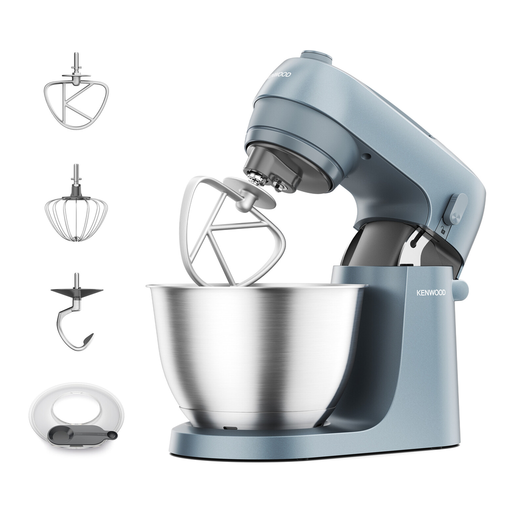
Kenwood Go KZM35000GY Stand Mixer
Why it stands out: The Kenwood Go is designed for maximum space-saving. At just 30 cm tall, the manufacturer claims it fits under wall cabinets or in deep drawers. Despite its compact design, it features a robust metal housing and a clever front-facing control design.
Pros:
Who is it for? This model is an excellent choice for hobby bakers and home cooks who work in a smaller kitchen but don't want to compromise on the quality and durability of a metal appliance. It's a practical stand mixer for baking for everyday use.

HONINST 7-IN-1 Multifunctional Stand Mixer
Why it stands out: This model positions itself as an all-rounder. It combines the functions of a classic stand mixer with a meat grinder and a blender attachment. This allows it to cover a wide range of kitchen tasks, from kneading and mixing to grinding meat.
Pros:
Who is it for? For users looking for a versatile appliance that replaces several kitchen gadgets. Anyone who loves to experiment and wants to prepare smoothies or make their own ground meat in addition to baking will find this to be a suitable solution.

Ariete Vintage 1588GR Stand Mixer
Why it stands out: The Ariete stand mixer combines high performance with a striking retro design. With its large bowl and powerful motor, it's designed for demanding baking projects while also making a visual statement in the kitchen.
Pros:
Who is it for? This appliance is aimed at ambitious home users who regularly process large batches and value an appealing design. The combination of performance, capacity, and aesthetics makes it a great choice for anyone whose stand mixer is intended to be a centerpiece in their kitchen.
The models presented here already cover a wide spectrum. However, if you're looking for more specific features or different designs, there are many other alternatives to discover.
? Discover more models in our Stand Mixers category
1. What is a planetary mixing action? A planetary mixing action is a mixing system where the attachment (e.g., the dough hook) rotates on its own axis while also travelling in a circular path around the inner edge of the bowl. This dual motion ensures that all ingredients, including those at the sides and bottom of the bowl, are captured and thoroughly mixed.
2. How many watts should a good stand mixer have? Wattage is an indicator of motor power, but it's not the only measure of quality. For most everyday tasks like whipping cream or mixing cake batter, models with 800 to 1000 watts are sufficient. If you plan to regularly knead heavy yeast or bread doughs, a powerful stand mixer with over 1000 watts can be beneficial, as it puts less strain on the motor and offers greater stability.
3. Can I use any stand mixer as a dough mixer? Most stand mixers come with a dough hook and can therefore be used as a dough mixer or dough machine. However, their effectiveness depends on the motor's power, the appliance's stability, and the shape of the dough hook. For very firm and heavy doughs, a robust model with a high weight and a strong motor is recommended to prevent the machine from "walking" across the countertop during operation.