
Lieferung heute & morgen

Qualitätsgarantie

Willkommens-Angebote freischalten: KOSTENLOSE Lieferung | Bis zu 80 % RABATT | Kostenlose 30-Tage-JoyPlus-Testphase
App herunterladen
The game of Taboo is a party game whose core mechanic is based on the verbal description of words. The objective is to have your team guess a specific word without using a list of five so-called "taboo words." This simple yet challenging premise makes it a dynamic word game and guessing game that demands linguistic creativity and quick thinking. The choice of the right edition depends on the composition of the playing group and the desired level of difficulty.
The decision for a specific version of the game should be based on objective parameters. The key distinguishing features of the available editions lie in the target audience, the content of the game cards, and the complexity of the rules.
The manufacturer's recommended age is a primary indicator of the game's suitability.
The content of the cards significantly shapes the gameplay experience.
While the basic principle remains the same, some editions offer additional game modes. According to the manufacturer, the classic Hasbro Taboo version includes five different game variants that provide variety. The Family Edition focuses on the core gameplay to keep the rules simple and accessible for younger players.
The game's components are designed for durability and functionality. Standard sets include game cards, a squeaker (buzzer) to signal rule violations, a scorepad, and a sand timer for timekeeping. The materials typically consist of cardboard and plastic. The compact packaging of newer editions facilitates transport and storage.
Based on the criteria mentioned, we present two editions that cater to different requirement profiles.
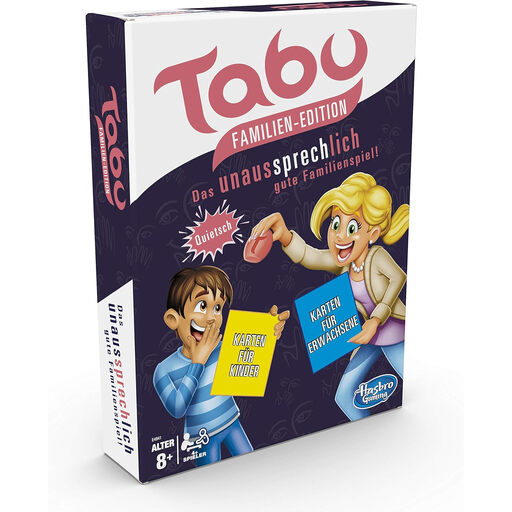
Why We Recommend This Product This family game solves the challenge of playing in mixed-age groups with a well-thought-out system. With 130 cards for children and 130 for adults, it creates balanced gameplay. The children's cards, featuring only two taboo words, lower the barrier to entry and prevent frustration, while adults remain challenged. This structure enables direct and fair competition between generations.
Pros
Who It's For This game is designed for families with children aged 8 and up who are looking for an interactive and communicative party game where all members can participate and have fun equally. It is particularly suitable for family gatherings and regular game nights.
Product Specifications
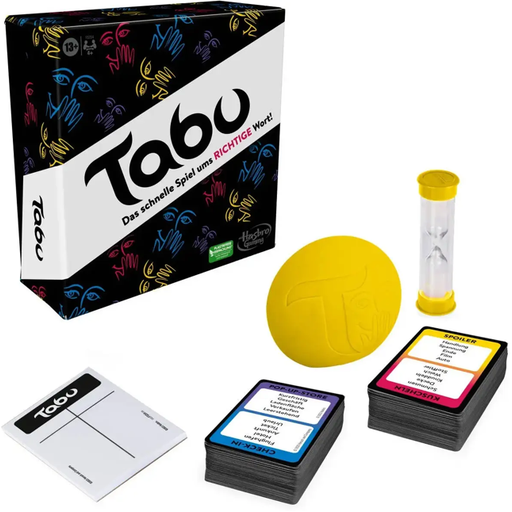
Why We Recommend This Product The classic edition of Hasbro Taboo is a party game for teens and adults. With over 1,000 terms drawn from pop culture and current trends, according to the manufacturer, the game remains relevant and engaging for its target audience. The five integrated game variants offer high flexibility and variety. Furthermore, the game allows for the use of digital tools like online timers, enabling a modern adaptation of the gameplay experience.
Pros
Who It's For This game for adults and teens aged 13 and up is the right choice for game nights that demand a dynamic and competitive challenge. It is excellently suited for parties, game nights with friends, or as an entertaining activity in larger groups.
Product Specifications
While the game of Taboo is an excellent choice in the realm of word and guessing games, there is a wide variety of other party games based on different mechanics. For those interested in a broader selection of interactive group games, our Card Games for Adults category offers a curated collection of further options.
1. What is the key difference between the Taboo Family Edition and the classic version? The main difference lies in the target audience and card content. The Taboo Family Edition uses separate, simplified cards for children (ages 8+) and more challenging cards for adults. The classic version is aimed at teens and adults (ages 13+) and uses a single, more complex deck of cards with terms from pop culture.
2. What are the basic rules of the game of Taboo? Players are divided into two or more teams. One player draws a card and tries to explain the main word at the top to their team. In doing so, the five taboo words listed below it cannot be used. The opposing team monitors for rule compliance and presses the buzzer for a violation. For each correctly guessed word within the time limit (measured by the sand timer), the team receives one point.