
Lieferung heute & morgen

Qualitätsgarantie

Willkommens-Angebote freischalten: KOSTENLOSE Lieferung | Bis zu 80 % RABATT | Kostenlose 30-Tage-JoyPlus-Testphase
App herunterladen
Choosing the right tree saw depends on specific parameters determined by the application, required power, and on-site conditions. Whether for routine tree care in your garden, demanding DIY wood projects, or professional deployment, the tool's technical specifications are critical for efficiency and safety. This guide analyses the key criteria for selecting a suitable wood saw and introduces various models based on their technical characteristics.
The decision for a particular model should be based on an objective assessment of its power source, saw type, and safety features.
The power source is a key determinant of the saw's performance and mobility.
Different designs are suitable for different tasks.
Features designed to minimise risk and reduce physical strain should be considered during selection.
The following selection is based on an analysis of the technical specifications and intended applications of each product.

Why we recommend this product: The WALDMANN YD5310 is equipped with a 53.2 cc engine that delivers a rated power of 2.0 kW (2.7 HP). Combined with a rated speed of 8500 rpm and a maximum chain speed of 21.8 m/s, this model is engineered for high cutting performance on demanding tasks. The 18-inch bar (approx. 45 cm) allows for processing larger diameter logs.
Advantages:
Who it's for: This model is aimed at experienced users, forestry professionals, and property owners who need a tool for felling trees, land clearing, or processing large volumes of wood.

Why we recommend this product: The WORKPRO folding saw stands out with its bi-metal blade, which combines high-speed steel teeth with a flexible backing material. This ensures excellent edge retention and break resistance. A unique feature is its adjustable cutting angle, allowing adaptation to various working positions. Weighing just 20 g and with a folded length of 230 mm, it is extremely portable.
Advantages:
Who it's for: Ideal for home gardeners, campers, and DIY enthusiasts who need a lightweight and versatile manual pruning saw for precise cuts on branches, shrubs, or for minor woodworking tasks.
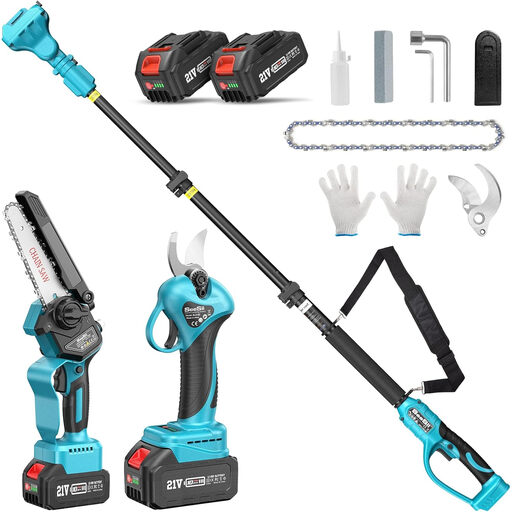
Why we recommend this product: This set offers exceptional functionality by combining multiple tools into one system. It includes a 6-inch mini chainsaw, loppers, and pruning shears, all powered by the same battery system. The key advantage is the telescopic pole, which extends from 1.49 m to 2.74 m, functioning as a pole saw to provide a reach of up to 4.57 m. The two included 4000 mAh batteries ensure a long runtime.
Advantages:
Who it's for: This multi-tool is designed for home and garden owners who need a versatile and flexible solution for various tree care tasks—from cutting low branches to thinning the tree canopy.
If these models don't include the right solution for your specific project, you can find a broader selection in our main category. Discover more models and accessories in the Saw category.
1. Which tree saw for which tree? The choice depends on the trunk diameter. For small branches and young trees (up to 10 cm in diameter), a manual pruning saw or a small cordless saw is sufficient. For medium-sized trees (15-30 cm), powerful cordless or smaller petrol chainsaws are suitable. For felling large trees (over 30 cm), a petrol chainsaw with an appropriate bar length is required.
2. What is the difference between a chainsaw and a power saw? In common parlance, the terms are often used interchangeably. Technically, "power saw" is the umbrella term for any saw driven by a motor (petrol, electric, battery). A "chainsaw" is a specific type of power saw that cuts with a saw chain.
3. Do I need a chainsaw license in Germany? For private use of a power saw on your own enclosed property, a license is generally not required. However, as soon as you work in public spaces, in forests (including for processing firewood), or in a commercial capacity, proof of competence, the so-called "chainsaw license" (e.g., AS Baum I), is typically required in Germany. The exact regulations can vary depending on the federal state and the forest owner.