
Lieferung heute & morgen

Qualitätsgarantie

Willkommens-Angebote freischalten: KOSTENLOSE Lieferung | Bis zu 80 % RABATT | Kostenlose 30-Tage-JoyPlus-Testphase
App herunterladen
A new TV stand is meant to elevate your living room, but the reality is often disappointing: the unit feels flimsy, cables hang messily, or its proportions are simply wrong for the TV. Before you make a decision you'll later regret, it's crucial to understand the common pitfalls. Many buyers focus on design and overlook critical functional flaws that disrupt daily life.
This guide will show you what to look for to avoid a bad purchase and find a TV unit that excels in both aesthetics and practicality. We'll focus on the three most common problems: poor stability, inadequate cable management, and incorrect dimensions.
Choosing the right TV console goes beyond mere appearance. Three core parameters are crucial for the longevity, safety, and functionality of your new furniture.
The material determines not only the look but also the stability and lifespan of your TV stand. Budget-friendly models are often made from basic particleboard, which can lose stability under heavy loads or when exposed to moisture. A more robust choice is MDF (Medium-Density Fibreboard), which offers higher density and strength.
Always check the specified maximum load capacity. This indicates how much weight the console can safely support. Remember to account for not just the weight of your television, but also gaming consoles, soundbars, and other devices. Surface finishes, like those on a high-gloss lowboard, can offer a modern look but should be scratch-resistant and easy to maintain.
A common mistake is choosing a TV console that is too small or too large. A TV table that is narrower than the television not only looks disproportionate but can also be unstable.
A clean, uncluttered look is essential for a harmonious living room media setup. Look for integrated cable management solutions, such as cut-outs in the back panel. These allow cables to be routed invisibly behind the unit.
Also, consider how much storage you need in your TV stand.
Based on the criteria above, we have selected a few models for different needs and style preferences.

Why This Fits Their Persona: Ideal for a first apartment or budget-conscious buyers looking for a functional and modern design. Its compact 120 cm size fits well in smaller living rooms.
Despite being made of particleboard, it specifies a clear maximum load capacity of 55 kg, which is sufficient for most TVs in this size class and eliminates uncertainty about stability.
Combines closed doors and a drawer for concealed storage. The soft-close mechanism is a premium detail in this price range.
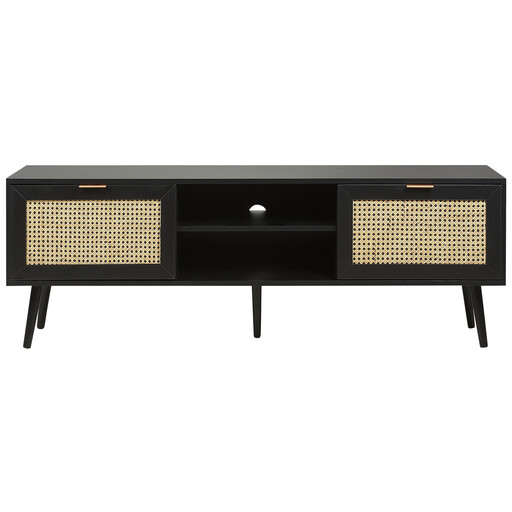
Why This Fits Their Persona: Perfect for those seeking a statement piece. The combination of a black body, rattan fronts, and gold handles embraces current interior design trends, becoming a focal point in the living room.
This model features a discreet cable opening, solving the problem of visible cable clutter and preserving the unit's stylish aesthetic.
The high 80 kg load capacity of the top panel provides security even for very large televisions. The rubberwood legs ensure a stable base.

Why This Fits Their Persona: For users who want to complement their entertainment setup with modern technology. The black lowboard with its high-gloss finish and integrated LED lighting creates a futuristic atmosphere.
The combination of a drawer and open glass shelves offers a thoughtful balance: remote-controlled devices have their place, while accessories are stored out of sight. This prevents clutter.
The 16-colour adjustable LED lighting allows for customisation to match the mood or on-screen content. The high-gloss surface is easy to maintain.
We have compiled a complete, up-to-date list of products that fully meet these strict selection criteria and all relevant safety standards.
The optimal height for a lowboard is typically between 40 and 55 cm. The key factor is your seating position: the centre of the TV should be at eye level when you are sitting comfortably on your sofa or armchair. Measure this height before choosing a model.
For a balanced look and secure stability, the TV stand should extend at least 10 to 15 cm beyond the television on each side. A console that is too narrow will make the TV look oversized and feel unstable.
The terms are often used interchangeably. A lowboard is a general term for any low-profile sideboard. A TV console (or TV board) is a specific type of lowboard designed to house home entertainment electronics. It typically includes features like cable pass-throughs, open shelves for devices, and an appropriate height for placing a television.