
Lieferung heute & morgen

Qualitätsgarantie
App herunterladen
Kategorien
The increasing number of mobile devices and their growing power needs place high demands on in-car power supplies. A modern USB-C Car Charger is no longer just an accessory but a necessity for commuters, families, and tech-savvy drivers. Selecting the right model depends on specific technical parameters that determine charging efficiency and device safety. This article analyses the crucial criteria and presents a selection of charging solutions for different user profiles.
The choice of a suitable charging adapter for the cigarette lighter socket should be based on an analysis of its technical specifications. The following parameters are relevant for making an informed decision.
The total output, measured in watts (W), defines the maximum amount of energy the adapter can deliver to all connected devices simultaneously. Models with an output of over 100W, such as a 150W car charging adapter, are capable of powering several demanding devices in parallel.
However, the power output of each individual port is also crucial. To charge a modern notebook (car charger for laptops), a USB-C port with Power Delivery (PD) and an output of at least 60W to 100W is required. For smartphones and tablets, 20W to 45W is generally sufficient for fast charging.
The port configuration determines the charger's flexibility.
A multi-port car charger is ideal for users who need to charge different types of devices at the same time.
The charging electronics must communicate with the device being charged to negotiate the optimal charging power. The most important protocols are:
A high-quality 12V USB adapter has integrated safeguards against overcurrent, overvoltage, overheating, and short circuits. These mechanisms are fundamental for protecting connected devices and the vehicle's electronics. Materials like aluminium alloys or flame-retardant polycarbonate (PC) contribute to heat dissipation and durability.
Based on the technical criteria mentioned above, we present three models that cover different use cases.
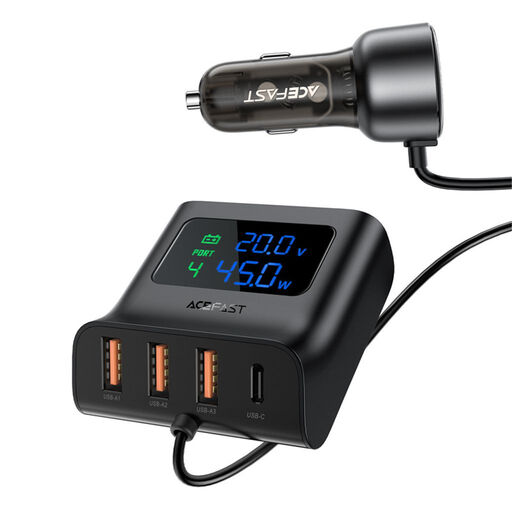
Why We Recommend This Product The ACEFAST B11 is designed as a central charging station for your vehicle. With a total of six ports and a combined output of 138W, it addresses the needs of users with a high density of devices. The integrated digital display for real-time monitoring of voltage and power per port offers a high degree of control and transparency over the charging process.
Advantages
Who It's For This model is ideal for families, carpools, or field service professionals who need to power a variety of devices like smartphones, tablets, and accessories simultaneously and efficiently.
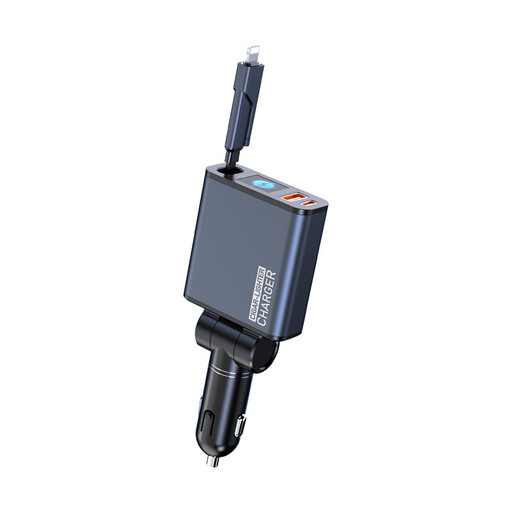
Why We Recommend This Product The ATSHARK K006S solves a common problem in vehicle interiors: cable clutter. Thanks to two integrated, retractable charging cables (90 cm), the cockpit remains organised. At the same time, the device offers exceptionally high performance with a 160W total output and QC5 certification, making it suitable for charging laptops.
Advantages
Who It's For Perfect for users who value an organised vehicle and simultaneously require uncompromising charging performance for demanding devices like MacBooks or other laptops.
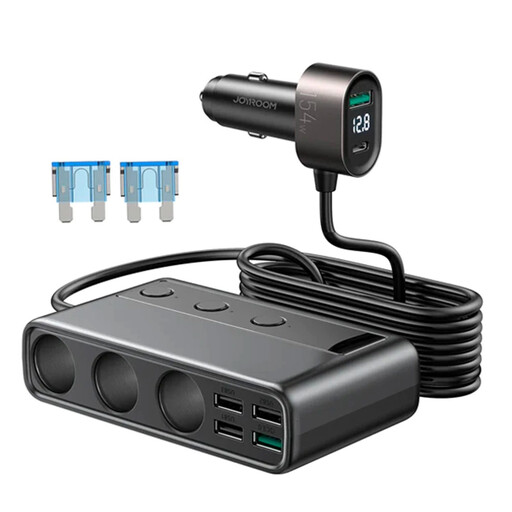
Why We Recommend This Product The JOYROOM JR-CL06 is more than just a USB-C car charger; it's a comprehensive cigarette lighter splitter. With a total of nine ports, including three additional 12V sockets, it transforms a single power source into a multifunctional power station for a wide range of devices.
Advantages
Who It's For This device is aimed at users who not only need to charge USB devices but also operate multiple traditional 12V appliances in the car. It is a comprehensive solution for camping, long journeys, or professional use in a vehicle.
The models presented cover specific use cases. If these do not fully meet your requirements, a wide range of other charging solutions with different power classes and form factors are available.
Discover our entire range of Car USB Adapters to find the right model for your vehicle and your devices.
1. Can a car charger charge my laptop? Yes, this is possible if the charger meets the technical requirements. You need a model with a USB-C port that supports the Power Delivery (PD) protocol and provides an output of at least 60 watts, ideally 100 watts. Additionally, your laptop must support charging via USB-C.
2. What is the difference between USB-A and USB-C in a car charger? The main difference lies in performance and functionality. USB-C is a modern, reversible connector that enables higher power outputs via protocols like Power Delivery (PD), making it suitable for laptops. USB-A is the older, more widespread standard that typically offers lower power outputs but often supports technologies like Quick Charge (QC) for compatible Android devices.