
Lieferung heute & morgen

Qualitätsgarantie

Willkommens-Angebote freischalten: KOSTENLOSE Lieferung | Bis zu 80 % RABATT | Kostenlose 30-Tage-JoyPlus-Testphase
App herunterladen
A dead smartphone on your way to an important meeting, or a fussy child in the back seat whose tablet is about to run out of battery—these are situations a reliable USB-C car charger can prevent. But the market is overwhelming, filled with products whose performance claims often don't hold up in practice. Before you make a purchase, it's crucial to understand the common pitfalls to avoid falling into a cost trap.
As your Joybuy Product Recommendation Officer, I'll help you objectively evaluate technical specs and find a charger that's a perfect fit for your requirements.
Many chargers look identical at first glance, but the differences are in the details. These three points are the most common sources of disappointment:
To avoid making the wrong choice, you should focus on three verifiable technical features. These determine the performance and safety of your future charger.
The total output, measured in watts (W), is the sum of the maximum power the charger can deliver across all its ports. However, the power per port is what's truly critical.
A good Power Delivery car adapter ensures your devices safely negotiate the maximum possible charging speed.
The choice of ports depends on how many and what types of devices you want to charge simultaneously. A multi-port car charger is the most practical solution for most users.
A combination of USB-C and USB-A ports offers the greatest flexibility. Check how the total output is distributed across the ports when multiple are used at the same time.
High-quality chargers offer more than just power.
Based on these objective criteria, we have identified several models suited for specific user profiles.
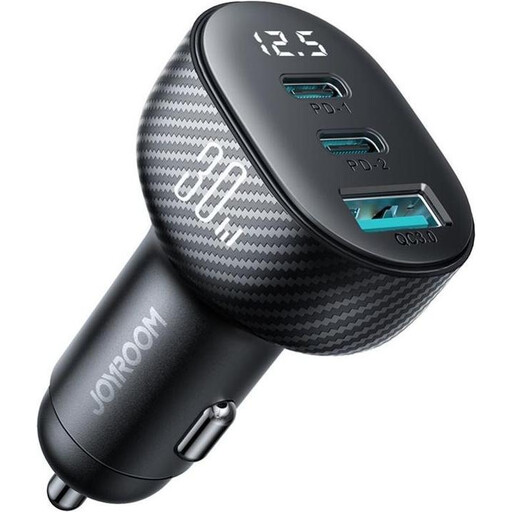
Why This Fits Their Persona: Ideal for commuters who need to quickly charge their smartphone while also powering another device like headphones or a GPS. The compact size and voltage display offer practical advantages for daily use.
Supports PD and QC3.0, ensuring broad compatibility and true fast charging. The 30W total output is realistic and sufficient for this use case.
Three ports (2x USB-C, 1x USB-A) for high flexibility; integrated real-time display of vehicle voltage.
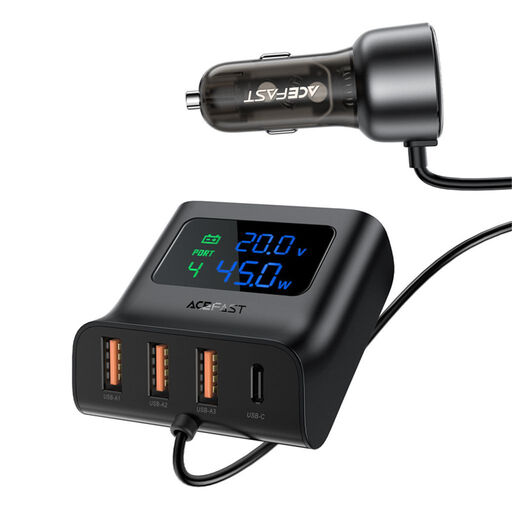
Why This Fits Their Persona: Perfect for long family road trips or for field reps running a mobile office. With six ports and 138W of total power, it can charge laptops, tablets, and multiple smartphones simultaneously at high speed.
The high total output of 138W prevents power drops, even when all ports are occupied. The display shows the power distribution, providing transparency instead of false promises.
Massive charging capacity with six ports (4x USB-A, 2x USB-C); detailed real-time display of voltage and power for each port.
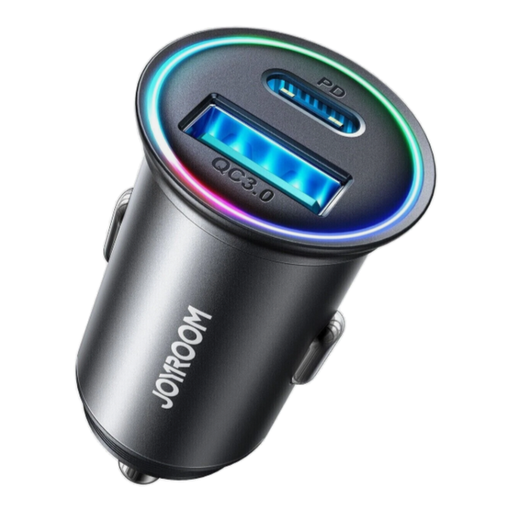
Why This Fits Their Persona: For tech-savvy users who need to charge their USB-C laptop on the go and prefer a discreet yet powerful design. The mini format integrates seamlessly into the cockpit.
This model focuses on high performance (up to 60W) with explicit support for Power Delivery 3.0. It delivers the necessary power for laptops, bypassing the trap of underpowered USB-C ports.
High 60W output in a very compact, mini form factor; aluminum alloy housing for efficient heat dissipation.
We have compiled a full, up-to-date list of products that fully meet these strict selection criteria and German safety regulations.
The required wattage depends on the laptop model. As a rule of thumb, a 60W car charger with Power Delivery is sufficient to efficiently charge most modern ultrabooks and MacBooks while driving. For more powerful workstation laptops, 90W or 100W may be necessary. Check the wattage rating on your laptop's original power adapter to determine its exact needs.
Yes, it's possible. While the engine is running, the alternator supplies power to the vehicle's electrical system and the charger. However, when the engine is off, some chargers continue to draw a minimal standby current, which can drain the battery over a long period (several days or weeks). Models with a car charger with a voltage display help you monitor the battery's condition. It's advisable to unplug the charger if the vehicle will be parked for an extended time.
Both are fast-charging technologies. Power Delivery (PD) is a universal standard that works via the USB-C port and is used by a wide range of devices, including iPhones, Google Pixel smartphones, and most laptops. Quick Charge (QC) is a technology developed by Qualcomm, primarily found in Android smartphones with Snapdragon processors. Many modern chargers support both standards to ensure maximum compatibility.