
Lieferung heute & morgen

Qualitätsgarantie

Willkommens-Angebote freischalten: KOSTENLOSE Lieferung | Bis zu 80 % RABATT | Kostenlose 30-Tage-JoyPlus-Testphase
App herunterladen
By a Joybuy Product Recommendation Officer, July 28, 2026
Choosing a wine opener might seem like a simple task at first glance. But anyone who has ever struggled with a broken cork, a bent worm, or a clumsy tool knows that the difference lies in the details. An unsuitable corkscrew can spoil the enjoyment of a good wine before it has even begun.
Many models on the market promise effortless operation but fail to meet basic requirements in practice. To help you make the right choice, we'll highlight the most common pitfalls and show you which objective criteria truly matter.
Before you make a purchase, you should be aware of two common problems that often only become apparent after you've bought the product:
To avoid a bad purchase, focus your attention on three core parameters. These will determine the durability, functionality, and ease of use of your future wine opener.
The type of opening mechanism is the most important distinguishing feature. Each type has specific pros and cons:
A professional-grade wine opener is distinguished by its robust materials. Look for the following features:
Many wine openers offer more than just one function. An integrated wine opener with a foil cutter is standard on most high-quality models today, saving you from needing a separate tool. An additional cap lifter for crown caps turns the corkscrew into a universal bottle opener. Such multi-functional models are not only practical but also make an ideal gift for wine lovers.
Based on the criteria mentioned, we have identified a few models that are suitable for different types of users.
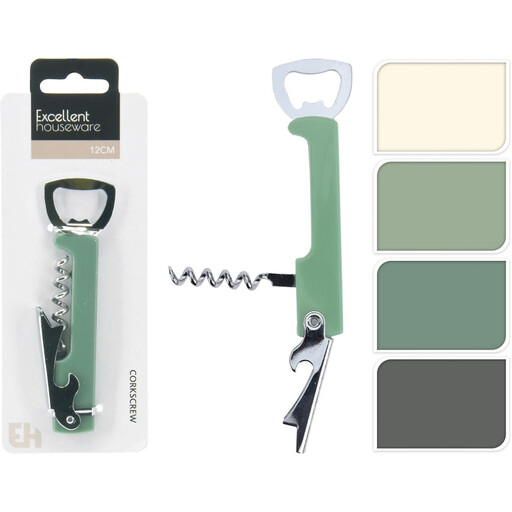
Why it's a good fit: Ideal for anyone who occasionally opens a bottle of wine or beer and wants a straightforward, reliable tool without unnecessary features. Its simple T-handle design is easy to understand and space-saving.
This model bypasses the trap of overly complex mechanisms. Its simple steel and plastic construction is robust enough for occasional use and has no delicate parts that could easily break.
Combines a corkscrew with a cap lifter for crown caps. The compact design allows for easy storage in any kitchen drawer.
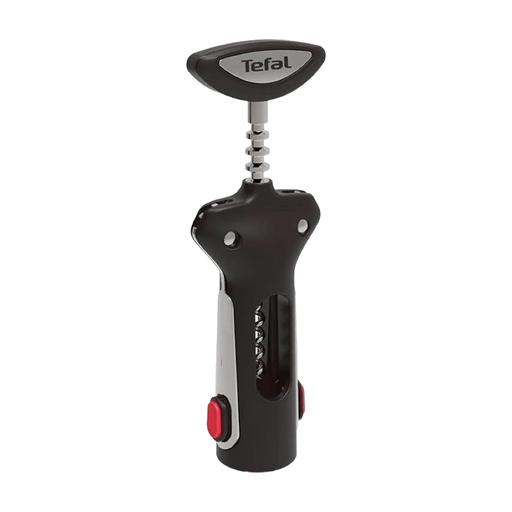
Why it's a good fit: Perfect for anyone who values effortless and safe handling. The winged mechanism minimises the force required, making uncorking even stubborn corks a simple matter.
This model directly counters the "leverage illusion." Its robust construction and proven winged mechanism ensure reliable and effective force transmission, pulling the cork straight up.
Very simple, intuitive operation. The integrated foil cutter ensures a clean cut of the capsule before uncorking.
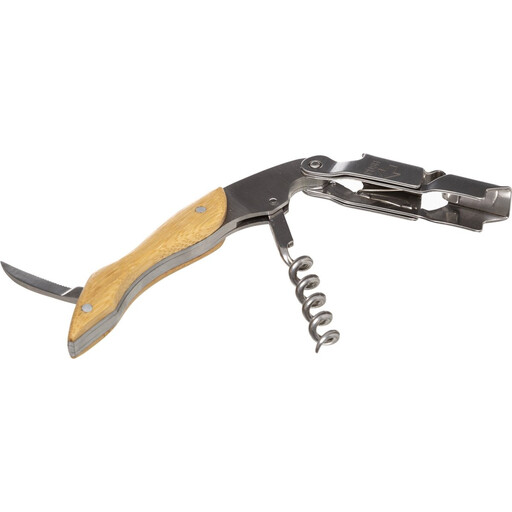
Why it's a good fit: This classic sommelier knife is the choice for wine enthusiasts who appreciate efficiency, a compact design, and style. It combines all the necessary tools in an elegant design with a bamboo handle.
It avoids the "material trap" by using robust stainless steel for all functional parts. The proven double-hinged fulcrum is a professional solution that guarantees optimal leverage.
Professional 3-in-1 design: corkscrew, foil cutter, and cap lifter in one. Very compact and ideal for a home bar or for taking on the go.
Besides the perfect wine opener, a reliable bottle opener for beer and other beverages is an indispensable tool for any home bar.
We have compiled a complete, up-to-date list of products that fully meet these strict selection criteria and all relevant safety standards.
The main difference is in the mechanism and shape. A waiter's friend is compact and uses one or two leverage points that rest on the lip of the bottle. It's highly efficient but requires some practice. A winged corkscrew is larger and uses two symmetrical levers (the wings) that are pushed down to pull the cork. It is considered easier for beginners to use but requires more storage space.
Most wine openers should not be cleaned in the dishwasher, especially models with wooden handles. Wiping it with a damp cloth after use is usually sufficient. Pay special attention to removing any cork residue from the worm to ensure it functions properly and provides a clean opening for the next bottle.
A high-quality worm is the heart of any corkscrew. It should be thin but sturdy, with a sharp tip to easily penetrate the cork. The spiral should be wide and open (often described as having a "channel" or "hollow core") so that it envelops the cork rather than just boring through and crushing it. A non-stick coating (like Teflon) is an added bonus, as it reduces friction and makes pulling the cork easier.