
Lieferung heute & morgen

Qualitätsgarantie

Willkommens-Angebote freischalten: KOSTENLOSE Lieferung | Bis zu 80 % RABATT | Kostenlose 30-Tage-JoyPlus-Testphase
App herunterladen
A Bialetti Moka Pot brings the traditional preparation of strong moka coffee into your home kitchen. Before buying, however, UK households should check carefully whether the size, material and hob compatibility suit their everyday needs. Many disappointing purchases are not caused by the brand, but by unclear product information and incorrect expectations of an Italian moka pot.
With a Bialetti espresso maker, the size usually refers to small Italian cups. Depending on the model, 1 cup is roughly 40 to 60 ml, 3 cups approximately 130 to 150 ml, and 6 cups around 250 to 270 ml. So, if you drink a large mug of coffee in the morning, you do not automatically need a 1-cup pot.
The “1 to 6 cups” specification describes the intended brewing volume. A 6-cup pot should not simply be half-filled for one serving, as the water chamber and coffee filter are designed for the relevant size.
The classic Bialetti Moka Express is primarily an aluminium espresso maker. Aluminium alone is not normally detected directly by an induction hob. Some Moka Express variants can be used with a suitable Bialetti induction plate, while other models are explicitly not suitable for induction.
For an induction hob, models such as Bialetti Moka Induction, Bialetti New Venus or Bialetti Brikka Induction are the more obvious choices, provided the relevant product description confirms compatibility. Many classic aluminium variants work directly on gas or electric hobs. The specifications for the individual product are what matter.
Moka pots consist of several parts: the lower chamber, funnel filter, seal, filter screen and upper chamber. Residue or a worn seal can affect both the flavour and the function. According to the product information, many Bialetti models should only be rinsed with clean water and are not dishwasher-safe.
Even where individual retailers provide conflicting care instructions, the relevant user manual should take priority. Before buying, it is worth checking the material specifications, availability of replacement parts and the manufacturer’s guidance.
These quantities should not be equated with portions of filter coffee. A 6-cup moka pot holding approximately 270 ml can produce two or three larger cups, depending on your drinking habits.
An espresso maker for a gas hob needs a suitable base and should not be placed over a flame that is too large. For an espresso maker for an electric hob or ceramic hob, a flat base is important. For induction, the product name or technical description must explicitly mention induction compatibility.
Stainless steel models such as the Bialetti New Venus are particularly versatile, as stainless steel can generally be designed for use on induction hobs. Nevertheless, you should check the specific model description, as not every stainless steel moka pot is automatically compatible with every hob.
Aluminium is widely used in classic moka pots and forms part of the traditional Moka Express design. It is lightweight and heats up quickly. The pot should be dried completely after rinsing to reduce water marks and deposits.
A stainless steel moka pot is often the more practical choice for induction and may offer a more robust outer construction. Depending on the product information, the Bialetti New Venus may be described as using stainless steel variants such as 18/6 or 18/10. As specifications can vary by market and model, the specific product page should be treated as authoritative.
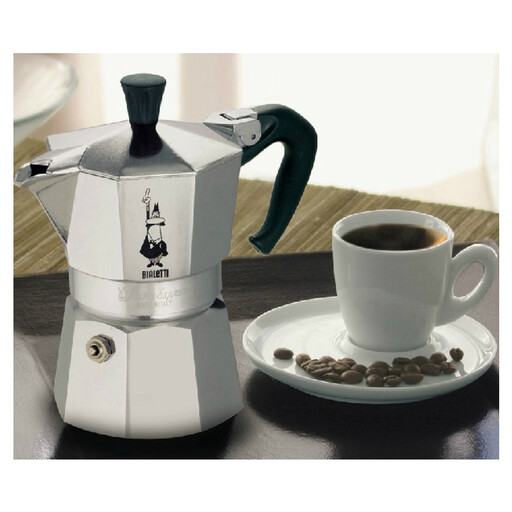
Why this product suits the profile: The compact aluminium pot is designed for a small portion and is ideal for individuals, small kitchens and travelling or camping with a suitable heat source.
The stated 60 ml capacity prevents the small size from being confused with a large mugful. It is designed for gas and electric hobs; induction requires a suitable adaptor plate.
Aluminium body, ergonomic handle and controllable safety valve; according to the product information, made in Italy.
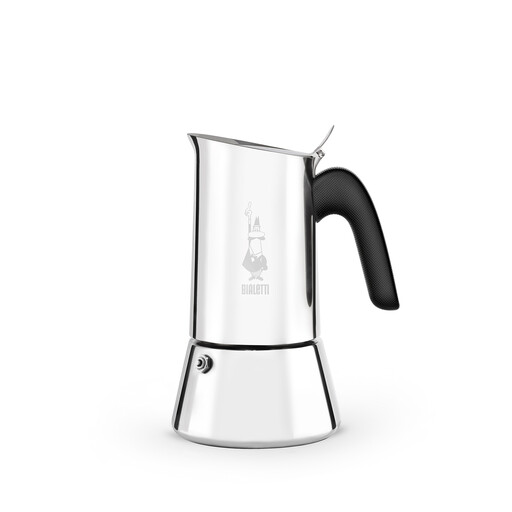
Why this product suits the profile: This manual stainless steel model is aimed at households with an induction hob that value clearly specified materials and features.
The product description explicitly states that it is induction-compatible. This removes the usual uncertainty associated with using a classic aluminium pot on an induction hob.
Stainless steel construction, ergonomic handle and reusable filter; according to the product data, designed for 4 cups.
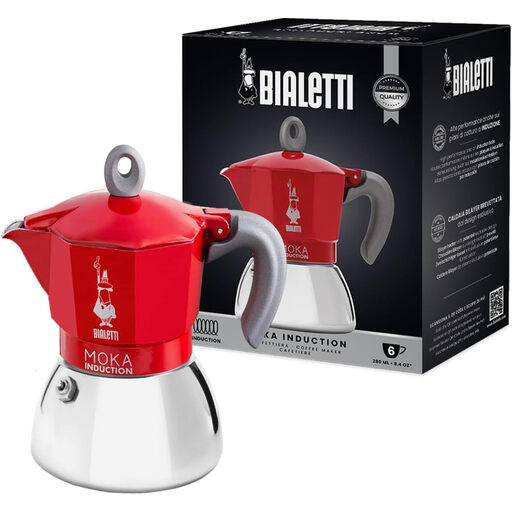
Why this product suits the profile: The combination of an aluminium upper section and stainless steel lower section is appealing to households that want to prepare larger quantities on an induction, gas or electric hob.
Induction compatibility is listed as a product feature. With a capacity of approximately 280 ml, the pot is also not limited to a single small portion.
Listed as suitable for all three hob types mentioned; manual preparation with a reusable filter and safety valve.
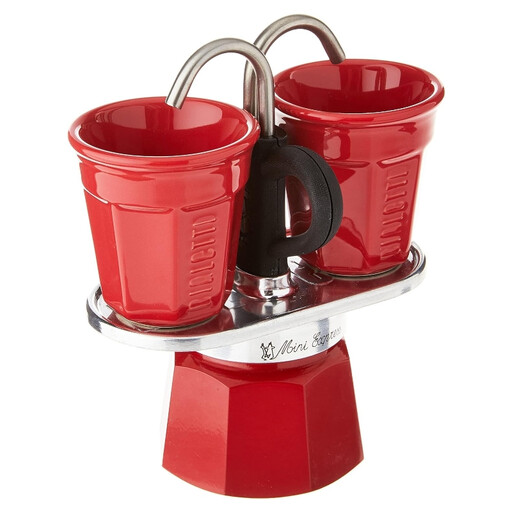
Why this product suits the profile: The Mini Express model serves coffee directly into two included cups, making it ideal for a shared, hands-on coffee ritual.
The cup count corresponds to two intended portions. This makes usage easier to plan than with a large pot that is only meant to be partially filled.
Coffee served directly into two cups, compact design and, according to the product description, made in Italy.
For classic moka preparation, fill the lower chamber with water up to the level of the safety valve. Then add ground coffee suitable for moka pots to the filter. The grounds should not be pressed down firmly. Next, close the pot and place it on the hob over a medium heat.
As soon as coffee flows into the upper chamber and the characteristic sound begins, switch off the heat source. The pot becomes hot during use; the handle and safety valve must not be obstructed. Once it has cooled, rinse the individual parts with water and dry them thoroughly. Washing-up liquid and dishwashers are not recommended for many models.
We have put together a complete, regularly updated list of products that fully meet these strict selection criteria and the safety regulations applicable in the EU.
A classic aluminium Moka Express is not automatically suitable for induction. Depending on the version, a Bialetti induction plate may be required. Models such as Moka Induction or New Venus are designed for induction hobs according to their respective product information.
Its lifespan depends on how it is used and cared for, as well as the condition of the seal, filter screen and safety valve. With proper handling, the body can be used for a long time. Wear parts should be replaced when necessary. A damaged or leaking pot should not be used any further.
Besides the ground coffee, the only usual additional costs are occasional replacements for seals or filter screens. The pot does not require capsules or its own power connection; it is heated on an existing gas, electric or induction hob. The actual costs therefore depend mainly on the type of coffee, your consumption and energy prices.