
Lieferung heute & morgen

Qualitätsgarantie

Willkommens-Angebote freischalten: KOSTENLOSE Lieferung | Bis zu 80 % RABATT | Kostenlose 30-Tage-JoyPlus-Testphase
App herunterladen
Anyone who regularly rides a bicycle, e-bike or city bike needs lighting that matches their routes and usage profile. A budget purchase can quickly become impractical if the mount slips, the battery does not last until the end of the workday or the light cannot legally be used as intended in road traffic.
This buying guide from the Joybuy Product Recommendation Officer explains the most important technical specifications and highlights which bicycle lights may suit commuters, everyday cyclists and rides in the dark.
Many bicycle lights advertise high lumen figures. Lumens describe the total amount of light emitted. However, how that light is distributed is also crucial for illuminating the road ahead. Lux indicates how much light reaches a specific surface area.
A 50-lux bicycle light may be sufficient for urban routes with street lighting. If you regularly ride on unlit country roads or longer commutes, a 100-lux bicycle light or brighter may be worth considering. A high lumen figure alone, however, says little about how clearly the road will actually be illuminated.
Protection ratings need to be read carefully. IP54, for example, indicates limited protection against dust and protection against water splashes. A light with IPX6 is protected against powerful water jets. Neither rating means that the product may be fully submerged.
USB ports can also be a potential weak point. The cover should be closed after charging. For an e-bike, you must also check compatibility with the onboard electrical system and confirm that the light is designed for the intended mounting position.
The stated battery life often refers to Eco mode or the lowest brightness setting. Runtime decreases at higher output levels. Look for specific figures for several brightness modes, as well as a charging indicator.
A USB-C rechargeable bicycle light can be charged with many existing cables and power adapters. Charging time, battery capacity and whether the front and rear lights need to be charged separately remain important considerations.
For use on public roads in Germany, you should choose a StVZO-compliant bicycle light. Look for a clear indication of approval or compliance with German requirements. The front light must be angled so that it does not dazzle oncoming road users. The rear light must be attached to the bicycle and clearly visible from behind.
A front and rear bicycle light set reduces the risk of forgetting part of the lighting setup. For products without clearly stated StVZO approval, suitability for public-road use should not be assumed.
For urban traffic with existing street lighting, 15 to 30 lux may be sufficient. On darker routes, 50 lux provides greater illumination. 100 lux can be useful for longer, unlit stretches, provided the light is adjusted correctly.
Range should be treated as a supplementary specification. It depends on the measurement method, beam distribution and surroundings. In everyday use, clear, glare-free illumination is often more relevant than a single peak figure.
Check the following before buying:
For e-bikes, distinguish between a battery-powered auxiliary light and permanently connected e-bike lighting. A USB light is not automatically designed to connect to an e-bike system.
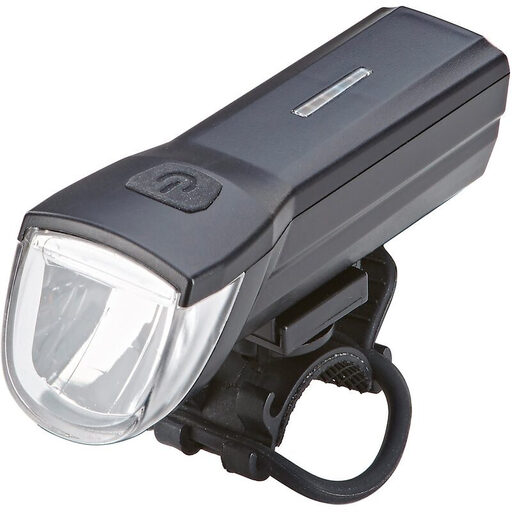
Why it fits: Ideal for short urban journeys and as a standalone front light with an integrated battery.
The two brightness levels and charging indicator make the specifications more meaningful in everyday use than a single maximum figure.
30 and 15 lux, lithium-ion battery, tool-free silicone mount and stated StVZO approval.
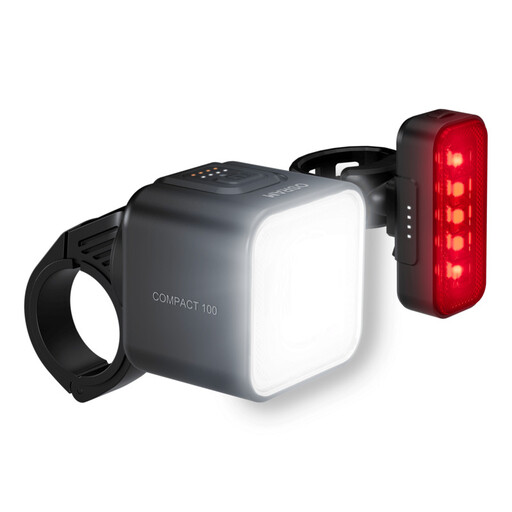
Why it fits: Practical for daily rides, with a coordinated bicycle light set including a rear light and USB-C charging.
The front and rear lights are supplied together, eliminating the need to source accessories separately or manage mismatched batteries.
50 lux, range of up to 75 m, USB-C, IP54, three front-light modes and up to 14 hours of runtime in Eco mode according to the product specifications.
Why it fits: Designed for commuters and leisure riders who want greater front-light output along with automatic adjustment.
The brightness sensor and charging indicator make it easier to adjust the output instead of running permanently in the strongest mode.
100 lux, range of up to 95 m, USB-C, IP54, automatic rear light and integrated brake-light function according to the manufacturer’s specifications.
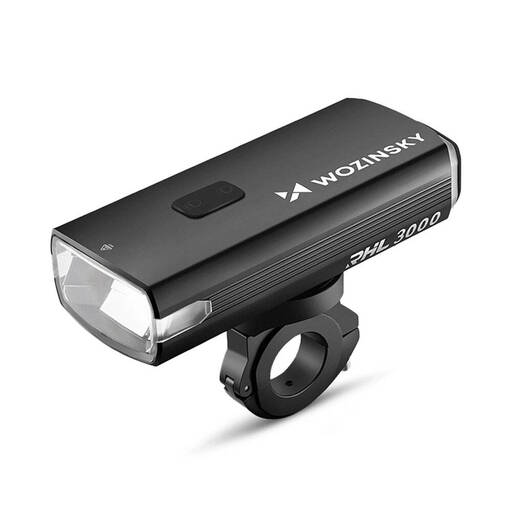
Why it fits: A strong front light for riders looking to tackle dark routes or more demanding terrain.
Six brightness levels allow you to reduce the output. The light must still be angled correctly so that it does not dazzle others.
Advertised 3,000 lumens, IPX6, 10,000-mAh battery, USB-C port and power-bank function. StVZO approval is not stated in the available specifications.
Explore the complete selection of bicycle lights for different routes, brightness levels and mounting styles. Before buying, check the relevant information on StVZO compliance, battery specifications and protection rating.
A bicycle helmet with an LED light can improve visibility around the head, but it does not automatically replace the bicycle lighting required on the bike itself. The DKONI HS-158 is specified as featuring front and rear lights, several rear-light modes, USB charging, 20 ventilation openings and adjustable sizing. Depending on the variant, sizes range from 48–55 cm, 52–58 cm or 56–61 cm.
The stated CPSC, CE and ASTM certifications should not be equated with German StVZO approval for bicycle lighting. Before using the product on public roads, check the product labelling and applicable local requirements. A helmet must also be replaced after a severe impact.
Fully charge battery-powered lights before your first ride and check the mount before every use. Clean the housing with a soft, dry cloth. Solvents, harsh cleaning agents and opening the battery can damage the product.
The electricity cost of USB charging is generally low compared with the purchase price. For everyday use, charging frequency, battery ageing and the ability to recharge the light in good time using a charging indicator are more important. If stored for an extended period, the light should be kept dry and not left completely discharged.
For illuminated roads, 15 to 30 lux may be sufficient. For darker routes, 50 or 100 lux can serve as useful reference values. Beam distribution, correct alignment and StVZO suitability remain decisive.
This depends on the battery, brightness setting and operating temperature. Manufacturer specifications such as “up to 14 hours” often refer to Eco mode. Runtime can be significantly shorter at full output.
No. An LED, USB-C charging or a high lumen rating does not automatically mean StVZO compliance. For use on public roads, the relevant approval should be explicitly stated in the product specifications.