
Lieferung heute & morgen

Qualitätsgarantie

Willkommens-Angebote freischalten: KOSTENLOSE Lieferung | Bis zu 80 % RABATT | Kostenlose 30-Tage-JoyPlus-Testphase
App herunterladen
If you love your bike, you work on it. Regular maintenance and repairs are essential to ensure your bike's performance and safety. But anyone who has tried to adjust a derailleur while kneeling on the floor or change a chain without a stable mount knows the frustration. A bicycle repair stand isn't a luxury purchase; it's a fundamental tool for any ambitious home mechanic.
However, the market is saturated with products that overpromise and underdeliver. Before you invest in an unstable stand that could endanger your expensive bicycle, you need to know the common pitfalls.
A good bicycle repair stand avoids these problems, making work on your bike easier, safer, and more efficient.
To avoid a bad purchase, don't be swayed by marketing buzzwords. Instead, focus on verifiable technical specifications. These three features are non-negotiable for a reliable, workshop-grade bike stand.
The maximum load capacity is the first critical value. Modern bicycles, especially e-bikes and full-suspension mountain bikes, can easily weigh over 20 kg. To be on the safe side, a repair stand for mountain bikes or other heavy bikes should be rated for a load of at least 30 kg.
But the stated load capacity alone isn't enough. Stability is heavily dependent on the base design. A wide base, ideally with four legs instead of a simple tripod, provides much better weight distribution and prevents tipping, even when you're applying force to the bike. Look for robust materials like alloy steel that won't flex under a full load.
The clamping mechanism is the most critical component. A high-quality clamp must do two things: hold the bike securely and protect the frame.
A good bike maintenance stand adapts to you, not the other way around. Infinitely adjustable height adjustment is crucial for working in an upright, back-friendly posture.
Additional features significantly enhance convenience. An integrated tool tray, ideally magnetic, keeps screws, Allen keys, and small parts within reach and prevents them from getting lost on the floor. For home workshops with limited space, it's also important that the repair stand is foldable so it can be stowed away compactly after use.
Based on these objective criteria, we have identified products that represent a suitable solution for specific user groups.
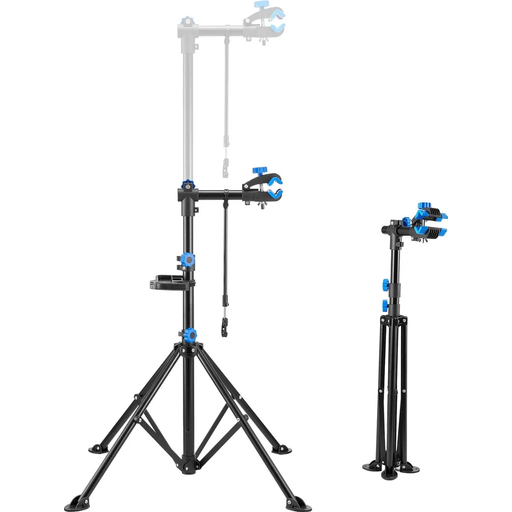
Why This Fits Their Persona: Ideal for cyclists who regularly work on various bikes (road, MTB, e-bike) and need a reliable, flexible, and space-saving solution for their home workshop or garage.
The 4-leg design made of alloy steel provides excellent stability, avoiding the stability trap. The rubberised, 360° rotating clamp protects the frame and bypasses the clamping trap. The height adjustment ensures proper ergonomics.
The combination of a 30 kg load capacity, a magnetic tool tray, and a foldable design offers a well-thought-out package for demanding maintenance tasks.
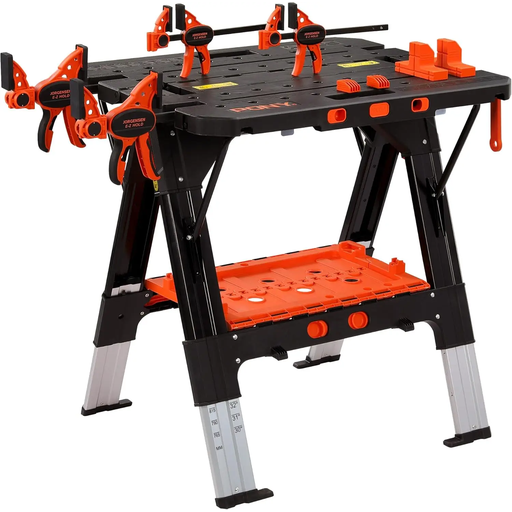
Why This Fits Their Persona: For the DIY enthusiast who works on more than just bikes and is looking for a multifunctional, extremely durable, and portable workstation for various projects in the garage or yard.
This product isn't a classic bike stand, but a full-fledged workbench. With a load capacity of 227 kg as a workbench, it bypasses any stability trap. The integrated clamping system with bar clamps and bench dogs offers flexible, albeit non-specialised, mounting options.
Extreme versatility and durability. It serves as a workbench and sawhorse with 6-level height adjustment and can be used for a wide range of craft projects, including bike repairs.
We have compiled a comprehensive, up-to-date list of products that meet these strict selection criteria and relevant safety requirements.
Yes, this risk exists with improper use or an unsuitable clamping mechanism. To avoid damage, choose a stand with a clamp that has soft-lined jaws to distribute pressure evenly. Never clamp a carbon bike by its thin-walled top tube or down tube. The safest method is to clamp it by the sturdy seatpost.
An average e-bike weighs between 20 and 30 kilograms. To ensure a safe and stable working environment, a repair stand with a specified load capacity of at least 30 kg is recommended. Always check the manufacturer's specifications before purchasing to ensure the stand is rated for your bike's weight.
Yes, a well-designed foldable repair stand is perfectly stable for most applications. The folding feature is for space-saving storage and should not compromise stability when assembled on high-quality models. Look for models with a wide base (e.g., a 4-leg design), solid locking mechanisms, and high-grade materials like steel tubing.