
Lieferung heute & morgen

Qualitätsgarantie

Willkommens-Angebote freischalten: KOSTENLOSE Lieferung | Bis zu 80 % RABATT | Kostenlose 30-Tage-JoyPlus-Testphase
App herunterladen
As your Joybuy Product Recommendation Officer, my mission is to provide you with clear, objective information to help you make an informed purchasing decision. In this guide, we'll focus on the adult bike helmet with a light—an essential piece of gear for anyone looking to enhance their visibility and safety on the road, especially at dusk or at night.
The goal of this article is to explain the key features of a helmet with lighting and to present a selection of models that meet different needs.
The selection is vast, but a few criteria are fundamental to making a good choice. Here are three points you should consider.
A safe bike helmet is the foundation. In Germany and the EU, bike helmets must meet the DIN EN 1078 standard. This certification ensures that the helmet meets basic impact protection requirements. Look for this certification mark. The fit is just as important. A helmet can only provide optimal protection if it sits securely and level on your head, without wobbling or creating pressure points. Modern helmets feature adjustment systems at the back of the head (usually a dial) and adjustable chin straps. Measure your head circumference before buying to find the right size.
The lighting is the key feature. A bike helmet with lighting can have just a rear light, a front light, or both.
Pay attention to the different lighting modes (e.g., steady, flashing) and the power source. A USB-rechargeable bike helmet is convenient and more eco-friendly than models with batteries. Battery life varies depending on the model and the mode used.
Consider where and how you ride most often.
Many modern helmets are designed as unisex models and, thanks to their adjustability, are equally suitable as a women's bike helmet and a men's bike helmet.
Based on the criteria mentioned, we have compiled a selection of helmets that stand out for their specific properties and functions.
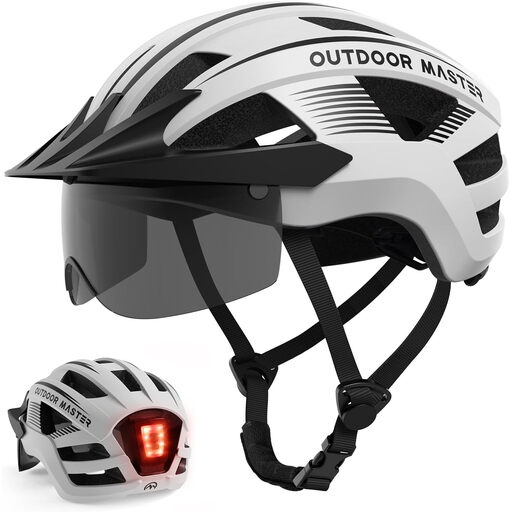
Why It Stands Out: This model combines safety with exceptional versatility. It offers not only an integrated rear light but also detachable magnetic goggles and a sun visor.
Pros:
Who It's For: Ideal for commuters and recreational cyclists who are looking for a helmet for various conditions and value flexible features like a visor and goggles.
View the OutdoorMaster RhinoUrban Helmet
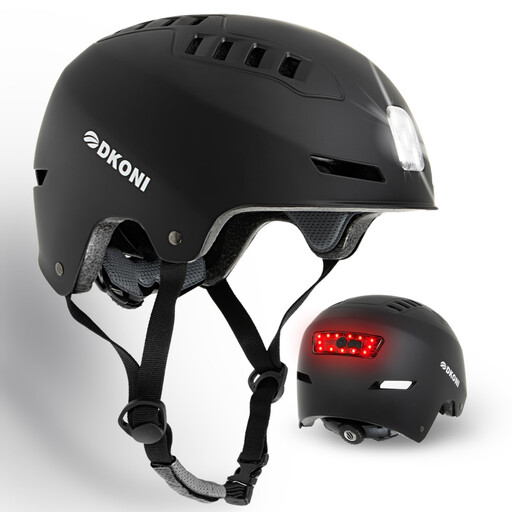
Why It Stands Out: This helmet focuses on maximum 360-degree visibility with a lighting system at the front and rear.
Pros:
Who It's For: Especially recommended for urban commuters and cyclists who frequently ride in the dark and want maximum visibility from all directions.

Why It Stands Out: This model is a specialised choice for mountain bikers, focusing on maximum protection and an extra-large visor.
Important Note: Please be aware that this model does not have integrated lighting. It is listed here as an alternative for a specific use case. If needed, it can be paired with a separate helmet light.
Pros:
Who It's For: For mountain bikers who want a lightweight helmet with maximum mechanical protection (e.g., from branches) and can do without an integrated light or prefer to use an external one.
Are your needs highly specific, or would you simply like to compare more models? Our full selection of bike helmets offers options for every need, from a lightweight road bike helmet to a robust e-bike helmet.
Discover All Bike Helmets Here
1. Is a bike helmet with a light permitted in Germany? Yes, a helmet with integrated lighting is permitted. It is considered additional safety equipment that increases your visibility. However, it does not replace the legally required, fixed bicycle-mounted lighting according to the German Road Traffic Licensing Regulations (StVZO).
2. How long does the battery last on a bike helmet with LED lighting? Battery life varies greatly depending on the model, brightness, and selected light mode (flashing generally consumes less power than a steady light). Most models offer a runtime of several hours, which is sufficient for typical rides. A USB-rechargeable bike helmet is the most practical solution here.
3. How do I find the right helmet size? Measure your head circumference with a flexible measuring tape. Place the tape about one centimetre above your eyebrows and ears, and wrap it around the widest part of the back of your head. Compare the measured value (in cm) with the manufacturer's size chart to determine the correct size.