Making larger batches of biscotti
If you’re baking several or longer dough logs, the usable tray area and space for the slices later on are key. King Arthur Baking recommends spacing the biscotti out on the tray for the second bake.


If the communal oven is available for both baking stages and your trays fit, you don’t necessarily need to buy your own appliance to make biscotti. For a mini oven, check the usable tray area for the dough logs and slices, as well as whether there’s a safe place for it. A larger oven will also take up more shared worktop space.
If you’re baking several or longer dough logs, the usable tray area and space for the slices later on are key. King Arthur Baking recommends spacing the biscotti out on the tray for the second bake.
You’d like to bake without relying on the communal oven, but you have limited space on the shared worktop. As well as the appliance’s dimensions, check the setup requirements for the exact model and make sure there’s a suitable power connection.
When several people use the oven, straightforward controls and easy-to-access cleaning features matter. Check the timer, heating functions and crumb tray on the specific model you’re considering.
A good fit if: the oven is available for both baking stages and your biscotti fit on a suitable tray.
The trade-off: You’ll need to coordinate baking times with the other people using it.
A good fit if: you want to bake smaller batches independently and have enough clearance and a suitable power connection at the intended spot.
The trade-off: A limited tray area may mean baking in several batches.
A good fit if: you want to fit longer dough logs or larger batches and have more space available permanently.
The trade-off: A larger housing takes up more room, and multiple shelf positions don’t guarantee even baking on two trays at once.
| Priority | What to check when buying | Who is this important to? |
|---|---|---|
| Suitable baking area | Compare the usable tray dimensions with your dough logs and slices; check whether a tray is included. | If I want to bake as few batches as possible, both the logs and the slices need to fit on my tray. Around 34% of consumers say baking area is their main priority. |
| A safe place to put it | Check the external dimensions, setup requirements for the exact model and whether there’s a suitable power connection at the intended spot. | In a shared kitchen, I want to find a safe place for it without blocking walkways or other work surfaces. Around 33% of consumers say a safe place to put the oven is their main priority. |
| Controls and cleaning | Compare the timer, available heating functions and how easy it is to access the crumb tray on the specific model. | When several people use the oven, the settings should be easy to understand and crumbs should be simple to clear away. Around 20% of consumers say ease of shared use and cleaning is their main priority. |
| Purchase and running costs | Take the oven you already have and available baking times into account; compare electricity costs only for similar baking sessions. | If the communal oven is available, I don’t want to buy another appliance based solely on a guess about electricity use. Around 13% of consumers say cost is their main priority. |
The internal capacity doesn’t tell you whether your dough logs and the slices will fit on the tray. Nor does it tell you how many batches you’ll need to bake.
Measure the dough logs you plan to bake and compare them with the usable tray dimensions and what’s included.
As well as the space it occupies, the oven needs the clearance and power connection specified for that exact model. Hot surfaces are another consideration in a shared kitchen.
Check the manual for the specific model and the spot where you plan to put it, rather than relying on clearance guidance for another oven.
Multiple shelf positions don’t confirm that two trays are included or that biscotti will bake as expected on two loaded shelves at the same time. Rommelsbacher Support’s guidance on using multiple levels refers to “BG 1580/E”, while the product is called “BGE 1580/E”.
Check what’s included and read the guidance for the full model name. If using two trays at once isn’t explicitly confirmed, plan to bake one batch after another.
The BGE 1580/E and BG 1550 are 30-litre mini ovens with different features.
The TO 2068 is a 20-litre model, while the TO 2058 has a 42-litre capacity. Severin lists a fan-assisted function for both.
According to Steba, the KB 27 U.2 is a 20-litre mini oven with grill, continuous fan-assisted operation and separately switchable top and bottom heat.
According to CASO Design, the TO 26 SilverStyle is a freestanding 26-litre oven with fan-assisted cooking, top heat and bottom heat.
The following Joybuy options are compact mini ovens with different stated capacities and features. Before choosing, compare the usable baking area, the space available and the specifications for both stages of baking biscotti.
 No image available
The stated capacity can help you compare how much you can bake; also check that your dough logs and slices will fit on the usable baking area.
32 l; 1600 W; temperature range 100–250 °C; 60-minute timer; removable crumb tray.
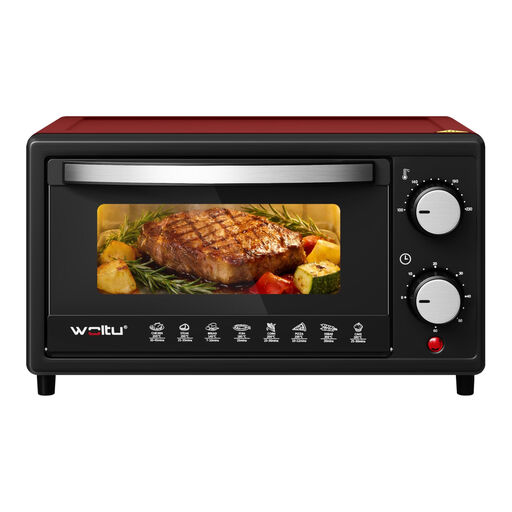 No image available
The smaller stated capacity may suit a limited space. Still, measure the clearance needed and check that the baking area is large enough for your biscotti.
10 l; temperature range 100–230 °C.
 No image available
If you’re considering a convection oven, compare the actual baking area and setup requirements with the space in your kitchen. The product name alone won’t tell you how it performs with several trays.
28 l; temperature control and timer listed in the product name.
No, you can bake smaller batches one after another. Biscotti are baked first as logs, then a second time after slicing. If you want to bake both stages on several shelves at once, multiple shelf positions aren’t enough to confirm that this is possible; check the guidance for the full model name.
Follow the clearance and safety instructions in the manual for your exact model, and take the socket and hot surfaces into account. For example, the manufacturer specifies an earthed, easily accessible socket and clearance around the appliance for the Steba KB 9.2; these requirements don’t automatically apply to other models. Clean the crumb tray and removable parts in line with the relevant manual.
You can’t assume that a mini oven will use less electricity for your batch of biscotti just because of the type of appliance. If running costs matter, compare the actual electricity used for similar quantities and both baking stages; the wattage alone doesn’t tell you how much electricity it uses.
When you buy from a retailer, your statutory rights against the seller are separate from any voluntary guarantee. If there’s a fault, you’ll generally need to request a remedy first, such as a repair or replacement. Any additional guarantee is subject to the terms in the relevant guarantee statement; the consumer advice centre explains the difference between statutory rights and a guarantee.
No, it isn’t approval from a central EU testing body. For products covered by the relevant harmonised EU rules, the manufacturer uses the CE marking to declare that the product meets the applicable requirements. The European Union describes it as a manufacturer’s declaration.