
Lieferung heute & morgen

Qualitätsgarantie

Willkommens-Angebote freischalten: KOSTENLOSE Lieferung | Bis zu 80 % RABATT | Kostenlose 30-Tage-JoyPlus-Testphase
App herunterladen
A bookcase should support your books safely, make good use of the space available and suit your room. In practice, though, it’s not just colour or style that can lead to the wrong purchase. Bookcases are often too narrow for the books you own, maximum load limits are misinterpreted, or the need to secure the unit to the wall is overlooked.
This buying guide explains what households in the UK should look for in a freestanding bookcase, ladder bookcase or storage unit. Our recommendations are based on objectively stated dimensions, materials, shelves and load limits.
A narrow bookcase can still be very tall, despite taking up little floor space. Before buying, measure the width, depth and height of the space where you plan to put it. Remember to allow for skirting boards, radiators, doors and room to assemble the unit.
A bookcase with a depth of 24 cm takes up little floor space, but that doesn’t automatically make it suitable for large coffee-table books or wide ring binders. A space-saving bookcase can still work well in a hallway, bedroom or small home office, provided the shelf width suits what you plan to store.
A figure such as ‘maximum load 60 kg’ usually refers to the whole unit. You should also check the weight capacity per shelf. Try to distribute books evenly, with heavier volumes on the lower shelves to keep the centre of gravity low.
For a bookcase with several shelves, also check whether the stated load limit applies to a static load under specific conditions. Actual capacity also depends on correct assembly, a level floor and secure wall fixings.
An open bookcase gives you easy access and is ideal for displaying books, plants or ornaments. However, tall freestanding bookcases can tip over if they’re loaded unevenly or accidentally pulled. Many models are designed to be secured to the wall or fitted with an anti-tip device; follow the instructions when fitting it.
Securing the bookcase is especially important in homes with children or pets. Before assembly, check that the wall plugs and screws are suitable for your wall. Plasterboard requires different fixings from concrete or masonry.
A living room bookcase can be wider, while a narrow design may be a better fit in a hallway or beside a desk. Shallow models work well in alcoves. A ladder bookcase makes use of vertical space, but depending on its design, it may need a reasonably wide base.
Check the following:
Many models combine a steel or metal frame with chipboard, MDF or melamine-coated surfaces. A metal frame can help stabilise the structure, while engineered wood is used for the shelves. The material description alone, however, is no substitute for checking the load limits.
A bookcase with a back panel or side rails can help keep items on the shelves. Adjustable feet are useful if the floor isn’t completely level. For an industrial-style or vintage bookcase, also check whether the surface is merely textured for decoration or has a practical, easy-care coating.
The maximum load should suit what you plan to store. A bookcase for light ornaments has different requirements from one holding an extensive book collection. Look for clear information on total load and load per shelf.
For tall furniture, anti-tip fittings, a back panel, crossbars and secure joints between components are all important. Make sure the assembly instructions are complete. Larger bookcases may be easier to assemble with two people.
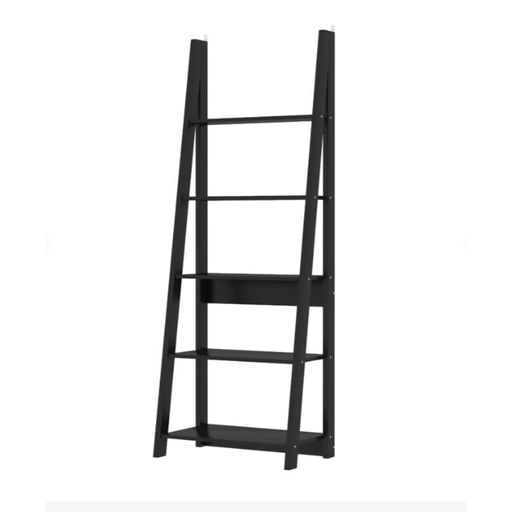
Why this product suits your needs: Measuring 64.5 × 39 × 175.5 cm, this ladder bookcase has open shelves for books, plants or ornaments, making good use of vertical space in living rooms and bedrooms.
The stated overall dimensions make it easy to check how much space you’ll need before buying. Assembly requires two people, so remember to take this into account when planning.
A vertical design, open storage and black melamine-coated chipboard shelves.
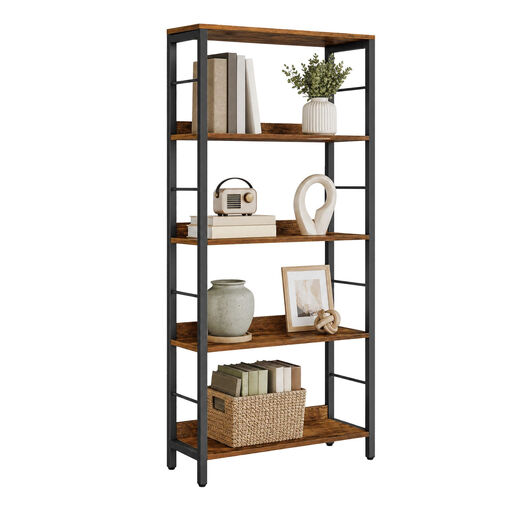
Why this product suits your needs: This living room bookcase combines five shelves and back panels with a steel frame, and has a stated total load capacity of 185 kg.
The stated capacity of up to 37 kg per shelf and 185 kg overall helps you distinguish between the load limit for an individual shelf and that of the whole unit.
Back panels help stop items slipping off, while the side rails can also act as bookends.
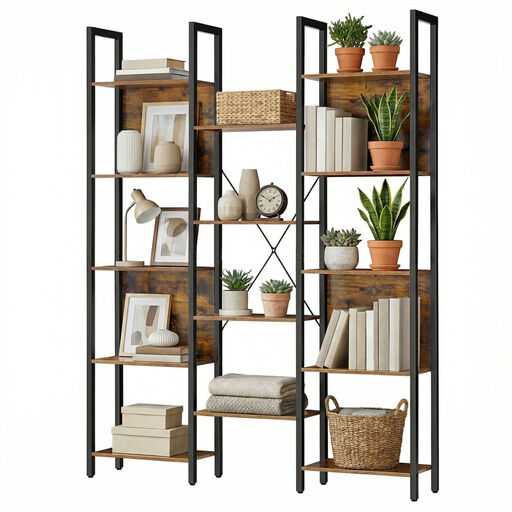
Why this product suits your needs: At 158 cm wide, this spacious unit has 14 staggered shelves, making it suitable for extensive collections, photo books and ornaments.
The stated capacity of up to 10 kg per shelf and 140 kg overall makes it clear that the total load limit doesn’t apply to each shelf individually.
Reinforced steel, thicker chipboard shelves, a back panel and an anti-tip kit included.
A bedroom bookcase is handy for books, baskets or plants, but shouldn’t be placed in front of a radiator. In a home office, make sure there’s enough space between shelves for ring binders and that the unit is secured against tipping. An open bookcase in the living room gives you easy access, but shows dust more readily than a cabinet with doors.
A kitchen shelf should only be placed where it won’t be exposed to splashes or persistent damp. For smaller spaces, a narrow bookcase, corner shelf or wall-mounted shelf may be a good choice. With wall-mounted models, make sure the wall material and wall plugs are compatible. For example, according to the product information, the WOLTU corner shelf isn’t suitable for plasterboard walls.
We’ve put together a complete, regularly updated list of products that meet these strict selection criteria and fully comply with the safety regulations applicable in the EU.
First, place the bookcase on a level surface and make sure it’s straight. Then attach the anti-tip device supplied, following the instructions, and secure it to a suitable wall. Use fixings designed for concrete, masonry or your particular stud wall.
It depends on what you’re storing. Light ornaments need less support than a collection of heavy hardback books. Always compare the load capacity per shelf with the maximum overall load, and keep heavier items on the lower shelves.
There’s no reliable one-size-fits-all answer. Lifespan depends on the materials, assembly, damp, sunlight and load. Regularly checking the screws, anti-tip fittings and stability, along with wiping the bookcase clean with a dry cloth, can help keep it safe and sturdy for years to come.