
Lieferung heute & morgen

Qualitätsgarantie

Willkommens-Angebote freischalten: KOSTENLOSE Lieferung | Bis zu 80 % RABATT | Kostenlose 30-Tage-JoyPlus-Testphase
App herunterladen
A black ceiling light can bring clear structure to a living room, bedroom, kitchen, hallway or office. At the same time, incomplete product details and exaggerated design promises can quickly lead to a bad purchase. What really matters is not just colour and shape, but also light output, colour temperature, ingress protection rating and your existing electrical installation.
Wattage describes power consumption, not directly how bright a light is. For light output, the lumen value is what counts. A black LED ceiling light with 10 watts can vary significantly in brightness depending on the LED technology used. So always check the stated lumen figure and the size of the room you want to illuminate.
A black ceiling light with 3000K produces warm white light, which is often chosen for living rooms and bedrooms. 4000K gives a neutral white light, suitable for kitchens, hallways or work areas. 6500K corresponds to cool white light and can be useful in functional spaces, but in a living area it often feels more clinical.
With a ceiling light offering 3000K, 4000K and 6500K, you should check whether the colour temperature is selected via a switch, remote control or app. An integrated selection option is not automatically the same as stepless colour temperature adjustment.
For damp rooms, the ingress protection rating is especially important. A black ceiling light with IP44 is protected against splashing water from various directions and may be suitable for certain areas in a bathroom or kitchen. However, the rating does not replace proper planning: direct water jets and persistently high humidity must be avoided.
With a flat LED ceiling light or a recessed spotlight, the diameter, installation depth and ceiling cut-out must all match. A model requiring a ceiling cut-out of 90 to 100 millimetres will not fit every existing opening.
As a practical guide, you should assess the required brightness based on the room's function and floor area:
Multiple lights or adjustable spots can be more practical than a single, very bright light source.
A dimmable ceiling light requires either an integrated dimmer, a remote control or a compatible external wall dimmer. With a dimmable LED ceiling light, you should check whether the dimmer is included and which dimmer technology is supported according to the instructions.
A specification like "10–100% dimmable" only applies with a compatible installation. Not every LED light works trouble-free with every existing dimmer. So before buying, it is worth checking the connection and compatibility details.
Ceiling lights are usually fixed to the ceiling and connected to the mains supply. In the UK, installation and electrical connection should be carried out by a qualified electrician. The power supply must be switched off before any maintenance work.
With a ceiling light featuring 3 lamps, you should also check whether bulbs are included and what the maximum permitted wattage is. An adjustable black ceiling spotlight offers flexible direction, but does not replace adequate general lighting if the spots only cover small areas.
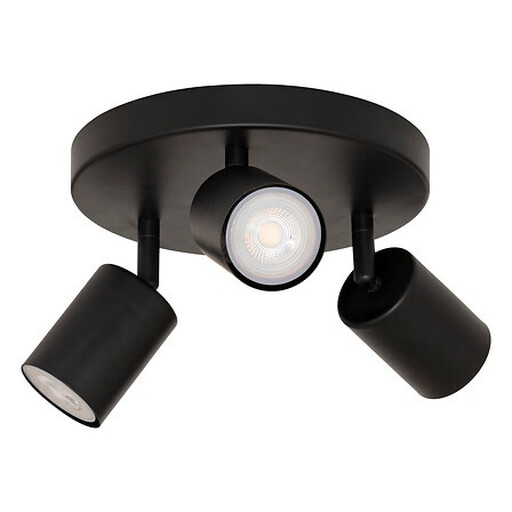
Why this product suits the profile: This compact light with three adjustable spots is ideal for rooms where targeted direction matters more than a large-area light source.
The three rotatable lights make the direction of illumination clear. However, before buying you must check the instructions for suitable bulbs and the maximum permitted wattage.
Black steel housing, 20 cm diameter and three adjustable spots.
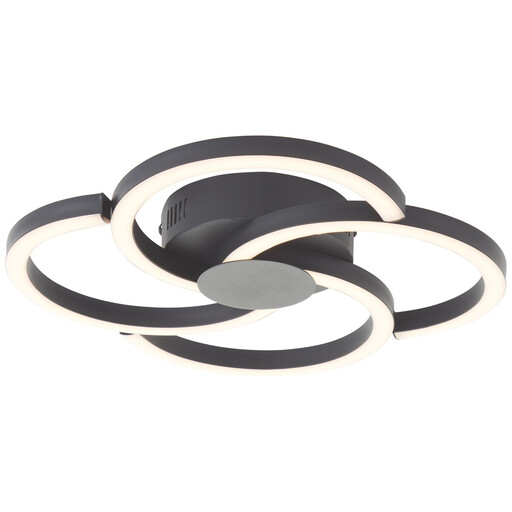
Why this product suits the profile: The integrated LED technology, 2300 lumens and 3000 Kelvin offer clearly stated performance data for living rooms, bedrooms, hallways or kitchens.
The product data states luminous flux, colour temperature, power consumption and IP20 rating. This makes it easier to assess the suitable application than with a description lacking technical values.
22 watts, 2300 lumens, 3000 Kelvin, 34 cm diameter and integrated LED.
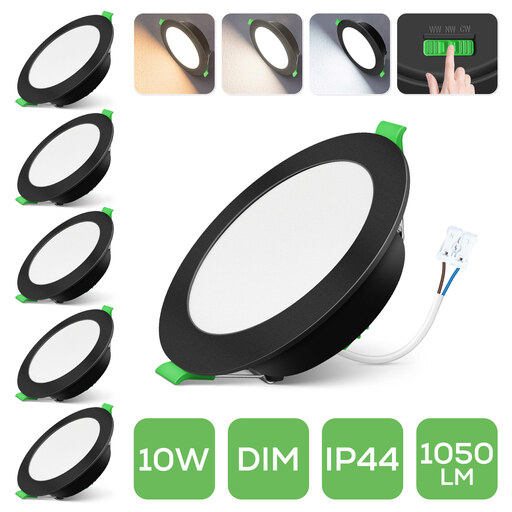
Why this product suits the profile: This set of six recessed spots is ideal for users who want to equip multiple ceiling cut-outs and adjust light colour and brightness flexibly.
The specifications state a 90–100 mm ceiling cut-out, 34 mm depth, IP44 and the necessary dimmer compatibility. This allows you to check installation and damp-room risks in advance.
10 watts, 1050 lumens per spot, 3000/4000/6500 Kelvin, 10–100% dimmable with compatible dimmer.
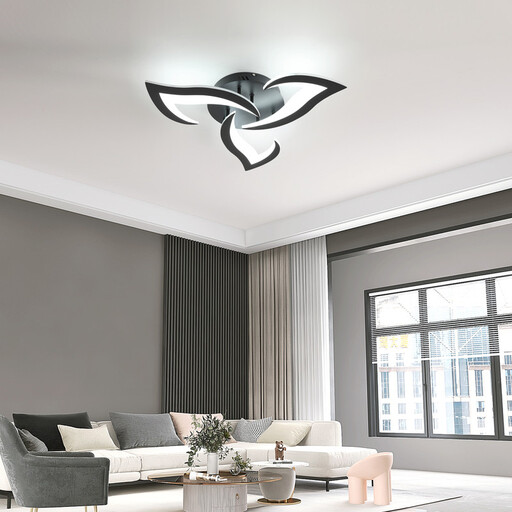
Why this product suits the profile: This black light with three light sources and stepless colour temperature adjustment is aimed at households that want to switch between atmospheric and functional lighting.
The product description states 35 watts, three lights and a range from 3000 to 6500 Kelvin. However, before ordering you should still check which controls and installation components are included.
Three light sources, black acrylic design, 35 watts and stepless colour temperature adjustment from 3000 to 6500 Kelvin.
For a rough cost calculation:
Power in kW × operating hours × electricity price = running costs
A 22-watt LED light running for 1,000 hours uses 22 kWh in theory. The actual amount depends on your individual electricity tariff and usage duration. A higher lumen output can be worthwhile if it means you can do without several additional lights. The energy efficiency class should still be taken into account when making your choice.
We have put together a complete, regularly updated list of products that fully meet these strict selection criteria and the safety regulations in force in the EU.
For the living room, warm white models at around 3000K are often chosen. A black lamp for the living room can be used as a central light source or as a design accent. What matters is sufficient luminous flux, glare control and a beam pattern that suits the room size.
That depends on the IP rating, the installation location and local safety requirements. A model with IP44 can be suitable for certain areas in a bathroom or kitchen. Installation should always be carried out by a qualified electrician. Lights with IP20, such as the Brilliant Fico, must be protected from moisture according to the product specifications.
The lifespan depends on the LED module, heat dissipation, operating hours and ambient temperature. With permanently integrated LEDs, a later replacement can be more involved than with a light that uses replaceable bulbs. So check the stated lifespan, warranty conditions and replaceability of the light source before buying.