Photographers who want distant details
You want to zoom in on individual cascades or rock formations from an accessible path, so you’re comparing optical telephoto focal lengths.


If you want to travel light on a hike but still switch between wide views and distant waterfall details, a travel zoom is a natural place to start. If reaching very distant subjects matters more than keeping your camera small, it’s worth comparing it with a bridge camera. If you’ll often be near spray, look for a clearly stated water-resistance rating; with the Tough TG-7, this comes with a much shorter telephoto range. To create a soft, flowing effect, shutter speed and a stable, permitted shooting position are key – a high zoom ratio alone won’t do the job.
You want to zoom in on individual cascades or rock formations from an accessible path, so you’re comparing optical telephoto focal lengths.
You take wide shots and the occasional distant detail, but don’t want to carry a large, heavy camera on longer walks.
You want to control how the water’s movement looks, so as well as zoom, you’re considering exposure settings, a stable shooting position and the light conditions.
A good fit if: You want to switch between wide and close-up shots on a hike. Panasonic lists an optical zoom range equivalent to 24–720 mm in 35 mm format for the LUMIX DC-TZ99.
The trade-off: Focal length describes the field of view, not image quality in low light; also check how well the camera’s size and weight suit your luggage.
A good fit if: You can prioritise distant subjects over keeping your kit as compact as possible. For the DC-FZ82D, Panasonic specifies an equivalent focal length of 20–1200 mm in 35 mm format for 4:3 photos.
The trade-off: The stated weight of the DC-FZ82D is around 596 g, including the battery and memory card; its focal-length range depends on the recording format.
A good fit if: You want to weigh up sensor and lens specifications against maximum telephoto reach for shaded subjects. Sony lists a 1.0-type sensor, F2.4–4 and an equivalent focal length of 24–600 mm in 35 mm format for the DSC-RX10M4.
The trade-off: Its telephoto end is shorter than the DC-FZ82D’s; these manufacturer specifications alone don’t prove it will deliver better results at a waterfall.
A good fit if: Protection from frequent spray is your priority. OM Digital Solutions states that the OM SYSTEM Tough TG-7 is waterproof to 15 m.
The trade-off: Its optical focal-length range of 25–100 mm in 35 mm equivalent is considerably shorter than that of the travel zoom and bridge camera models listed above.
| What matters when buying | What to check | Who it matters most to |
|---|---|---|
| Distant details | Optical telephoto end focal length and recording format; distinguish optical zoom from digital zoom. | If I want to get closer to individual cascades or rocks from the path, telephoto reach is my top priority. It’s the most important purchase consideration for around 36% of consumers. |
| Size and weight | Camera body dimensions and weight, including the battery and memory card. | On a longer walk, I want to take a camera without its size and weight adding unnecessary bulk to my luggage. A compact size is the priority for around 29% of consumers. |
| Exposure at a waterfall | Shutter speed control and options for finding a stable shooting position. | If I want to control how the water’s movement looks, adjustable shutter speeds matter more than maximum zoom. This is the top priority for around 21% of consumers. |
| Water and spray | The protection rating for the specific camera model and the telephoto range you need. | If I’m often taking photos in spray, I’d give a stated water-resistance rating more weight than maximum magnification at a distance. Water resistance is the most important purchase consideration for around 14% of consumers. |
Digital zoom figures don’t describe the same optical focal length, so they’re not a direct substitute for comparing the optical telephoto end focal length.
First compare the optical zoom’s 35 mm equivalent focal length, and check which photo format it applies to.
With deliberately long exposures, camera movement can also blur the parts of the scene that aren’t moving.
Check whether you can adjust the shutter speed, and plan to use a stable position on a permitted path.
Depending on the shooting conditions, you may need a suitable tripod or other compatible accessories for a stable setup.
According to OM Digital Solutions, the Tough TG-7 is waterproof to 15 m, but its optical range only goes up to 100 mm in 35 mm equivalent. These specifications apply to this model and don’t confirm that other cameras offer the same protection.
Consider the specific location and decide whether protection from frequent spray or framing a distant subject tightly matters more to you.
The DC-TZ99 and DC-FZ82D are differently sized models for comparing a travel zoom with a bridge camera.
The DSC-RX10M4 provides a point of comparison for a bridge camera with a 1.0-type sensor and optical telephoto zoom.
The Tough TG-7 is an option to compare if water resistance matters more than a powerful telephoto zoom.
The PowerShot SX70 HS is another bridge camera to consider when comparing long optical zooms.
The COOLPIX P1100 offers particularly impressive telephoto reach among the compact cameras in Nikon’s range.
The Joybuy products below include a compact digital camera with a stated optical zoom and a portable camera whose product description mentions digital zoom and underwater use. If distant details matter to you, check carefully whether the zoom is optical or digital.
 No image available
For outings when you want a compact body and optical zoom, the product description presents this camera as a travel option; this doesn’t provide an independent assessment of its image quality.
The product details list 12x optical zoom, 64 MP, 4K and Wi-Fi.
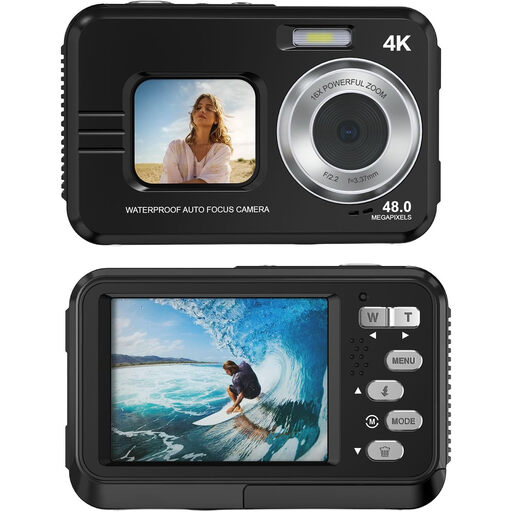 No image available
If you’ll be taking photos near water, the product description states that it can be used underwater to a depth of 3.5 m. Its stated 16x zoom is digital, so it won’t replace optical telephoto reach for distant waterfall details.
The product details also list autofocus and two displays.
No. The National Park Authority says that visitors must stay on the paths when taking photographs. Stick to designated paths and observe seasonal closures; this guidance applies to the national park, not every waterfall in the Black Forest.
According to the National Park Authority, non-commercial photography is covered by the stated exemption from obtaining advance permission for photo and film reporting, as long as you stay on signed paths. Different conditions apply to commercial reporting.
Choose a longer exposure time and a stable, permitted position for your camera. Nikon recommends using a tripod in its long-exposure photography tutorial; whether you also need an ND filter, and whether it can be attached to your specific camera model, depends on the light and the camera’s features.
Check who the seller is and what voluntary warranty terms apply: your statutory rights against the seller and a voluntary warranty aren’t the same thing. According to the consumer advice centre, online purchases generally come with a 14-day right to cancel; exceptions and the circumstances of the contract should be taken into account.