
Lieferung heute & morgen

Qualitätsgarantie

Willkommens-Angebote freischalten: KOSTENLOSE Lieferung | Bis zu 80 % RABATT | Kostenlose 30-Tage-JoyPlus-Testphase
App herunterladen
An unreliable pen can disrupt your workflow, whether through smudging, inconsistent ink flow, or an uncomfortable grip. Clean, neat handwriting is crucial, especially for important notes, journal entries, or official documents. A high-quality black gel pen is therefore an indispensable tool for the office, university, and creative projects.
This article serves as your guide. We will introduce you to various models and explain the key features to consider when making your choice. Our goal is to provide you with the information you need to make an informed decision and find the perfect gel pen for your needs.
With so many options available, the search for the right pen can be overwhelming. The following criteria will help you narrow down your choices based on objective features.
A key advantage of gel ink is its vibrant colour and smooth application. The downside, however, can be a longer drying time, which leads to unsightly smudging. This is an especially critical factor for left-handers, whose hands glide over freshly written text.
Look for products with ink described as quick-drying and smear-proof. These formulas are specially engineered to set on paper within seconds. The result is clean, smudge-free writing, even when you're writing quickly.
The line width, measured in millimetres (mm), significantly defines the character of your handwriting.
Compared to a black fineliner, which often has a fibre or plastic-based tip, a gel pen's rolling ball provides a consistently smooth, scratch-free gliding sensation.
Comfort plays a crucial role during long writing sessions. An ergonomically shaped grip area, often made of a rubberised material, can reduce hand fatigue and improve control over the pen.
The mechanism is also important: Retractable pens with a click mechanism are practical for on-the-go use, as there's no cap to lose. They are ready to use in an instant and protect both the tip and your pocket from ink stains.
Here is a selection of gel pens that cover a range of needs—from daily office supplies to specialised creative applications.
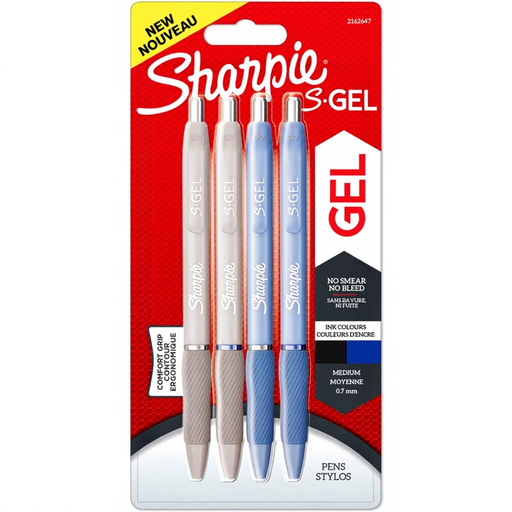
Why it stands out: The Sharpie S-Gel combines a modern design with a high-performance ink formula. Its 0.7 mm tip delivers a bold, clear line.
Pros:
Who it's for: Users looking for a reliable pen for daily use at the office or at home who prefer a slightly wider, more distinct line.

Why it stands out: This gel pen set offers excellent value for money, catering to high-volume needs for office supply pens. The focus is on functionality and everyday reliability.
Pros:
Who it's for: Students and professionals who need a large stock of functional and economical pens for daily use.
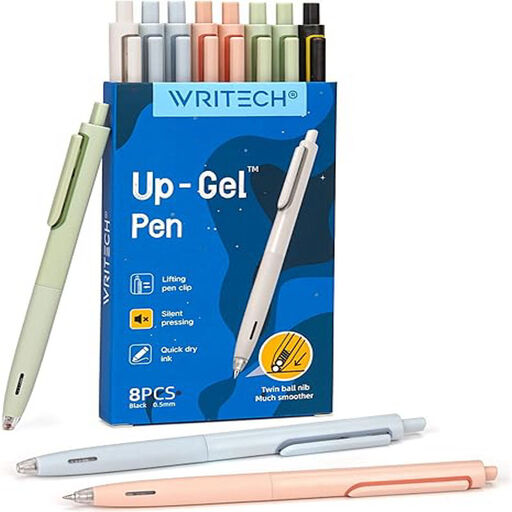
Why it stands out: This model is distinguished by its patented silent click mechanism and a special tip technology that ensures an exceptionally smooth writing experience.
Pros:
Who it's for: Creatives who need pens for journaling or sketching, as well as anyone who works in a quiet environment and values precision and a silent mechanism.
If your needs aren't fully met here or you're looking for other colours and designs, you can find a wider range of models in our main category.
? Explore the full selection of black gel pens here.
1. What is the difference between a gel pen and a fineliner? A gel pen uses a pigmented, water-based gel ink and a rolling ball tip. This creates a very fluid, gliding writing feel and bold colours. A fineliner typically has a fine tip made of fibre or plastic and uses a thinner ink. It is well-suited for drawing and precise lines but can feel slightly scratchier on paper.
2. Are gel pens generally suitable for left-handers? Yes, as long as the ink is quick-drying. Left-handers push their hand across what they have just written, which is why slow-drying ink inevitably smudges. Models explicitly advertised as "quick-drying," "fast-drying," or "no-smear" are a safe bet.
3. How should I store gel pens correctly to prevent them from drying out? To maximise their lifespan, gel pens should always be stored with the tip retracted (for click mechanisms) or with the cap on. Storing them horizontally is ideal. Alternatively, they can be stored tip-down to ensure the ink stays at the ballpoint and doesn't flow back into the barrel.