
Lieferung heute & morgen

Qualitätsgarantie

Willkommens-Angebote freischalten: KOSTENLOSE Lieferung | Bis zu 80 % RABATT | Kostenlose 30-Tage-JoyPlus-Testphase
App herunterladen
An open-plan kitchen with a central island is the centerpiece of modern living. However, the joy of cooking can quickly be diminished by rising steam, grease, and odours. A black, island-mounted extractor hood is not just a functional appliance in this setting, but also a central design element. The selection is vast, and marketing promises are often lofty. As your Joybuy Product Recommendation Officer, I'll help you identify the crucial features and avoid common purchasing pitfalls.
Before you buy a kitchen extractor hood, it's essential to critically evaluate manufacturers' claims. Many buyers regret their decision because they encounter one of these three problems:
To make an informed decision, you should focus on objective, technical specifications. These three parameters are crucial for the performance and comfort of your extractor hood.
The airflow rate indicates how much air the hood can circulate per hour. This value is critical for its effectiveness. A simple formula for guidance is: Room Volume (Length x Width x Height in m) x 10 = Recommended Airflow Rate in m?/h. For an open-plan living and kitchen area, this value should be generously calculated. Pay attention to whether the specified value applies to extraction or recirculation mode, as performance in recirculation mode is often slightly lower due to filter resistance.
Ignore the advertised minimum values. What's relevant is the noise level at the highest setting you will use regularly (often called the intensive or boost setting). Values below 65 dB(A) at this level are considered comparatively quiet and allow for conversation at a normal volume while cooking. A modern and quiet island extractor hood will provide transparent data for each power level.
The type of filter determines the maintenance effort and running costs.
While there are various types, such as the under-cabinet hood or the wall-mounted hood, the island extractor requires a free-hanging design that places special demands on both aesthetics and performance.
Instead of making a blanket recommendation, we are highlighting a product tailored to a clear user profile.
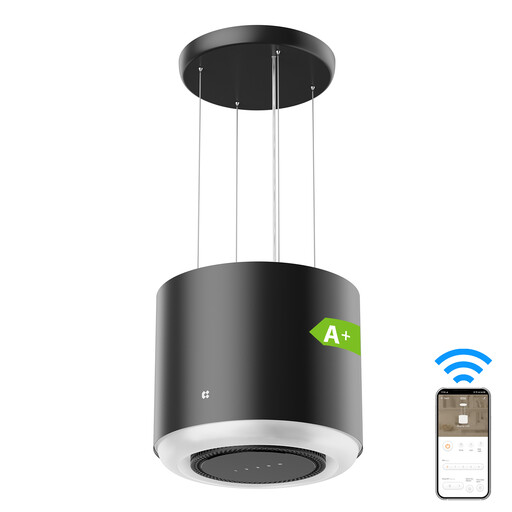
Why This Fits Their Persona: This model combines a modern, chandelier-like aesthetic with smart functionality. It is ideal for users who want to equip their open-plan kitchen with a functional design object that can be controlled via an app.
The product description transparently lists the noise level for each of the four power settings (up to 62 dB at 407 m?/h). It comes with washable aluminium grease filters and a matching activated charcoal filter, ensuring effectiveness in recirculation mode and minimizing running costs.
Advantage: Complete control via Wi-Fi and app, including adjustment of power levels and lighting. Pros: A+ energy efficiency rating and a two-level dimmable LED light for creating a pleasant atmosphere.
We have compiled a complete, up-to-date list of products that fully meet these strict selection criteria and German safety regulations.
1. How loud is a "quiet island hood" really? A good benchmark for a hood perceived as quiet is under 65 dB(A) at the highest normal operating setting. Always check the technical specifications for the value at maximum power, not the lowest value, as the latter is less relevant for practical use.
2. Do I need an external exhaust duct for an island hood? Not necessarily. There are two operating modes: extraction (ducts air outside) and recirculation (filters air and returns it to the room). A recirculating island hood is easier to install as no wall penetration is required. Modern recirculation systems with high-quality activated charcoal filters achieve very good odour elimination.
3. How often does the activated charcoal filter need to be replaced in a recirculation hood? This largely depends on your cooking intensity. As a rule of thumb, replacement is needed every 3 to 6 months. Some models use regenerable filters that can be "refreshed" in the oven and have a longer lifespan. A smart extractor hood can indicate the optimal time for a change, taking the guesswork out of maintenance.