
Lieferung heute & morgen

Qualitätsgarantie

Willkommens-Angebote freischalten: KOSTENLOSE Lieferung | Bis zu 80 % RABATT | Kostenlose 30-Tage-JoyPlus-Testphase
App herunterladen
A wall mirror with a black metal frame is more than just a functional necessity; it's a central design element that can add structure, depth, and a modern character to a room. However, the selection process is fraught with pitfalls that often only become apparent after purchase. Certain defects in material and construction can cause a seemingly high-quality mirror to lose its appeal after just a few months or even become a safety hazard. This guide highlights what you need to look out for to make an informed decision.
Many products on the market advertise with appealing images, but the reality is often quite different. Pay close attention to these three weak points to avoid disappointment.
To avoid the problems mentioned above, you should check a few technical specifications before buying. These define the longevity and functionality of your mirror.
The frame is the defining feature of a black decorative mirror. Look for materials like powder-coated steel or aluminium. A powder coating forms a protective, uniform layer that is significantly more resistant to scratches and moisture than a simple paint job. This is especially important if you want a modern bathroom mirror, as the humidity is consistently high. The finish of the corners—whether sharply welded or smoothly rounded—is also an indicator of manufacturing quality.
The quality of the mirror depends directly on the thickness and composition of the glass. A glass thickness of 4 mm is considered a good standard for a clear, distortion-free image. Another important but often overlooked feature is a shatterproof film applied to the back. This film prevents the glass from shattering into thousands of sharp fragments in case of breakage, significantly minimising the risk of injury.
The shape of the mirror significantly influences the room's ambiance. A rectangular wall mirror creates a classic, structured look, while a mirror with rounded corners produces a softer, more organic feel. For a narrow hallway mirror, a tall, vertically oriented model is suitable as it visually elongates the space and makes it appear brighter. Measure the intended space precisely, keeping in mind that there should be enough free space around the mirror for it to achieve its full effect.
Instead of making a one-size-fits-all recommendation, we have identified products that suit different user profiles and requirements.
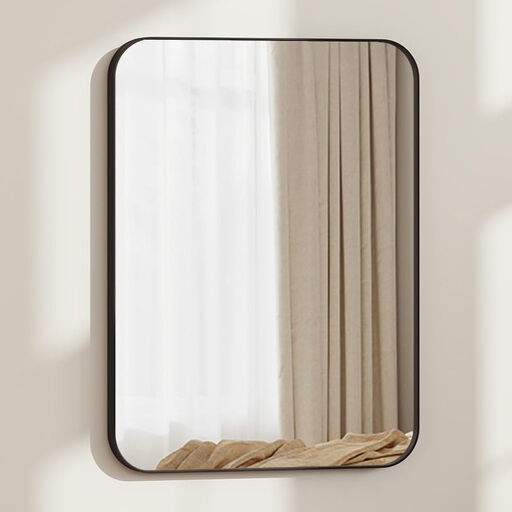
Why This Fits Their Persona: Ideal for users seeking a clean, functional, and timeless solution. The design seamlessly integrates into modern bathrooms, hallways, or bedrooms without being obtrusive.
The high-quality painted metal frame is robust. The 4 mm thick mirror glass with a shatterproof film prevents distortion and enhances safety. The included accessory kit ensures stable installation.
Can be flexibly hung vertically or horizontally. Offers a clear 1:1 reflection without distortion.

Why This Fits Their Persona: Perfect for creative minds who aren't looking for a standard solution. This set of four individual mirrors allows for custom wall installations that can be adapted to any room.
The simple adhesive mounting bypasses the problem of complex or unsuitable hanging systems. Its modular nature means you don't have to mount a single large, heavy mirror.
Infinitely expandable for custom designs. Easy to apply to various surfaces using the included adhesive strips.
We have compiled a complete, real-time list of products that fully satisfy these strict selection criteria and UK safety regulations.
1. How do you securely mount a heavy metal mirror to the wall? Safety is the top priority. First, check the composition of your wall. For solid concrete or brick walls, the included wall plugs and screws are usually sufficient. For plasterboard walls (drywall), you should use special cavity wall anchors rated for the mirror's weight. Ideally, mount the mirror to the underlying wood or metal studs. Always check the maximum load capacity of the mounting hardware.
2. Can a wall mirror with a metal frame rust in the bathroom? That depends on the material and the surface treatment. Models with a frame made of powder-coated steel or aluminium are very well protected against rust and are suitable for humid environments. Avoid untreated iron or simply painted frames, as they are prone to corrosion with prolonged exposure to moisture.
3. What mirror size is ideal for a narrow hallway? In a narrow hallway, a mirror can visually enlarge and brighten the space. A portrait-oriented, rectangular mirror (e.g., 40x100 cm) is a great choice as it emphasizes the ceiling height. Position it to reflect natural or artificial light to maximise the effect. A mirror that is too wide, on the other hand, could make the walkway feel cramped.