
Lieferung heute & morgen

Qualitätsgarantie

Willkommens-Angebote freischalten: KOSTENLOSE Lieferung | Bis zu 80 % RABATT | Kostenlose 30-Tage-JoyPlus-Testphase
App herunterladen
A blackout blind without drilling is suitable for rented flats, children’s rooms, bedrooms, offices and mobile accommodation. It can usually be fitted with less risk of leaving marks than a permanently screwed-in solution, and can be taken with you when moving home or travelling. However, mobile window coverings vary considerably in terms of material, fitting method and how effectively they block out light.
If you focus only on phrases such as “100% lightproof” or “UV protection”, you can easily overlook important details. The following points will help you choose a suitable product and avoid common buying mistakes.
An opaque surface does not automatically prevent light from entering the room at the sides. Particularly in children’s rooms or bedrooms, fabric that has been cut too narrowly can significantly reduce the desired blackout effect.
You should therefore look for:
For the window covering described, it is recommended to leave an edge of 2 to 3 cm when cutting. This overlap can help reduce gaps around the edges.
A blackout curtain with adhesive backing can be practical, but it requires a clean, suitable surface. Dust, grease, moisture, textured wallpaper or damaged window frames can affect adhesion. If the fabric is attached to an unsuitable surface, it may come loose or leave marks when removed.
Before fitting, you should therefore:
In rented flats, it is also advisable to follow the instructions provided by the landlord and the adhesive tape manufacturer.
A reflective coating can reduce the amount of solar radiation entering the room. However, it does not replace external structural shading and does not automatically maintain a constant room temperature. Its effectiveness depends, among other things, on the window size, orientation, outdoor temperature, fitting distance and edge coverage.
Heat protection for windows and solar-control film for windows have similar aims, but they are not identical. Film is usually applied permanently to the glass, while a mobile blackout curtain can be removed, folded and transported.
For mobile blackout solutions, multi-layer materials with a dense surface are a sensible choice. The product described has a silver PU-coated material on the front, while the reverse is made from 420D Oxford fabric. According to the product information, the coating is intended to reflect UV radiation and reduce heat entering the room. The reverse is described as light-blocking.
The claim “100% lightproof” should be considered in practical terms: it refers to the material under suitable fitting conditions. Light gaps can still appear at the sides, along the top edge or between adhesive strips. The material specification is therefore not the only important factor — the cut and fitting method matter too.
Measure the glass area or the section you want to cover. Take the following into account:
A piece of fabric measuring 145 × 100 cm may be sufficient for many standard windows and, according to the product description, can be cut to size. The larger 1.45 × 3 m version offers more flexibility for wide windows, several smaller areas or cutting more than once.
A mobile blind should be easy to fit without drilling or specialist tools. Adhesive strips or fastening tapes make installation easier, but they are wear-and-tear components. Removing and reattaching the blind frequently can reduce their adhesive strength.
For travellers and campers, a compact packed size and a storage bag are useful. When cleaning, a gentle clean with a soft, damp cloth is generally kinder to the material than harsh products. Before each use, check the fabric and fittings for damage. Keep the product away from naked flames and strong heat sources.
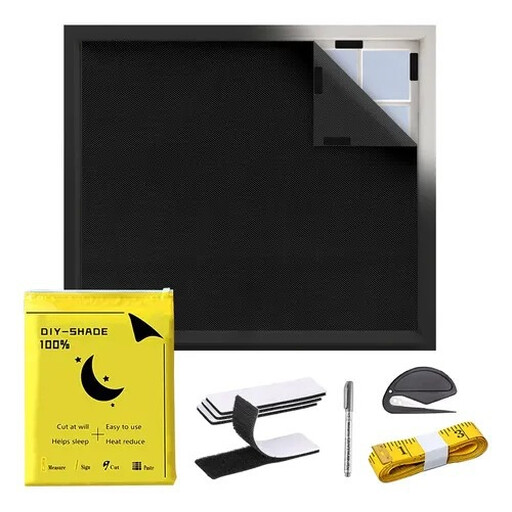
Why this product suits this profile: The 145 × 100 cm format is suitable for individual windows. The fabric can be cut to size and attached without drilling using adhesive strips.
The recommended 2 to 3 cm edge allowance takes potential gaps around the edges into account when cutting. The surface can be checked for suitability before fitting.
Cut-to-size 420D Oxford fabric, silver PU coating, adhesive strips and included storage bag.
Why this product suits this profile: The 3-metre format provides more spare material for wide windows, several rooms or a particularly generous edge allowance when cutting.
The larger area reduces the risk of having to buy again because the material was cut too narrowly. Even so, you should calculate the dimensions and edge allowance in advance.
1.45 × 3 m of material for flexible cutting and different window sizes.
Why this product suits this profile: For campers, travellers and holiday accommodation, a foldable blackout curtain with a storage bag is a practical option when permanent installation is not wanted.
It can be folded and stored for transport between uses. However, according to the product information, it is not intended for uneven or damaged surfaces.
Generous material dimensions, foldable design, mobile storage and no drill required.
We have put together a complete, regularly updated list of products that fully meet these strict selection criteria and the safety regulations applicable in the EU.
First, measure the area you want to cover. Then cut the material to the required size, leaving the recommended edge allowance wherever possible. Clean and dry the window area before applying the adhesive strips.
Press the fabric down section by section, then check whether any creases or uncovered areas have appeared. With a blackout blind for a motorhome or a mobile blackout curtain, check before setting off that all fastening points are secure. During use, keep a sufficient distance from naked flames and strong heat sources.
Its lifespan depends on the material, exposure to sunlight, temperature, cleaning and the surface to which it is attached. Adhesive strips can lose their grip through frequent removal, dust or moisture. Check the fittings regularly and replace damaged strips or fabric.
This cannot be guaranteed in every case. Residue depends on the adhesive, how long it remains in place and the underlying surface. Test the fitting first in an inconspicuous area and remove the strips slowly, following the manufacturer’s instructions. Take particular care with delicate, painted or recently renovated surfaces.
Such a product can be used as an opaque window covering, provided it is securely fitted and has no loose parts or accessible cords. It is not a toy and should be kept away from naked flames, heat sources and children. Check the fabric and fittings for damage before every use.