
Lieferung heute & morgen

Qualitätsgarantie

Willkommens-Angebote freischalten: KOSTENLOSE Lieferung | Bis zu 80 % RABATT | Kostenlose 30-Tage-JoyPlus-Testphase
App herunterladen
A blackout blind without drilling can quickly screen a bedroom, children’s room, home office, rented flat or motorhome. However, portable window coverings vary considerably in their materials, fixings and light-blocking ability. If you focus only on an opaque surface or a low price, you may not spot potential drawbacks until it’s time to install it.
Retailers sometimes use the terms blackout, privacy screen and sun protection interchangeably. An opaque window covering prevents people from seeing in, but it won’t necessarily make the room completely dark. If you’re buying for a bedroom or children’s room, check whether the retailer provides specific information about how much light the product blocks.
The edges matter too. If a blind is cut too narrow, light can creep in at the sides. With a self-adhesive option, it’s a good idea to measure the window carefully and allow enough overlap.
A stick-on blind needs a clean, dry and as even as possible contact surface. Dust, grease, moisture or an uneven window surface can affect how well it sticks. Fixings may also be less reliable on damaged or textured surfaces.
Before fitting, clean the window frame or glass as instructed and allow it to dry completely. If you’re renting, it’s also worth testing the adhesive strips in an inconspicuous spot first.
“Fits standard windows” is no substitute for measuring accurately. Windows in older properties, loft rooms, motorhomes or hotel rooms can vary considerably in size. A portable blackout blind that can be cut to size offers more flexibility than a fixed, ready-made size.
For effective window sun protection, the product’s material description should be clear. The product listed at 145 x 100 cm has a silver PU coating on the front and 420D Oxford fabric on the back, according to its product description. The coating is designed to reflect UV rays and reduce heat build-up in the room. The product description also states that it blocks out all light.
These details refer to the product’s features and do not indicate any medical or therapeutic effect. For a practical comparison, check the following:
A thermal curtain can also help provide cover, but it often needs a curtain pole or another fixed hanging point. For rented homes, travel and camping, a foldable sunshade with adhesive strips is often easier to use.
Measure the window in several places, as the frame and glass may not be exactly the same width. For a model that can be cut to size, we recommend allowing an overlap of around 2 to 3 cm when trimming. This can help reduce light coming in at the edges.
The 145 x 100 cm blackout option is suitable for small to medium-sized windows and can be cut to the required shape, according to the product description. A 1.45 x 3 m size, on the other hand, provides more material for several smaller windows or unusual shapes.
A blackout blind without drilling should be installable without specialist tools. Before you buy, check whether adhesive strips, fixings and, if applicable, a storage bag are included. If you move around frequently, a compact, foldable design with a bag is handy.
When removing it, don’t pull sharply on the fabric. Depending on the surface, adhesive strips may leave residue or affect delicate coatings. Careful removal is particularly important in rented homes.
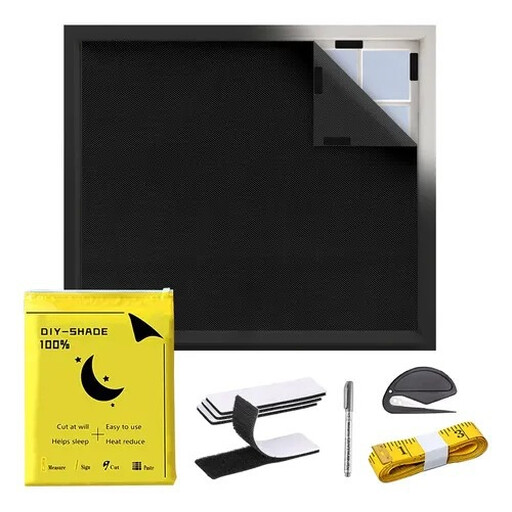
Why this product suits this user type: The 1.45 x 3 m size can be cut to fit several smaller windows or made to cover individual areas. It’s suitable for renters who want to add temporary privacy and sun protection without using a drill.
The generous length reduces the risk of having to put up with visible gaps at the edges because a ready-made size doesn’t fit. You’ll still need to measure carefully before buying.
UV-blocking window-covering fabric; 1.45 x 3 m for flexible trimming.
Why this product suits this user type: The combination of a silver PU coating, 420D Oxford fabric, adhesive strips and a travel bag is a good fit for anyone comparing material details, portability and a set size of 145 x 100 cm.
The product description clearly sets out the material, dimensions, fitting method and care instructions. This makes it easier to check whether the design is right for your window and its surface.
420D Oxford fabric backing; cut-to-size design, adhesive strips and storage bag, according to the product description.
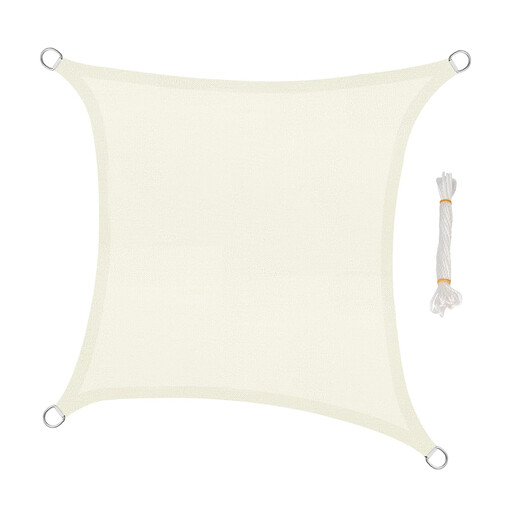
Why this product suits this user type: This shade sail is designed for balconies, gardens, pools or patios, not as a traditional indoor blind. It’s a good option for anyone looking to add shade to a permanent outdoor space as well.
Its clearly stated outdoor use helps prevent it being bought by mistake as an opaque window covering for a bedroom or children’s room.
HDPE or PES design; reinforced corners, stainless steel rings and ropes included, according to the product description.
We’ve put together a complete, regularly updated list of products that meet these strict selection criteria and fully comply with the safety regulations in force in the EU.
On windows that get direct sunlight, an internal covering can help reduce heat build-up, but it’s no substitute for building work or adequate ventilation. In children’s rooms, keep loose parts and fixings out of children’s reach.
First, clean and dry the window area. Then measure the material, cut it to size if needed and attach it to the window frame or glass using the adhesive strips provided. The surface should be smooth and undamaged. Before using the blind, check that the fixings are secure.
How long it lasts depends on factors such as the surface, temperature, moisture, exposure to sunlight and the strain caused by repeated removal. It’s therefore not possible to give a general lifespan. Check the adhesive strips and fabric regularly for signs of damage or a weaker hold.
Foldable models with a storage bag can be suitable for motorhomes, hotels, camping and rented homes, as long as the dimensions and surface are right. Before fitting, check delicate surfaces and make sure the fixings are secure each time you move.