
Lieferung heute & morgen

Qualitätsgarantie

Willkommens-Angebote freischalten: KOSTENLOSE Lieferung | Bis zu 80 % RABATT | Kostenlose 30-Tage-JoyPlus-Testphase
App herunterladen
Undisturbed sleep or a glare-free screen are often just one curtain away. However, choosing the right blackout curtain is more complex than it seems. Many products promise more than they deliver, leading to disappointment. As your Joybuy Product Recommendation Officer, I'll help you identify the crucial features and avoid making the wrong choice.
Before you make a decision, you should be aware of the common pitfalls that often lead to unsuitable purchases.
To find the right curtain for your needs, focus on these three objective criteria.
The degree of darkness depends directly on the colour and weave of the fabric. Darker colours like black or dark grey naturally absorb more light than a lighter shade like white or beige.
A key feature of high-quality blackout fabrics is Triple-Weave Technology. This process involves weaving a black thread layer between two outer fabric layers. This middle layer is the core of the blackout function and contributes significantly to blocking light. At the same time, this dense structure improves the thermal properties, allowing the curtain to also function as a thermal curtain that keeps warmth in during the winter and blocks heat in the summer.
The fabric weight is a direct indicator of the curtain's density and quality.
Polyester is the most commonly used material as it is easy to care for, durable, and colourfast. Models with a linen-look offer an appealing aesthetic but are often also based on a robust polyester fibre.
The choice of hanging style determines not only the look but also the functionality.
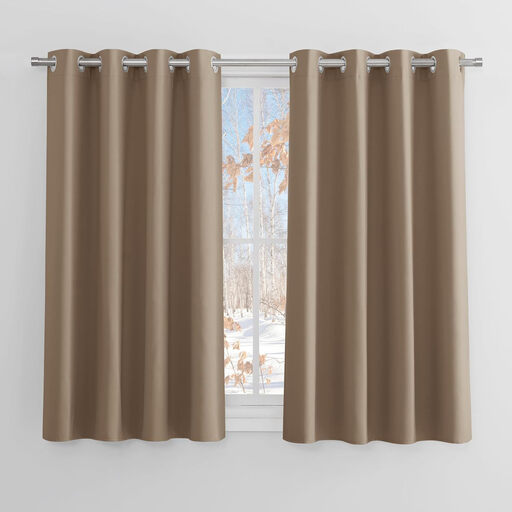
Why This Fits Their Persona: This set of 2 is a hassle-free, all-in-one solution for standard windows. The eyelet mounting requires no special skills or tools beyond a curtain rod—ideal for rental properties where simple installation and removal are key.
The product states a realistic blackout level of 80–95%, avoiding exaggerated promises. The fabric weight of 230 GSM ensures the curtain not only darkens the room but also provides thermal insulation.
The Triple-Weave Technology provides effective light reduction and energy efficiency. Delivered as a set of 2, it offers excellent value for money.
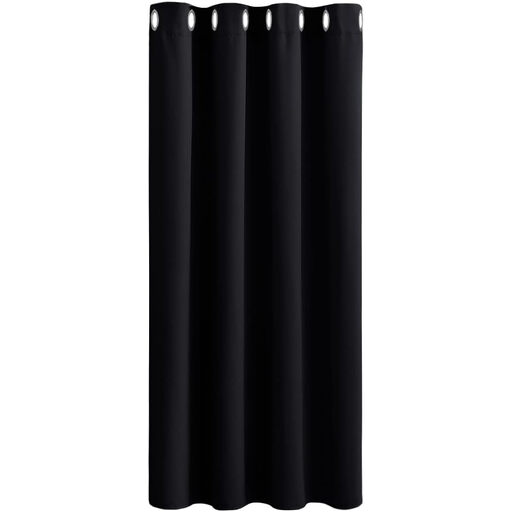
Why This Fits Their Persona: For those who need to sleep during the day, maximum light reduction is essential. This black curtain uses its colour and Triple-Weave Technology to achieve an 85–95% light blockage. The dense fabric also acts as a noise-reducing curtain, dampening disruptive outside sounds.
Instead of an unrealistic 100%, a clear range for the blackout level is provided. The function is based on verifiable Triple-Weave Technology and the dark colour, not on empty marketing promises.
Maximum light absorption due to the black colour. The dense weave contributes to noise reduction and thermal insulation, enhancing sleep comfort in the bedroom.
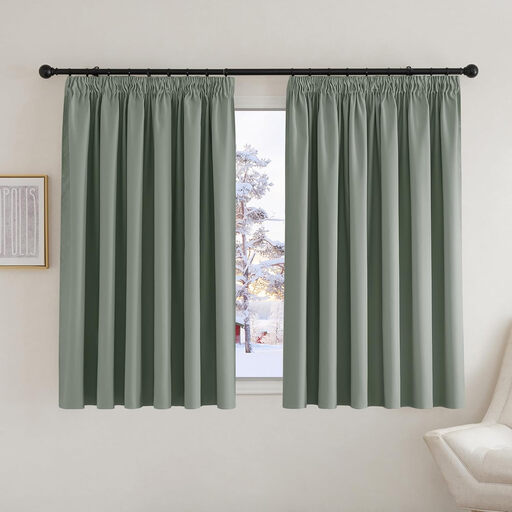
Why This Fits Their Persona: Those who value elegant and flexible interior design will benefit from the pencil pleat heading. It allows for custom pleating and mounting on both track and rod systems. The sage green colour and high-quality feel blend seamlessly into sophisticated living concepts.
This model solves the incompatibility problem, as the pencil pleat heading is suitable for almost any common hanging system. You won't accidentally buy a product that doesn't fit your existing track.
High flexibility in mounting and pleating. The fabric, made from recycled polyester with 85–95% blackout, combines aesthetics with functionality and sustainability.
We have compiled a complete, up-to-date list of products that meet these strict selection criteria.
1. How do I measure correctly for a blackout curtain? First, measure the width of your curtain rod or track. For an attractive pleat, the total width of the curtains should be 1.5 to 2.5 times the width of the rod. For the length, measure from the top of the rod or track to your desired endpoint (e.g., windowsill or floor). For eyelet curtains, remember that the fabric starts about 2-3 cm above the rod.
2. Can a thermal curtain really save on heating costs? Yes, a thick thermal curtain can help reduce energy consumption. The dense fabric creates an insulating air layer in front of the window, which reduces heat loss in winter and slows the entry of heat in summer. This leads to a more stable room temperature and can reduce the need for heating or air conditioning. An exact saving cannot be universally quantified, as it depends on many factors like window quality and outside temperature.