
Lieferung heute & morgen

Qualitätsgarantie

Willkommens-Angebote freischalten: KOSTENLOSE Lieferung | Bis zu 80 % RABATT | Kostenlose 30-Tage-JoyPlus-Testphase
App herunterladen
A blackout pleated blind without drilling can quickly provide rented homes, bedrooms and offices with privacy and protection from the sun. However, inaccurate measurements, unsuitable clamp brackets and exaggerated claims often lead to the wrong purchase. The key is not just the colour, but the combination of fitting method, fabric construction, dimensions and operation.
A semi-transparent pleated blind reduces visibility from outside and cuts glare from bright sunlight, but still lets daylight through. For example, the light grey Dream-Seeker model is described as having semi-opaque, light-filtering fabric. For a bedroom where you want to keep residual light to a minimum, look instead for a model explicitly described as blackout, lightproof or room-darkening.
Even a blackout pleated blind may let light in around the sides of the window. Fitting it directly to the window sash and choosing a suitable width can improve coverage, but won’t automatically block light at the sides.
With no-drill models, the stated measurement may refer to the entire product, including the brackets. According to the product description, the fabric on the WOLTU thermal roller blind 80 x 150 cm is approximately 4 cm narrower than the overall width. If you measure only the glass, you may therefore order a blind that is too narrow.
Before buying, check the following:
A pleated blind without drilling needs a sturdy, accessible frame. The acceptable frame thickness varies by model. WOLTU honeycomb pleated blinds are designed for frames measuring 10 to 23 mm, while the WOLTU thermal roller blind specifies a frame thickness of 16 to 22 mm for clamp fitting.
Clamp fittings may not be suitable for very narrow, sharply angled or delicate frames. Adhesive surfaces must also be clean, dry and dust-free. Otherwise, the adhesive may lose its grip.
A light-filtering fabric is often enough for a living room, kitchen or home office: it improves privacy while letting in soft daylight. For bedrooms, media rooms or children’s rooms, a lightproof pleated blind with a coated backing is a more practical choice.
A thermal honeycomb pleated blind has a double-layer, honeycomb-style fabric construction. According to the product descriptions for the WOLTU models mentioned, this construction helps regulate heat and can reduce outside noise. However, the actual effect depends on the window, wall, fitting and room, and shouldn’t be taken as a guarantee of noise reduction or energy savings.
Models with top and bottom rails can be positioned flexibly. You can close the upper section and let daylight in below, or do the reverse. Cordless options with a handle, such as the WOLTU thermal roller blind, reduce the number of loose operating parts around children and pets.
Even so, keep small fitting parts out of children’s reach. For products with a pull cord, follow the relevant fitting instructions.
Polyester is the main fabric used in the products mentioned. It can be wiped clean and is suitable for rooms with normal indoor humidity. For bathrooms, also look for a moisture-resistant surface. These blinds can usually be cleaned with a slightly damp cloth; harsh cleaning products may damage the coatings and colours.
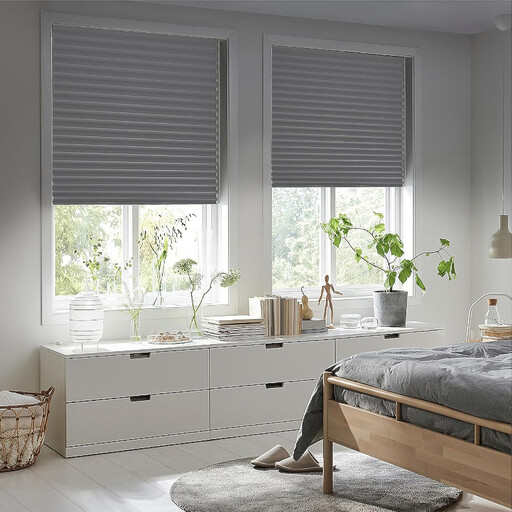
Why this product suits you: The light-filtering fabric is a good choice for living rooms, kitchens or offices where you want privacy and softer light, without making the room too dark.
The product description clearly identifies the semi-transparent fabric, so it won’t be mistaken for a lightproof blackout model.
100 x 130 cm, clamp or adhesive fitting, light grey polyester fabric and cleaning with a damp cloth.

Why this product suits you: The double-layer honeycomb fabric, metal frame and infinitely adjustable top and bottom rails appeal to buyers who value construction and flexibility.
The stated frame range of 10–23 mm makes it easy to check compatibility before ordering.
100% polyester, metal frame, clamp fitting and moisture-resistant, wipe-clean fabric according to the product details.

Why this product suits you: Suitable for bedrooms, children’s rooms, bathrooms or doors, this cordless roller blind is operated with a handle and has a coated backing to reduce light.
The product details specify both the suitable frame thickness of 16–22 mm and the difference between the overall width and fabric width.
Cordless handle operation, 200 g/m² polyester, clamp or drill fitting and a silver-coated backing according to the product description.
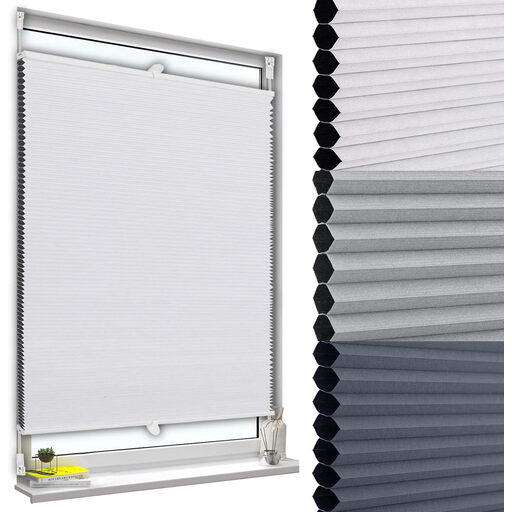
Why this product suits you: The 80 x 120 cm size may suit windows or doors of the same dimensions, provided you check the frame, handles and clearance first.
The manufacturer recommends measuring the full window frame for width and height, while avoiding any overlap with handles.
80 x 120 cm, two-tone honeycomb fabric, top and bottom operating rails and clamp brackets for 10–23 mm frames.
We’ve put together a complete, regularly updated list of products that meet these strict selection criteria and fully comply with the safety regulations in force in the EU.
Depending on the model, it is fitted either with adjustable clamp brackets on the window frame or with adhesive strips. For clamp-fit pleated blinds, choosing the right frame thickness is essential. Read the fitting instructions in full before installing the blind.
Its lifespan depends on fabric quality, exposure to sunlight, humidity and how it is operated. Opening and closing it carefully, wiping it down regularly and avoiding harsh cleaners can help protect the fabric surface. Without information from the manufacturer, it isn’t possible to give a reliable general estimate of its lifespan.
Coated fabrics and honeycomb structures can affect the amount of heat entering through a window. However, the result depends on factors including the glazing, window aspect, room ventilation and fitting distance. A thermal roller blind should therefore be viewed as an additional window blind for sun protection, not a substitute for structural insulation.