
Lieferung heute & morgen

Qualitätsgarantie

Willkommens-Angebote freischalten: KOSTENLOSE Lieferung | Bis zu 80 % RABATT | Kostenlose 30-Tage-JoyPlus-Testphase
App herunterladen
A blackout roller blind no drill can protect rented flats, children’s rooms, bedrooms and offices from light and prying eyes without any fuss. Yet many clamp-fit models don’t fit the window properly once unpacked. The problem often isn’t the blind itself, but inaccurate measurements, unsuitable window frames or misleading information about blackout performance.
With many roller blinds, the stated width includes not just the fabric but also the brackets and side parts. For the WOLTU blackout roller blind, the fabric panel is approximately 4 cm narrower than the overall width, according to the product details. So a blind with an 80 cm external measurement does not provide an 80 cm wide blackout surface.
To minimise light seepage at the sides, the order width should be roughly 4 cm wider than the glass width. At the same time, you must ensure that window handles, seals and protruding parts are not obstructed.
An opaque blind can darken the fabric area significantly. However, light gaps can still appear at the sides, top and bottom. The actual effect therefore depends on the fabric width, the position on the window and the brightness of the room.
Claims such as “100 % blackout” or “100 % light-blocking” should be understood as manufacturer specifications. They usually refer to the light permeability of the material and not necessarily to a completely light-free room situation.
A roller blind with clamp brackets requires a suitable window frame. Different models have different requirements:
Before buying, you should measure the thickness of the movable window sash. Roof windows, wooden frames and certain sliding or fixed glazing are excluded for some products. A clamp-fit roller blind is therefore not automatically suitable for every window or balcony door.
For bedrooms or rooms with a computer workstation, an opaque fabric with a coated backing is ideal. A silver-coloured backing can reflect light and reduce solar gain, according to product descriptions. For living rooms, bathrooms or kitchens, on the other hand, an internal sun protection roller blind with a light-filtering fabric may be sufficient.
Double roller blinds work with alternating transparent and opaque stripes. By shifting the fabric layers, you can adjust the light entry. This solution offers flexible privacy but does not achieve the same level of full-surface darkening as a closed blackout roller blind.
Polyester is widely used for indoor roller blinds. Look for specific details on:
The WOLTU blackout roller blind is specified with 200 g/m² polyester and OEKO-TEX certification. According to the product description, the fabric is water-repellent and tear-resistant. A certification should always be linked to the specific product; it is not a blanket guarantee of all a blind’s properties.
A cordless roller blind with a control handle on the bottom rail reduces loose cords around the window area. This can be practical for families with children or pets. With a chain-operated model, on the other hand, the supplied chain tensioner must be correctly fitted. Loose cords and small parts should be kept out of reach of children.
A roller blind is not a substitute for supervision. After installation, check that the brackets are secure and that the window sash can still be opened or tilted without any issues.

Why this product fits the profile: The size suits many standard windows. The clamp-fit system allows installation without a drill, provided the frame is 16–22 mm thick.
The fabric width is considered separately. Before ordering, you can check against the glass width to see if there is enough side overlap.
200 g/m² polyester, silver-coated backing, operation via the bottom aluminium handle and optional screw mounting.

Why this product fits the profile: The double honeycomb structure combines adjustable positioning with claims for light, sun and thermal protection. Suitable for windows and doors with a 10–23 mm frame thickness.
The clamp brackets are designed for a defined frame range. This means compatibility can be checked specifically before purchase.
100 % polyester, metal frame, moisture-repellent fabric and control handles at the top and bottom, according to the product description.
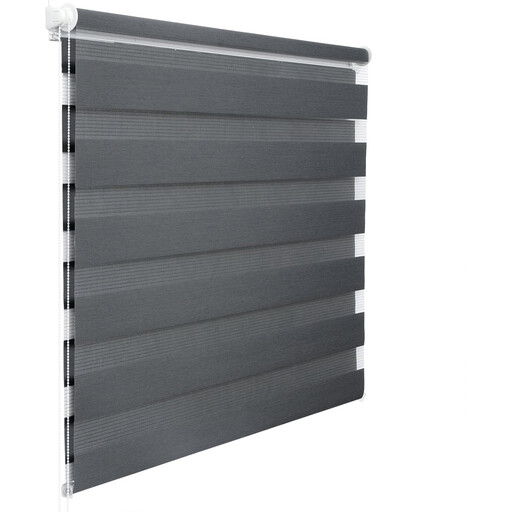
Why this product fits the profile: The alternating transparent and opaque stripes allow flexible light control in living rooms, kitchens, bathrooms, children’s rooms or offices.
It is not marketed as a blackout roller blind for every situation: the stripe structure is designed for variable light regulation rather than continuous darkening.
Clamp mounting for frames of 13–23 mm, chain pull can be fitted on the left or right, and cleaning with a damp cloth or soft brush.
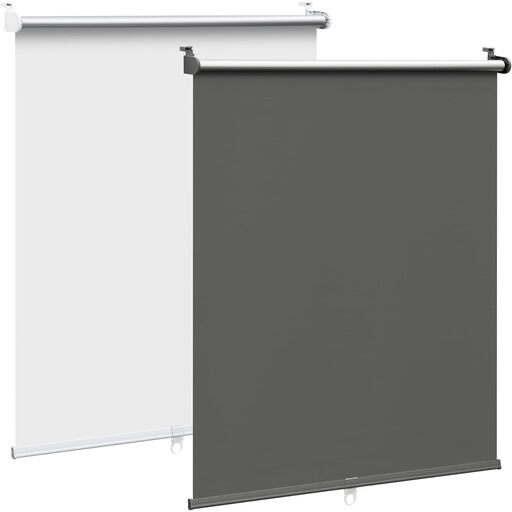
Why this product fits the profile: The cordless operation via the bottom handle avoids a dangling pull cord and is suitable for bedrooms, children’s rooms and living areas.
The product description highlights the required frame thickness of 16–22 mm and the fabric panel being approximately 4 cm narrower. Both points can be checked before purchase.
According to the manufacturer, opaque polyester fabric with silver-coated backing, water-repellent surface and cordless control handle.
For a roller blind 80x150 cm, the window size should therefore be chosen not just by the name, but based on glass width, frame measurement and fabric overlap. For larger windows or balcony doors, multiple blinds or special sizes may be more suitable.
We have compiled a complete, regularly updated list of products that fully meet these strict selection criteria and the safety regulations in force in the EU.
A clamp-fit roller blind is attached to the top of the window frame using clamp brackets. No tools are required. The prerequisite is that the frame thickness and window type match the specific model. Depending on the product, screw mounting may also be an option.
The lifespan depends on the material, mechanism, installation and operation. Smooth operation, avoiding overloading and cleaning according to the instructions can help maintain function. Without a specific manufacturer’s statement, it is not possible to give a reliable fixed service life.
A coated fabric can reflect sunlight and reduce heat gain, according to product descriptions. However, the actual room temperature also depends on the window area, orientation, glazing, ventilation and installation. A thermal roller blind should therefore be seen as a supplementary sun protection measure, not a replacement for structural insulation or air conditioning.