
Lieferung heute & morgen

Qualitätsgarantie

Willkommens-Angebote freischalten: KOSTENLOSE Lieferung | Bis zu 80 % RABATT | Kostenlose 30-Tage-JoyPlus-Testphase
App herunterladen
A stand blender is an indispensable tool in many kitchens. Whether for morning smoothies, creamy soups, or baby food, its applications are diverse. However, the market is crowded and filled with marketing promises that often create more confusion than clarity. Many buyers quickly discover that their new appliance can't handle daily demands, is difficult to clean, or was simply overkill for their needs.
As your Joybuy Product Recommendation Officer, I'm here to help you avoid the common pitfalls. We'll focus on the objective criteria that truly matter, enabling you to make an informed decision.
Before we dive into the key features, let's look at the most common missteps that lead to disappointment.
To find the right blender for your needs, you should focus on a few, but critical, technical features.
Motor power, specified in watts, is the foundation. For most everyday tasks like making smoothies or shakes, a blender with 500W to 800W is perfectly sufficient. More important, however, is how that power is transferred to the blades. A high number of rotations per minute (RPM) combined with sharp, robust stainless steel blades ensures fine and consistent results. A good appliance should also feature variable speed settings and a pulse function. This is especially useful for crushing hard ingredients like ice cubes and gives you more control over the texture. A blender for crushing ice needs this function for optimal results.
The blender jar is the heart of the appliance. Here, you have the choice between glass and plastic.
The capacity should match your household size. For singles or couples, a volume of 1 litre is often sufficient. For families or if you plan to prepare larger batches, a blender with 1.2L or more is a sensible choice.
Some models offer more than just blending. An integrated blender with a grinding function significantly expands its range of uses. With special attachments, you can freshly grind coffee beans, nuts, or spices. This not only saves kitchen space but also the cost of a separate appliance. Check if such accessories are included in the box.
Here are our recommendations, tailored to different use cases.
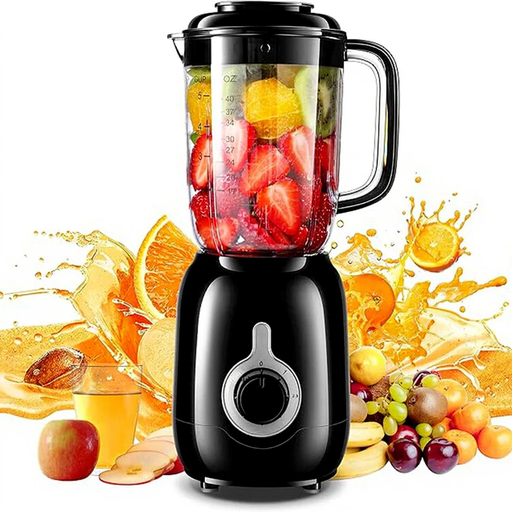
Why This Fits Their Persona: This model is ideal for health-conscious individuals and small families who prepare fresh drinks daily. The combination of a 1.2-litre capacity and a 500-watt motor offers balanced performance for most standard tasks without being overkill.
The Bear blender avoids the wattage trap by offering an efficient 500W of power, which is perfectly sufficient for smoothies and shakes. The included grinding and chopping cups eliminate the need for separate appliances.
Versatility: Includes grinding and chopping cups for spices, nuts, or meat. Easy Cleaning: The pulse function can be used with water and dish soap for quick self-cleaning.
Why This Fits Their Persona: For ambitious home cooks who want to make nut butter, prepare hot soups directly in the blender, or pulverise fibrous greens like kale. This requires high power (>1000W) and a robust construction.
This class of appliance justifies its high wattage with a robust motor and high-quality components designed for continuous use. It helps you avoid buying a standard model that would overheat or fail with tough ingredients.
Maximum Power: Effortlessly crushes ice, frozen fruit, and nuts. Durability: Often equipped with a metal drivetrain and durable jars made of glass or Tritan.
Why This Fits Their Persona: Ideal for singles, students, or anyone with limited kitchen space. These appliances are designed for preparing single portions, and the blending jar often doubles as a to-go bottle.
You avoid buying a large, bulky blender that is oversized for daily individual use and takes up valuable counter space. The focus here is on convenience and efficiency for one person.
Space-Saving: Compact design that fits on any countertop. Convenient: The blending jar is often dishwasher-safe and can be used as a travel cup.
We have compiled a complete, up-to-date list of products that fully meet these strict selection criteria and all relevant safety regulations.
For most applications like smoothies, shakes, and light soups, 500 to 800 watts is generally sufficient, provided the blade design is efficient. For regularly crushing very hard ingredients, like turning nuts into butter or blending large amounts of ice, models with 1000 watts or more are recommended.
No. Only blenders with a jar made of glass or a heat-resistant specialist plastic (e.g., Tritan) are suitable for hot liquids. With standard plastic jars, there is a risk that they could warp or release chemicals. Always follow the manufacturer's instructions.
The easiest method is self-cleaning. Fill the jar halfway with warm water and add a drop of dish soap. Run the blender on its highest setting for about 30 seconds, then rinse. For a thorough cleaning, removable parts should be placed in the dishwasher or washed by hand, if specified by the manufacturer.