
Lieferung heute & morgen

Qualitätsgarantie

Willkommens-Angebote freischalten: KOSTENLOSE Lieferung | Bis zu 80 % RABATT | Kostenlose 30-Tage-JoyPlus-Testphase
App herunterladen
The search for the right stand blender can quickly become overwhelming. Manufacturers advertise high wattages, countless features, and lofty promises. But not every expensive appliance delivers, and not every affordable model is a good buy. In daily use, many blenders prove to be impractical, difficult to clean, or simply too weak for the job. This guide will help you identify the crucial features and avoid three common pitfalls when buying a blender.
Before you choose a model, you should be aware of the most common issues that often only become apparent after the purchase.
universal blender or a food processor with a blending function sound tempting. In practice, the blender attachments are often a compromise. They rarely achieve the performance and fine blending results of a dedicated stand blender, especially for demanding tasks like grinding nuts or crushing frozen fruit.Focus on the following three objective criteria to find an appliance that meets your needs.
The power, specified in watts, is a benchmark for the motor's strength. Your intended use is the deciding factor:
smoothie maker that can also handle frozen fruit and tougher vegetables.high-performance blender designed to process fibrous leafy greens, nuts, seeds, and ice cubes into a perfectly smooth consistency. Models with an explicit blender with an ice crush function usually fall into this category.However, power alone isn't everything. The quality and shape of the stainless steel blades are just as important. Multiple blades at different levels create a better vortex and ensure a more consistent result.
The choice of blender jar affects its durability, handling, and hygiene.
The capacity should match your household size. For individuals or couples, a volume of under 1 litre is often sufficient. Families or those who prepare larger batches should consider a model with 1.5 litres or more.
Additional features and accessories should offer real added value. An extra small blending container for pesto or a to-go cup can be practical. A pulse function provides better control over the texture. For easy daily use, straightforward cleaning (e.g., via a self-cleaning program or dishwasher-safe parts) and intuitive controls are crucial. An immersion blender is designed for puréeing soups directly in the pot and cannot fully replace a stand blender, but it can be a useful supplement for specific tasks.
Here are some recommendations tailored to different user profiles and the criteria mentioned above.
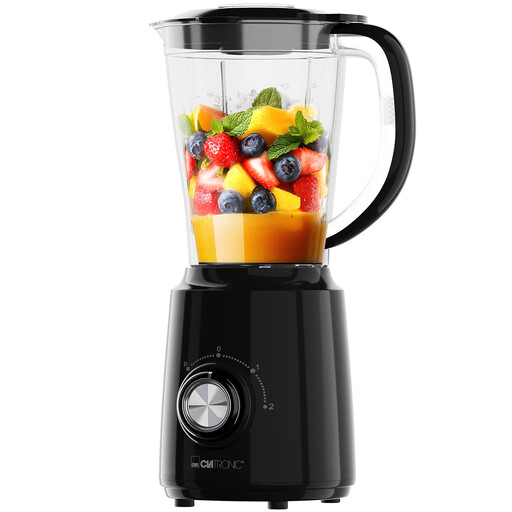
Why it's a good fit: Ideal for those who primarily want to make smoothies, shakes, or simple soups. It offers the essential functions without unnecessary complexity, making it a solid choice for beginners or occasional use.
This model focuses on the core function of blending, avoiding the "all-in-one" trap. The removable blade assembly solves the problem of difficult cleaning.
Features a 1.5-litre BPA-free plastic jar, a pulse/turbo function for better control, and an ice-crush function, which is not a given in this price range.
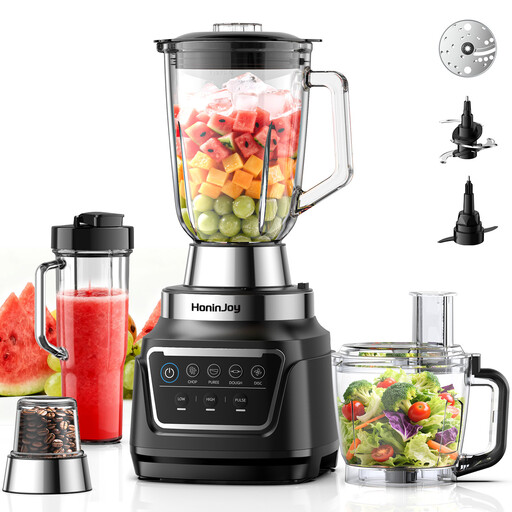
Why it's a good fit: For users seeking a versatile appliance that goes beyond simple blending. It combines the functions of a stand blender with those of a food processor for chopping, grating, and even kneading dough.
Unlike many combo devices, this model offers dedicated attachments with ample capacity (e.g., a 2-litre food processor bowl). The high motor power of up to 1300 watts ensures it can handle more demanding tasks.
Comprehensive accessory kit including a 1.5-litre glass blending jar, a 2-litre food processor bowl, and a grinding cup. Preset programs (CHOP/PUREE/DOUGH/DISC) simplify operation. All removable parts are dishwasher-safe.

Why it's a good fit: Perfect for users who regularly make plant-based milk, hot soups, or ultra-fine green smoothies. The combination of high RPM and a heating function makes it a specialist for nutrient-rich preparations.
This appliance avoids the wattage trap by relying on high RPM (36,000 according to the manufacturer) and a special jar design to achieve a fine result without needing to strain. The automatic self-cleaning function efficiently solves the cleaning issue.
Specialised programs for nut, soy, and oat milk. Integrated heating element (800 W) for soups and a keep-warm function. Delay timer (up to 12 hours) and an inner container made of food-grade 304 stainless steel.
We have compiled a complete, up-to-date list of products that fully meet these strict selection criteria and local safety regulations.
The required wattage heavily depends on the intended use. For simple smoothies with soft fruits and yoghurt, 300–500 watts is often enough. If you plan to regularly blend frozen fruit, ice cubes, or fibrous vegetables like kale, models with 600–1000 watts are a better choice. For making nut butter or grinding grains, a high-performance blender with 1200 watts or more is recommended. Keep in mind that the quality of the blades and the shape of the jar also significantly impact efficiency.
Both materials have their pros and cons. A glass jar is very hygienic, as it doesn't absorb odours or stains, and its weight provides a stable base. However, it is prone to breaking. A jar made of BPA-free plastic (like Tritan) is significantly lighter and shatterproof, which makes handling easier. With highly pigmented foods like turmeric or carrots, slight staining can occur over time. The choice is ultimately a trade-off between weight, durability, and long-term aesthetics.
An immersion blender (or hand blender) and a stand blender are optimised for different tasks. An immersion blender is excellent for puréeing soups and sauces directly in the pot or for making small batches of dips and mayonnaise. A stand blender is superior when it comes to larger quantities, achieving an exceptionally fine and smooth consistency (e.g., for green smoothies), or crushing hard ingredients like ice and nuts. For creamy smoothies, a stand blender is generally the more suitable choice.