
Lieferung heute & morgen

Qualitätsgarantie

Willkommens-Angebote freischalten: KOSTENLOSE Lieferung | Bis zu 80 % RABATT | Kostenlose 30-Tage-JoyPlus-Testphase
App herunterladen
A blender should reliably process smoothies, soups, purées and ingredients for family meals. The range extends from compact smoothie makers to comprehensive multifunction blenders with choppers and whisks. However, high wattage, numerous accessories and terms such as “high-speed” reveal little about how practical a device is in everyday use.
The following criteria help you assess marketing claims and select a model suited to your household.
Motor power is a useful technical reference, but it is not the only factor that matters. Blade design, jug geometry, fill volume and operating time also affect the results. A high-performance blender with a large jug may be suitable for frozen ingredients, while a compact personal blender with a lower rated output may be more practical for individual servings.
It is also important to distinguish between rated power and the maximum motor output advertised by the manufacturer. Buyers should compare the specifications in the product description and user manual.
For a dishwasher-safe blender, this statement generally applies to removable jugs, lids, blade attachments or accessories. The motor unit must never be immersed in water. With a hand blender, only the removable blending shaft should be cleaned as described in the instructions.
Underestimating cleaning requirements can lead to residue around seals, blade mounts or connection points. A design that can be disassembled, together with clear care instructions, is therefore more valuable than a marketing claim promising particularly easy cleaning.
A blender with chopper or blender with whisk can handle several kitchen tasks. What matters, however, is whether the attachments suit your intended use. A small chopper is better suited to herbs, onions or smaller quantities. For larger family portions, a container with greater capacity is the more sensible choice.
Do not compare wattage alone. Also consider:
A blender for smoothies and soups is not automatically designed to process boiling-hot liquids. Check the permitted temperature range. The WMF Küchenminis Smoothie-to-Go, for example, specifies a maximum temperature of 60 °C.
For individual servings, 300 to 600 ml is often sufficient. Families are more likely to benefit from 1.2 to 1.8 litres, provided there is enough counter and storage space. Containers made from Tritan, plastic or stainless steel differ in weight, impact resistance and care requirements. For plastic containers, specifications such as BPA-free construction and the recommended cleaning method are relevant.
Dimensions should also be checked: a tall countertop blender will not fit beneath every wall cabinet. A compact model may be the better choice for small kitchens, student accommodation or the office.
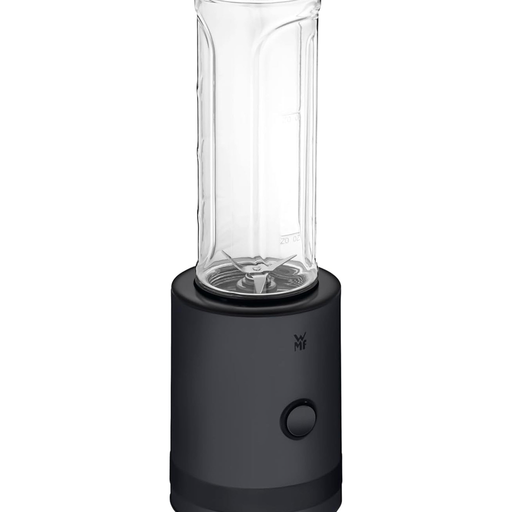
Why does it suit this profile? This compact 300-watt model comes with two 0.6-litre containers that can also be used as drinking vessels. That makes it practical for professionals, students and smaller households with limited storage space.
The capacity and maximum operating temperature are clearly specified. The containers and lids are dishwasher-safe; the motor unit should only be wiped clean.
23,000 rpm according to the product specifications, four stainless-steel blades, safety shut-off and two containers with leak-proof screw lids.
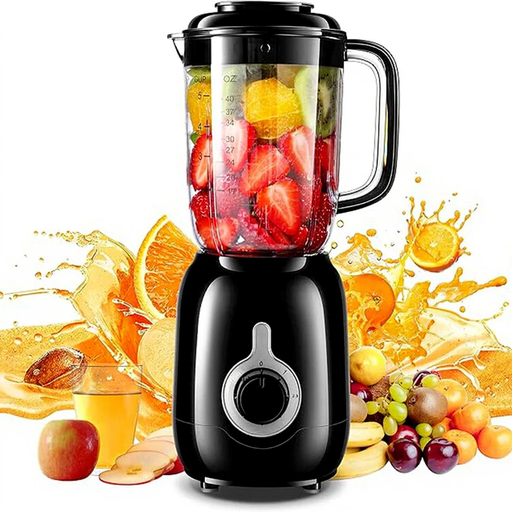
Why does it suit this profile? The countertop blender offers a 1.2-litre container along with additional grinding and chopping cups. This makes it suitable for multiple portions, smoothies, purées and preparatory kitchen tasks.
The assessment goes beyond wattage: container capacity, three speed settings, a pulse function and a safety lock are also specified.
500 watts, four stainless-steel blades, non-slip base and accessories for grinding and chopping. According to the instructions, at least 300 ml of liquid should be used.
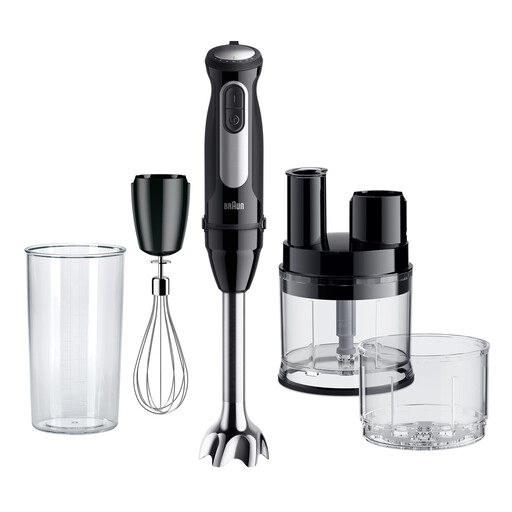
Why does it suit this profile? This hand blender is designed for a wide range of kitchen tasks: according to the product specifications, it is intended for puréeing, chopping, whisking and processing certain frozen ingredients.
The accessories are listed individually instead of being promoted solely as a “4-in-1” appliance. The product documentation also specifies 25 speed settings, a turbo mode and cleaning instructions for the removable parts.
1000 watts, PowerBell Plus blade, splash guard, whisk, chopper, ice-crushing blade and 600-ml measuring jug.
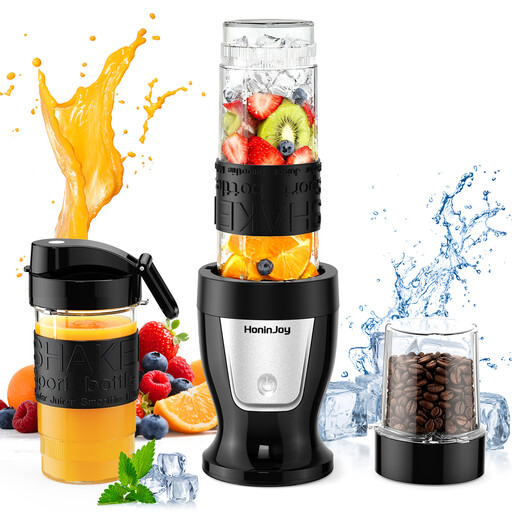
Why does it suit this profile? Two portable cups with capacities of 20 and 14 oz are designed for users who want to prepare shakes or smoothies for the office, university, gym or commute.
The model combines pulse control, overheating protection and cup-locking mechanisms. Its stated suitability for dry ingredients applies to the separate grinding cup.
650-watt peak output according to the product specifications, two BPA-free sports cups, a separate grinding cup, and dishwasher-safe cups, lids and grinding cup.
Browse and compare the full selection of appliances for compact kitchens, smoothies and versatile food preparation by design and features.
Before using the appliance for the first time, clean the containers, lids and removable attachments. Never touch the blades by hand. For electrical appliances rated at 220–240 V, cables, plugs and housings must be free from damage.
When preparing hot foods:
For individual servings, a personal blender or smoothie maker with a drinking cup is particularly convenient. Families may prefer a countertop blender with a capacity of around 1.2 litres or more. When processing frozen fruit or ice, check the blades, pulse function and the manufacturer’s approval for these ingredients.
There is no reliable one-size-fits-all estimate. Service life depends on frequency of use, ingredients, cleaning, permitted operating time and maintenance. Avoiding overloading, observing breaks and keeping the blades clear of hard foreign objects can reduce typical wear-related risks.
Consumption depends on the actual wattage and operating time. A 1000-watt appliance running for one minute uses approximately 0.017 kWh. With short blending cycles, the energy used per operation is generally limited; frequency of use and your electricity tariff are the key factors affecting running costs.