
Lieferung heute & morgen

Qualitätsgarantie

Willkommens-Angebote freischalten: KOSTENLOSE Lieferung | Bis zu 80 % RABATT | Kostenlose 30-Tage-JoyPlus-Testphase
App herunterladen
A blender should save time in everyday use and reliably deliver the consistency you want. In practice, however, poor purchases are often caused not by the price, but by unsuitable designs, confusing power specifications or accessories that are rarely used later. If you are comparing a countertop blender, hand blender, smoothie maker and personal blender, you should first decide how you intend to use it.
High motor power alone does not indicate how evenly a machine will work. The blade geometry, container design, speed settings and permitted filling quantity are also important. A compact mini blender with 350 watts may be sufficient for soft fruit and individual portions, while frozen fruit, ice or nuts require different technical capabilities.
Manufacturer specifications are not always directly comparable, either. Check whether the figure refers to rated power, maximum power consumption or a peak value. If the specifications conflict, the technical documentation for the particular model should take precedence.
A 2-litre container is practical for family-sized portions, but it requires more worktop space and is harder to store. A 600- or 700-millilitre cup is more suitable for individual portions and taking drinks with you. It is also important to distinguish between total capacity and the effective usable filling quantity.
Hot liquids require particular caution. Not every blender is designed for them. Steam can loosen the lid and cause scalding. Always check the instruction manual and allow hot ingredients to cool first where necessary.
With a self-cleaning blender, the cleaning programme often applies only to the container. The motor unit must generally not be immersed in water. Blades, seals and attachments must be checked separately. Removable parts and components explicitly labelled as dishwasher-safe make maintenance easier, but they do not replace manually checking hard-to-reach areas.
A simple speed control is often sufficient for soft ingredients. For varied recipes, several speed settings and a pulse function are useful. This allows short, controlled bursts and can help with chopping.
Pay attention to:
A BPA-free blender uses container materials that, according to the product information, do not contain bisphenol A. Even with products featuring Tritan, PP or ABS components, you should still follow the care instructions and observe temperature limits.
It is worth checking the accessories carefully against your own needs. Measuring jugs, whisks, potato mashers, choppers, grinding cups and on-the-go lids can all be useful. More accessories also mean more individual parts to clean and store.
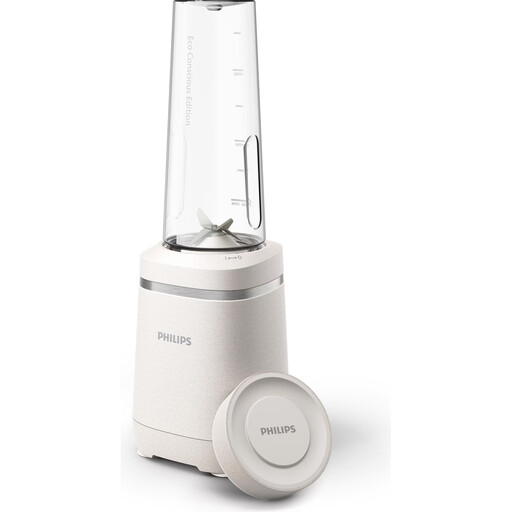
Why this product suits this profile: With a compact design, 350-watt motor, 600-ml container and dishwasher-safe removable parts, this countertop blender is designed for individual portions and easy storage.
The clearly limited capacity reduces the risk of expecting an appliance designed for individual portions to handle family-sized quantities.
600-ml Tritan container, stainless-steel blades and compact dimensions of approximately 11.8 × 11.6 × 36 cm.
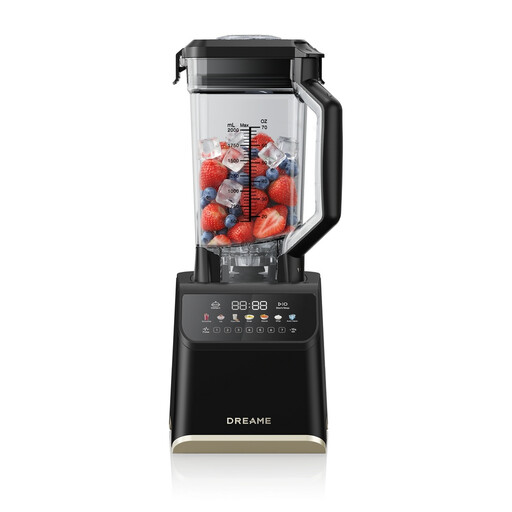
Why this product suits this profile: This 2,000-watt blender features a 2.0-litre container, a 700-ml on-the-go cup, seven speed settings and nine programmes for different preparations.
The information about container sizes, programmes and temperature limits makes the intended use clearer. According to the product information, hot liquids above 60 °C are not supported.
Eight stainless-steel blades, iDetect sensor technology, touchscreen and One-Touch Auto-Clean function according to the product description.

Why this product suits this profile: As a hand blender set with a measuring jug, whisk, potato masher and chopper, it is designed for soups, purées, sauces and smaller preparation tasks.
The removable attachments and variable speed control are more specific than a blanket promise that one appliance can do “everything”.
Four functions, 600-watt motor, 500-ml chopper and 800-ml measuring jug according to the product specifications.
We have put together a complete, regularly updated list of products that fully meet these strict selection criteria and the safety regulations applicable in the EU.
For individual portions, a personal blender or smoothie maker with an on-the-go cup is practical. For several people, a countertop blender with a larger container offers greater capacity. When processing frozen fruit, the motor power, blade design and permitted operating time should all be suitable for the task.
Its service life depends on how it is used and cleaned, whether it is overloaded, and the quality of its blades and seals. Observe the maximum quantities and recommended breaks. An appliance should not be run empty, and it should be switched off immediately if you notice unusual noises or smells.
Electricity consumption depends on the power rating and the actual operating time. A 2,000-watt appliance uses more energy during ten minutes of continuous operation than a 350-watt model running for the same length of time. Automatic programmes and short blending intervals can limit operating time; the specific intended use remains the deciding factor.