A mains-powered mini blender is suitable for a shared office only if your workplace allows it, there’s an appropriate place to use it and the noise won’t disturb anyone. Otherwise, it’s more considerate to make your smoothie in advance and bring it in a sealed cup. A rechargeable blender doesn’t need to be plugged in while blending, but you’ll need to charge it and cleaning requirements vary by model.
Who blends in a shared office?
Being considerate in a shared office
If I want to make a kiwi smoothie while people are concentrating on their work, being allowed to use the blender in that location and the noise it makes matter more than extra programmes. The Federal Institute for Occupational Safety and Health describes unwanted noise as a source of stress when working in an office.
Quick and easy in the office kitchen
If you’re making a single serving, you’ll want to clean the cup, lid and blade afterwards without any fuss. A blending cup that can also be used as a drinking cup can save you from having to transfer your smoothie.
Blending on the go without a mains socket
If I want to blend in different places, a rechargeable blender can do away with the need for a socket while blending. You’ll need to make sure the charging port, cup size and cleaning requirements suit the way you plan to use it.
What should you look for?
Mains-powered mini blender with drinking cup
A good fit if: There’s a socket and a suitable place to blend, and you want to make one serving without transferring it to another cup.
The trade-off: You’ll need to use it in a fixed location. The wattage alone won’t tell you how noisy it is or how smooth it will make your kiwi.
Rechargeable cup blender
A good fit if: You want to blend in a suitable place without relying on a mains socket.
The trade-off: Charging and cleaning requirements vary by model. A rechargeable blender isn’t necessarily quiet.
Blend it in advance and take it with you
A good fit if: The noise might be disruptive, your workplace doesn’t allow you to use appliances or there’s nowhere suitable to clean the blender on site.
The trade-off: A tightly sealed cup and suitable storage become more important. The German Federal Institute for Risk Assessment recommends drinking freshly made smoothies as soon as possible. Its specific chilling advice for green smoothies doesn’t apply to every kiwi recipe.
| Priority |
What to check before buying |
Who is it important to? |
| Noise and where you can use it |
Check your workplace’s rules and find a suitable spot. Compare noise levels only when they’ve been measured under comparable conditions. |
If I don’t want to disturb anyone who’s concentrating, I’ll first check whether and where I’m allowed to blend. Around 31% of consumers would make noise and where they can use a blender their top buying priority. |
| Cleaning |
Check which parts of the exact model can be removed and are dishwasher-safe. |
If I use the blender in a shared kitchen, I’ll want to clean the cup and blade without too much effort. Around 25% of consumers would make ease of cleaning their top buying priority. |
| Blending without a mains socket |
Compare the cup capacity, charging port and cleaning instructions for the specific version. |
If I want to blend a serving somewhere without a mains socket, the cup capacity needs to suit my recipe. Around 25% of consumers would make blending on the go their top buying priority. |
| Texture with other ingredients |
Check the manufacturer’s information and any available practical tests against the ingredients and recipes you actually plan to use. |
If I want to blend fibrous or frozen ingredients as well as kiwi, the results with those ingredients matter more than a single wattage figure. Around 19% of consumers would make blending other ingredients their top buying priority. |
Common buying mistakes
-
Assuming wattage or rechargeable operation means quieter blending
Neither the wattage nor the lack of a mains cable tells you how much noise a blender makes. The Federal Institute for Occupational Safety and Health describes unwanted noise as a source of stress when working in an office.
First, check your workplace’s rules and choose a suitable spot for blending. Compare noise measurements only when they use comparable measures and conditions.
If the spot isn’t suitable, you may not be able to use the blender there effectively.
-
Assuming dishwasher-safe instructions apply to the whole appliance
Cleaning instructions can vary by model and component. Approval for certain parts doesn’t automatically apply to the motor unit, battery or every accessory.
Check the instructions for the exact version and look up the guidance for the cup, lid, seals and blade separately.
If some parts need to be washed by hand, you’ll have extra cleaning to do after blending.
-
Assuming a travel cup guarantees safe storage
A lid makes a smoothie easier to carry, but it doesn’t automatically tell you how to store one that’s freshly made. The German Federal Institute for Risk Assessment recommends drinking freshly made smoothies as soon as possible.
Check that the specific cup seals properly, and prepare and store your smoothie according to the ingredients you use.
Key brands at a glance
Bosch
The VitaPower Series 2 includes compact mains-powered blenders with a travel cup, designed for single servings at a suitable fixed blending spot.
- Bosch lists the MMB2111S as having 450 W of power and a 0.6-l cup. According to the manufacturer, parts can be dismantled and some are dishwasher-safe.
- The cleaning instructions apply only to the parts specified. The wattage and the manufacturer’s information about blending results don’t prove that it runs quietly or produces a particular texture with kiwi.
WMF
The Kult X Mix & Go and KÜCHENminis Mix on the Go are two different types of cup blender.
- WMF says the mains-powered Kult X Mix & Go has a 0.6-l cup with a screw-on lid.
- The separate rechargeable KÜCHENminis model has a 300 ml capacity and, according to WMF, isn’t dishwasher-safe. The features of these two models aren’t interchangeable.
nutribullet
The Portable NBP003B is a rechargeable blender for making one serving without a mains connection while blending.
- The manufacturer lists a 475-ml cup and USB-C charging.
- The manufacturer’s stated number of possible blending cycles isn’t an independent battery-life test and doesn’t prove that it runs quietly in an office.
Philips
The Daily Collection HR2600/80 is a compact mains-powered mini blender for smoothies to take away.
- Philips lists a 350 W motor for this exact model.
- The power rating alone doesn’t tell you how noisy it will be in an office or guarantee a particular result with a kiwi recipe.
Beast
The Mega 1200 Plus is a smoothie maker tested by IMTEST under a range of test conditions.
- On 22 October 2026, IMTEST measured 74.2 dB while blending its red test smoothie.
- According to IMTEST, the result with its green test smoothie was slightly fibrous. The measurement and blending result apply to the test conditions used and don’t prove that it runs quietly in a shared office or produces a particular result with kiwi.
Blenders at Joybuy to consider
This selection includes portable blenders with travel cups, as well as rechargeable cup blenders for single servings of smoothies.
 No image available
Ninja BlendBoss Portable Blender, 710 ml, Cyberspace
The removable travel cup is designed for a serving to take away; this doesn’t mean the blender runs quietly.
The product name lists three automatic programmes. Removable parts are described as dishwasher-safe.
View at Joybuy
 No image available
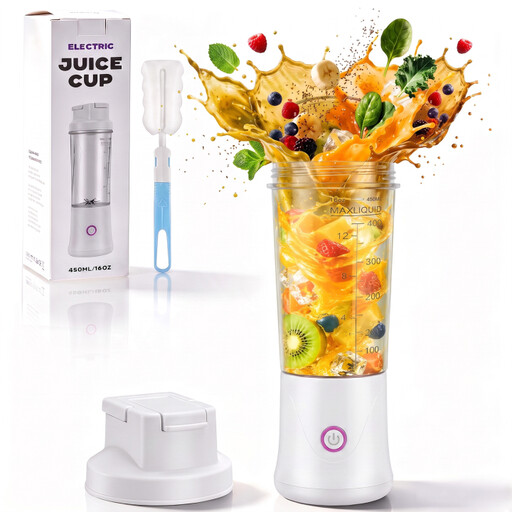
Portable smoothie blender, 652 ml, 6 blades, white
The cup with a travel lid is described as suitable for smoothies to take away; the product information doesn’t prove that it runs quietly in an office.
Removable parts are described as dishwasher-safe. For the stated blending results, ingredients should be cut into smaller pieces first and the cup shouldn’t be overfilled.
View at Joybuy
 No image available
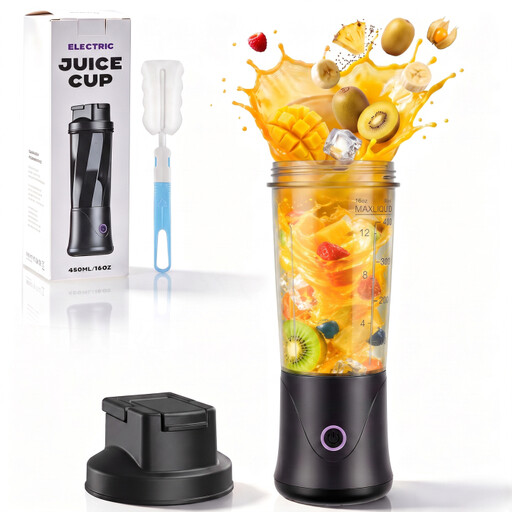
Portable smoothie blender, 400 ml, 6 blades, black
The 400-ml cup is designed for one serving and is also described as having a travel lid.
The product description says to clean the cup by blending water and washing-up liquid in it. For the stated blending results, ingredients should be cut to a suitable size and enough liquid should be added.
View at Joybuy
 No image available
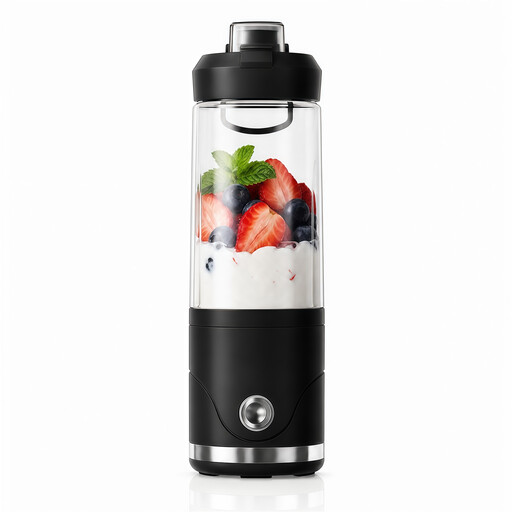
Rechargeable USB-C blender, 650 ml, 6 blades
This rechargeable cup blender is described as suitable for making smoothies without a mains connection while in use; quiet operation isn’t guaranteed.
The description lists USB-C charging and a self-cleaning mode. Don’t immerse the appliance in water, use it with hot liquids or run it empty.
View at Joybuy
 No image available
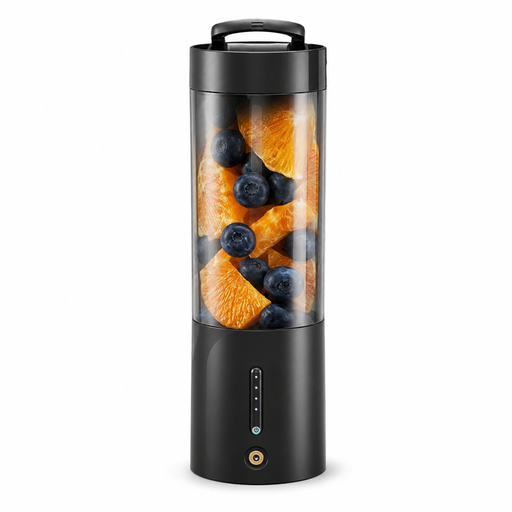
Portable smoothie blender, 450 ml, 6 stainless steel blades, magnetic charging
This rechargeable blender is described as suitable for making one serving without a mains connection while in use; the product information doesn’t prove that it runs quietly.
The product description lists magnetic charging. For the stated blending results, hard ingredients should be cut into small pieces and liquid should be added.
View at Joybuy
Frequently asked questions
Can I simply plug in a blender I bought for personal use at the office?
Check with your workplace before plugging in the appliance. The German Social Accident Insurance (DGUV) points out that electrical appliances brought in from home can also be faulty and should be considered as part of workplace appliance checks. This doesn’t mean there’s a blanket rule allowing or banning them in every office.
How should I clean a blender after making a smoothie?
Follow the instructions for the exact model and clean the parts that come into contact with food promptly. Bosch describes some parts of the MMB2111S as dishwasher-safe; WMF says the KÜCHENminis Mix on the Go isn’t dishwasher-safe. This doesn’t mean you can put a motor unit in the dishwasher.
What should I bear in mind if I make my smoothie in advance?
Use fresh ingredients with no signs of spoilage, and wash fruit and vegetables thoroughly. The German Federal Institute for Risk Assessment recommends drinking freshly made smoothies as soon as possible. Its specific advice to keep them at no more than 7 °C and drink them on the day they’re made applies explicitly to freshly prepared green smoothies.
What requirements apply to blending cups in Germany?
Regulation (EC) No 1935/2004 sets requirements for materials and articles that come into contact with food, including food-processing equipment. Choose a cup intended for food use and for the way you plan to use it; a claim such as ‘BPA-free’ alone doesn’t prove that it meets all applicable requirements.


