
Lieferung heute & morgen

Qualitätsgarantie

Willkommens-Angebote freischalten: KOSTENLOSE Lieferung | Bis zu 80 % RABATT | Kostenlose 30-Tage-JoyPlus-Testphase
App herunterladen
Blinds without drilling are a practical solution for rented homes, children’s bedrooms, balcony doors and refurbished rooms where you want to avoid damaging window frames and walls. But not every clip-on blind will fit every window. The key things to consider are frame thickness, measurements, operation and the level of light control you need.
For many blinds, the stated width includes the brackets and side pieces as well as the fabric. For several duo blinds, product details state that the fabric is around 4 to 5 cm narrower than the ordered width. So if you measure only the glass, you may end up with gaps at the sides that let light through.
Before ordering a window blind, check:
A light-filtering blind, duo blind or zebra blind controls how much light comes in, but it won’t necessarily block it out completely. The alternating transparent and opaque stripes on a clip-on double roller blind allow you to adjust the balance between privacy and greater light reduction.
For bedrooms and children’s rooms, a model specifically described as a blackout blind is a better choice. Even then, light may still come through at the sides if the blind isn’t wider than the glass.
Clip-on systems need a frame of a certain thickness. According to the product details, the WOLTU duo blinds mentioned here are designed for frames 13 to 23 mm thick. Other models, such as a thermal pleated blind, may be designed for frames 10 to 23 mm or 16 to 22 mm thick.
Wooden windows, roof windows, angled windows and windows with special seals aren’t necessarily compatible. Check the exclusions in the relevant product description before buying.
Clean and dry the window frame before fitting. Make sure the clip-on brackets are positioned evenly so the blind hangs straight and doesn’t shift when you open the window.
Polyester is the base material used in many window blinds. It can usually be cleaned with a soft cloth or brush. However, the way a blind controls light depends more on its design:
A chain-operated blind can be adjusted precisely to the desired height. Depending on the model, the chain can be fitted on the right or left. In homes with young children, fit it out of their reach. Check whether a chain safety device is included and fit it according to the instructions.
Alternatively, choose a cordless blind with a handle. This does away with the pull chain, but the brackets and small components still need to be securely fitted.
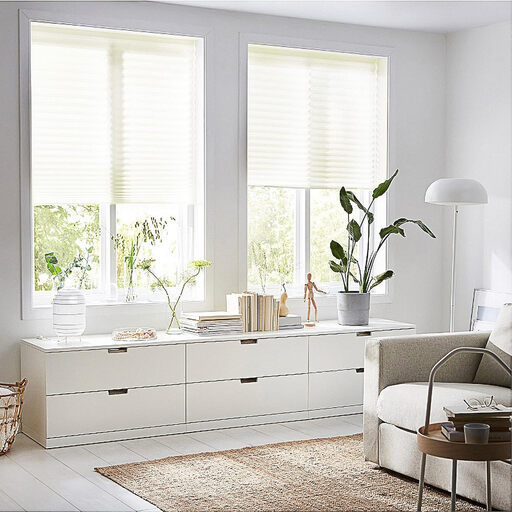
Why this product is a good fit: This light-filtering pleated blind has clip-on fittings and is designed for living rooms, offices, kitchens and children’s rooms. It can be adjusted to the desired height.
The product details specify the fitting type and size, and advise securing the brackets firmly to the frame. This isn’t a blind that automatically blocks out light.
Clip-on fitting with no drilling, polyester fabric and height-adjustable operation.

Why this product is a good fit: According to the product details, the honeycomb structure and opaque fabric make this blind suitable for bedrooms, living rooms, offices and bathrooms.
The suitable frame thickness is specified as 10 to 23 mm. The product details also warn that the blind must not interfere with the window handles.
Opaque polyester, clip-on system, operation using top and bottom handles, and easy cleaning with a damp cloth.

Why this product is a good fit: According to the product details, this cordless blind is designed for bedrooms, living rooms, offices, bathrooms and balconies.
The product description specifies the required frame thickness of 16 to 22 mm and notes that the blind isn’t suitable for roof windows. It is operated without a pull chain.
Cordless operation, a silver-coated backing according to the product details, clip-on or screw fitting, and polyester that can be wiped clean with a damp cloth.
We’ve put together a comprehensive, regularly updated list of products that meet these strict selection criteria and fully comply with the safety regulations in force in the EU.
How long they last depends on the frame, fittings, weight and how often they’re used. A clip-on system that fits properly can stay securely in place. With adhesive fittings, the surface is particularly important. Pulling forcefully on the blind or having it blocked by the window handle can put strain on the fittings.
According to the product details, many models are designed for both windows and doors. For balcony or patio doors, also check that the blind won’t catch on the door handle, wall or floor when the door opens. For doors you use frequently, a model with an easy-to-use handle or a chain fitted on the right side may be a good choice.
The blind itself doesn’t use electricity. Ongoing costs are usually limited to cleaning and, if needed, replacing the brackets or operating parts. The purchase price of a blackout blind or thermal pleated blind may vary depending on the material, fitting method and size you need.