
Lieferung heute & morgen

Qualitätsgarantie

Willkommens-Angebote freischalten: KOSTENLOSE Lieferung | Bis zu 80 % RABATT | Kostenlose 30-Tage-JoyPlus-Testphase
App herunterladen
Blinds without drilling are particularly useful for rented homes, offices and households where window frames or walls should not be permanently altered. Clip-on brackets and adhesive fittings provide flexible installation options – although not every system is suitable for every window.
Many disappointing purchases are not caused by the blind itself, but by inaccurate measurements, an unsuitable installation method or unrealistic expectations regarding room darkening and heat protection. The following criteria will help you choose a suitable blind without drilling for rented homes or for other rooms.
With a blind featuring clip-on brackets, the stated width may include the entire construction, including the brackets. The actual fabric is therefore narrower. According to the product information, the difference between the overall width and the fabric width is approximately 4 to 5 cm for some WOLTU models.
You should therefore measure:
For the most complete coverage possible, several models recommend ordering a width approximately 4 cm greater than the glass width. However, this recommendation is only suitable if it does not cover the window handle.
A privacy blind protects against prying eyes, but does not necessarily darken the room completely. A semi-transparent pleated blind allows daylight through, while a blackout blind with a coated backing lets considerably less light pass through.
Pay attention to the specific functional description:
The name alone is no substitute for information about the material, backing coating and coverage provided by the installation.
A clip-on blind is usually attached to the upper window sash. The frame must therefore be sufficiently sturdy and accessible. Depending on the model, specific frame thicknesses are required, such as 13–23 mm or 16–22 mm. Windows with seals, wooden frames, roof windows or sliding windows may not be suitable.
Adhesive installation also requires a smooth, grease-free and as level a surface as possible. Rough, porous or uneven surfaces can affect adhesion. Before installation, check the manufacturer’s instructions and confirm whether the product is suitable for windows or doors.
A clip-on bracket can generally be removed without leaving any marks, making it a good choice for rented homes. However, it must not obstruct the window sash when closing. The frame thickness must fall within the stated range.
Adhesive installation does not require a specific frame thickness, but places greater demands on the surface. It is practical for doors or narrow glass panels, but should not be used on dusty, damp or uneven surfaces.
A day-and-night blind consists of alternating transparent and opaque fabric stripes. By moving the two layers of fabric, you can adjust the amount of light entering the room and the level of privacy. This type of system offers more flexibility than a standard blind, but does not automatically provide complete blackout.
A no-drill pleated blind with a closed, light-blocking fabric is better suited to bedrooms when you want to let in as little outside light as possible. For living rooms, kitchens or home offices, a light-filtering version may be more suitable.
Polyester is commonly used for many interior blinds because it is easy to clean and retains its shape. For the products mentioned, cleaning with a soft, damp cloth is sufficient. Harsh cleaning products and abrasive sponges can damage coatings and fabric.
With chain-operated systems, the chain must be secured out of children’s reach. Cordless models operated via a handle rail reduce loose operating components and may be more practical for households with children or pets. Regardless of the operating method, the blind must be installed securely and firmly.
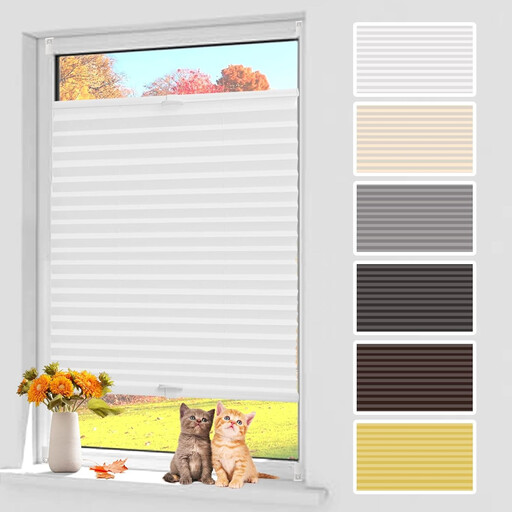
Why this product suits this profile: Its compact size and adhesive brackets are suitable for smaller windows and doors, provided the surface is smooth and level. According to the product information, the fabric is designed to provide blackout and privacy.
The product description explicitly states that the surface must be cleaned and that the product is unsuitable for rough or uneven surfaces.
70 x 120 cm, polyester fabric, no-drill installation and cleaning with a damp cloth.

Why this product suits this profile: The polyester honeycomb structure and metal frame are appealing to users who want to combine blackout performance, privacy and flexible operation using upper and lower handles.
The suitable frame thickness of 10–23 mm is clearly stated. This allows you to check before buying whether the clip-on bracket will fit your window.
Honeycomb structure, opaque polyester, infinitely adjustable positioning and clip-on installation for frames measuring 10–23 mm.

Why this product suits this profile: This cordless blind with a handle rail is designed for bedrooms, children’s rooms, offices and rooms where strong light protection is needed. According to the product information, the silver-coated backing acts as a blackout and thermal protection layer.
The 16–22 mm frame thickness, narrower fabric width and exclusion of roof windows should all be taken into account before buying.
80 x 150 cm, cordless operation, coated polyester fabric and clip-on or screw installation.
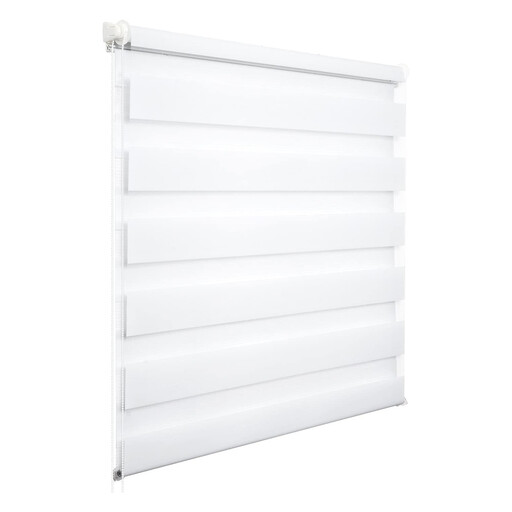
Why this product suits this profile: The two layers of fabric allow you to adjust the blind from light-filtering to a more shielding setting. This makes it suitable for living rooms, home offices and offices with changing light requirements.
The description mentions both clip-on installation and the intended frame range of 13–23 mm. The chain can also be installed on either the left or right.
100% polyester, two layers, chain operation on the left or right, and cleaning with a damp cloth or soft brush.
Depending on the model, they are installed using clip-on brackets on the window frame or self-adhesive holders. With clip-on systems, the frame thickness and window shape must be suitable. Adhesive holders require a clean, smooth surface.
Their lifespan depends on the installation, operation, exposure to sunlight and cleaning. Avoid pulling abruptly, overloading the brackets or using harsh cleaning products. With clip-on blinds, check occasionally that the brackets are still firmly in place.
No. Interior blinds, pleated blinds and day-and-night blinds are operated manually using a chain, handle rail or pull mechanism. They therefore do not incur ongoing electricity costs. A thermal blind can affect solar heat gain, but it does not replace structural insulation or air conditioning.
We have put together a complete, regularly updated list of products that fully meet these strict selection criteria and the safety regulations applicable in the EU.