
Lieferung heute & morgen

Qualitätsgarantie

Willkommens-Angebote freischalten: KOSTENLOSE Lieferung | Bis zu 80 % RABATT | Kostenlose 30-Tage-JoyPlus-Testphase
App herunterladen
Regularly monitoring your blood pressure at home is an established method for managing cardiovascular health. A suitable blood pressure monitor provides the necessary data for this. The choice of a model depends on individual requirements for measurement accuracy, ease of use, and range of features. Digital blood pressure monitors for home use can be primarily divided into two categories: upper arm blood pressure monitors and wrist blood pressure monitors. Modern devices also offer additional functions such as arrhythmia detection or connectivity to a blood pressure monitor with an app.
This article analyses the technical criteria relevant to selecting a device and presents a selection of models with different specifications.
The decision for a specific model should be based on an analysis of objective technical parameters. The following criteria are relevant for your selection.
A crucial quality feature is the clinical validation of a device. Products classified as medical devices (indicated by the CE mark with a four-digit code of a notified body) have undergone testing procedures that confirm their fundamental safety and performance according to EU standards. Measurement accuracy is typically specified as a deviation in mmHg for blood pressure and as a percentage for pulse rate.
The accuracy of the measurement is directly dependent on the correct fit of the cuff. A cuff that is too tight or too loose can significantly skew the measurement results. The arm circumference should be measured at the intended measurement site (upper arm or wrist) before buying a blood pressure monitor. Most manufacturers specify the appropriate circumference range for their cuffs in centimetres. For upper arm devices, universal cuffs for circumferences from approx. 22 to 42 cm are often available.
Based on the technical criteria mentioned, we present three models with different feature focuses.
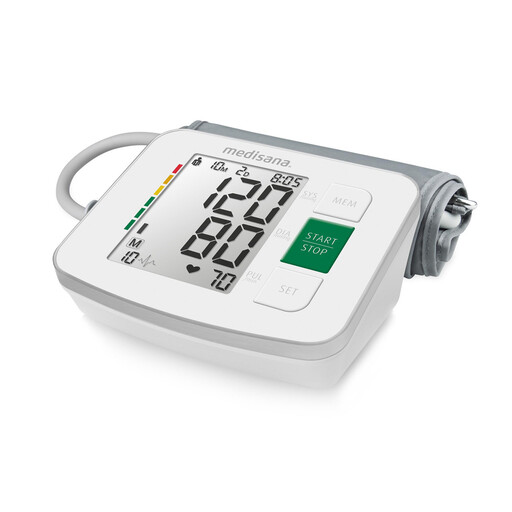
Why We Recommend This Product The medisana BU 512 is a digital upper arm blood pressure monitor that focuses on the core functions of blood pressure monitoring. It is characterized by its particularly straightforward operation and a large, easy-to-read display. The readings are classified using a color scale based on WHO guidelines, allowing for a quick assessment of the results.
Pros
Who It's For This model is suitable for users looking for a reliable and straightforward upper arm blood pressure monitor for daily checks by up to two people, who do not require app connectivity.
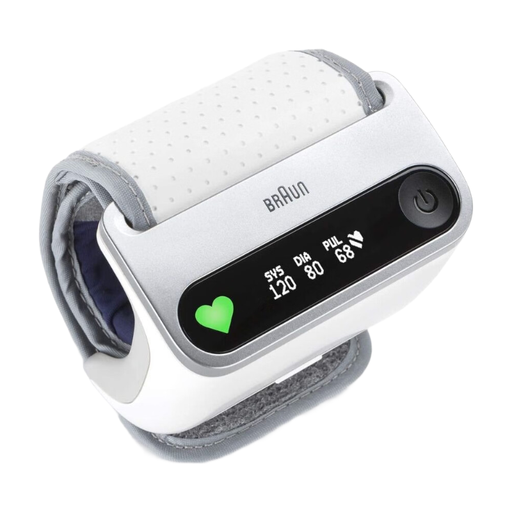
Why We Recommend This Product The Braun iCheck 7 is a modern wrist blood pressure monitor that combines portability with smart technology. A key feature is the "ball-in-the-hole" positioning system, which guides the user to correctly position the wrist at heart level for a precise measurement. Bluetooth connectivity to the Braun Healthy Heart app enables seamless data synchronization.
Pros
Who It's For This device is designed for tech-savvy users who prefer a compact blood pressure monitor with app connectivity for use on the go or at home and who value guided, precise measurement.
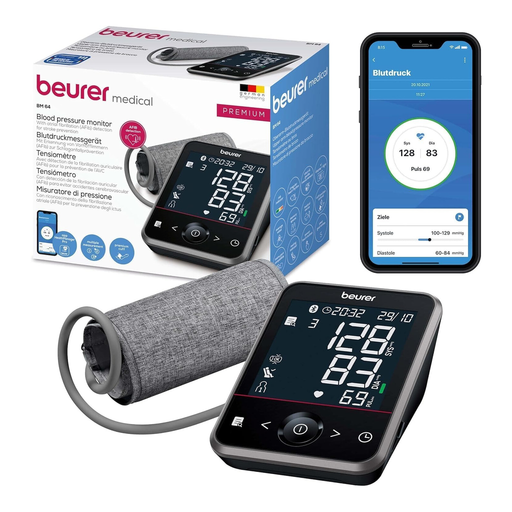
Why We Recommend This Product The Beurer BM 64 is a feature-rich upper arm blood pressure monitor that offers advanced arrhythmia control in addition to standard measurement. It has a specific function for atrial fibrillation detection, which can contribute to stroke prevention. The patented rest indicator and the cuff position check are additional mechanisms to ensure measurement quality.
Pros
Who It's For This model is aimed at health-conscious users and individuals with an elevated cardiovascular risk profile who desire the most comprehensive monitoring possible with arrhythmia detection and specific atrial fibrillation detection, and who want to manage their data digitally.
The products presented cover different requirement profiles. If none of these models meet your specific needs, you will find a broader selection of devices with various technical specifications and in different price categories in our main category.
Discover more models in the category: Blood Pressure Monitors
1. Which blood pressure monitor is more accurate: upper arm or wrist? Upper arm blood pressure monitors are generally considered less prone to user error, as the measurement is taken closer to the heart and the arm positioning is more intuitive. Wrist devices can also deliver precise results with correct application – especially models with a positioning aid. The choice often depends on the priority between stationary precision and mobile flexibility.
2. What does arrhythmia detection mean on a blood pressure monitor? Arrhythmia detection is a function where the device identifies deviations from a normal heart rhythm during blood pressure measurement. It registers irregular pulse waves and indicates this with a symbol on the display. This does not replace a medical diagnosis but can be an important indicator to consult a doctor if it occurs repeatedly.
3. How important is the correct cuff size? The cuff size is a critical factor for measurement accuracy. A cuff that is too small can lead to falsely high blood pressure readings, while a cuff that is too large can cause falsely low readings. It is therefore essential to measure your arm circumference before purchase and choose a cuff whose specified range covers this circumference.
Written by: Joybuy Product Recommendation Officer