
Lieferung heute & morgen

Qualitätsgarantie

Willkommens-Angebote freischalten: KOSTENLOSE Lieferung | Bis zu 80 % RABATT | Kostenlose 30-Tage-JoyPlus-Testphase
App herunterladen
A blood pressure monitor for home use can help you record readings regularly and present them clearly at medical appointments. However, the device, cuff and controls must be suitable for the individual user. Eye-catching packaging or the word “smart” alone says little about practical benefits.
Typical buying pitfalls occur in three areas:
An upper-arm blood pressure monitor is generally fitted to the bare upper arm at heart level. Models of this type often offer a wider choice of cuffs and additional features such as position checks or movement alerts. For regular use at home, using the device correctly is essential.
A wrist blood pressure monitor is more compact and easier to transport. The wrist must be held precisely at heart level during the measurement. If you cannot maintain this position reliably, check before buying whether an upper-arm model would be easier to use.
Measure the circumference at the intended point and compare it with the specified range. Common cuff sizes include 22 to 42 cm or 22 to 45 cm. For larger upper arms, a blood pressure monitor with a large cuff is more suitable, provided the actual circumference falls within the manufacturer’s stated range.
A “universal size” cuff is not a guarantee of a good fit. Children, very slim arms and particularly large upper arms may require a specially sized cuff. Only use the cuff designed for the device.
A digital blood pressure monitor usually displays systolic and diastolic blood pressure as well as pulse rate. A blood pressure monitor with memory can store multiple readings by date and time. Two user profiles are useful when a couple or family shares the same device.
Automatically calculating the average of the last three readings makes it easier to track changes over time. A blood pressure monitor with arrhythmia detection can indicate irregular heartbeats during a measurement. Such alerts are not a diagnosis. If irregularities occur repeatedly, seek medical advice.
For comparable results, sit quietly for around five minutes before taking a measurement. Keep both feet flat on the floor, support your back and rest your arm comfortably at heart level. Do not speak or move your arm during the measurement.
It is helpful to take readings at similar times of day and save them together with the date and time. If a result seems unusual, repeating the measurement after a short rest may be sensible. However, do not change your medication based on individual readings.
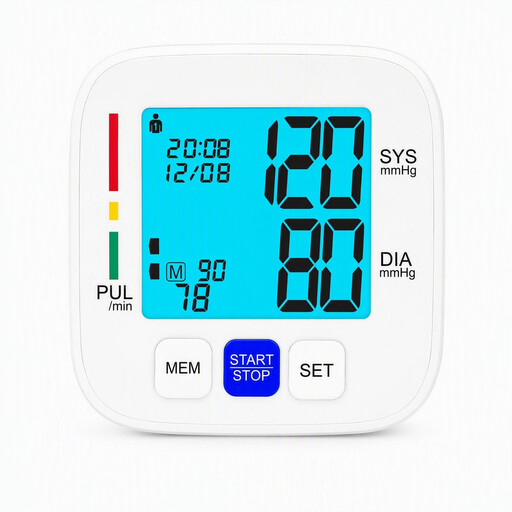
Why this product suits this profile: This automatic upper-arm monitor is straightforward to use and offers two memory profiles with 90 entries each, plus a cuff for 22 to 42 cm.
The cuff range is clearly specified, while memory and the average of the last three readings are available directly on the device.
Compact dimensions, time stamps and automatic switch-off.
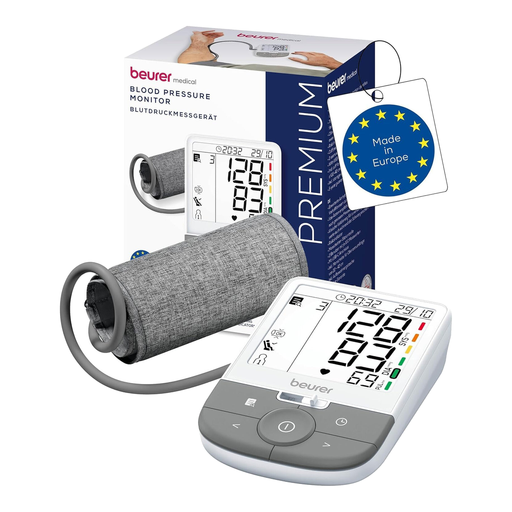
Why this product suits this profile: This model combines an XL backlit display with triple measurement, a resting indicator and cuff-fit control.
The suitable cuff covers 22 to 42 cm; resting and fit indicators help highlight common operating errors.
Two memory profiles with 100 entries each and synchronisation with health apps.
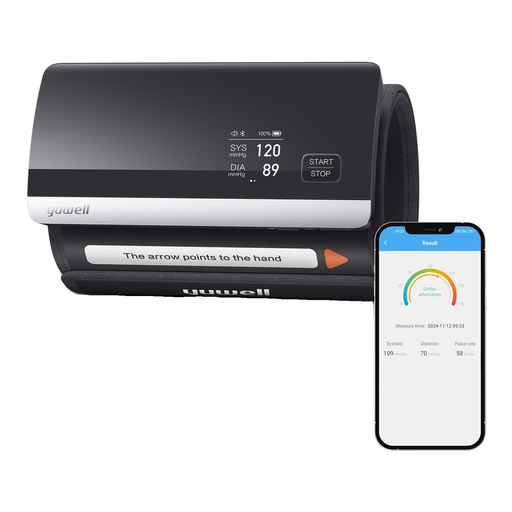
Why this product suits this profile: The 22 to 45 cm cuff, voice guidance, Bluetooth and indication of possible AFib detection are designed for users who need more advanced record-keeping.
The large cuff range reduces the risk of choosing an unsuitable standard size. Voice guidance can make operation easier.
App connectivity for iOS and Android, plus a rechargeable battery.
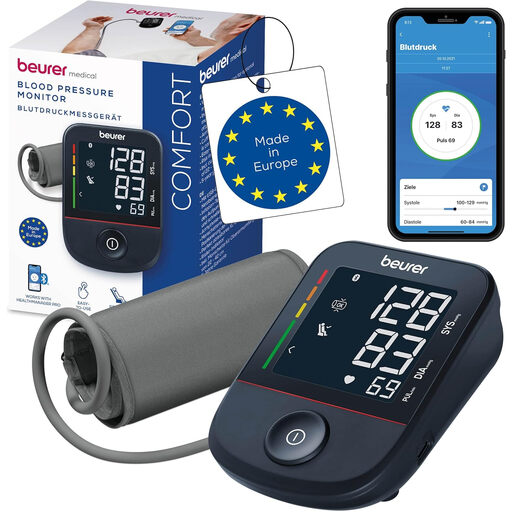
Why this product suits this profile: The one-button operation, extra-large display and 22 to 42 cm cuff make everyday use easier.
Operation is centred on a single start button, while the resting and cuff-fit checks provide additional guidance.
Bluetooth transfer to the beurer HealthManager Pro app and compatibility with selected health platforms.
We have put together a complete, regularly updated list of products that fully meet these strict selection criteria and the safety regulations applicable in the EU.
This depends on the individual reason for measuring and on medical advice. Regular readings taken at similar times of day can be helpful for monitoring changes over time. Also note or save any relevant circumstances, such as stress, physical activity or caffeine consumption.
Its lifespan depends on usage, storage, batteries and the cuff. Store the device in a dry, protected place and follow the instructions for use. Check the cuff regularly for cracks or loose fastenings. It should be replaced if there is visible damage. Information about service life and the warranty can be found in the relevant product documentation.
A blood pressure monitor with an app can transfer readings automatically and display trends more clearly. Before buying, check compatibility with iOS or Android, any required accounts, Bluetooth requirements and export options. If you do not want to use an app, a device with an easy-to-read display and sufficient memory is often the simpler choice.