
Lieferung heute & morgen

Qualitätsgarantie

Willkommens-Angebote freischalten: KOSTENLOSE Lieferung | Bis zu 80 % RABATT | Kostenlose 30-Tage-JoyPlus-Testphase
App herunterladen
If you want to buy blood glucose test strips for daily testing at home, you should look beyond the price per pack. Compatibility with your existing blood glucose meter, shelf life after opening and the actual contents of the package are all important. A cheap pack can be impractical if the test strips do not fit your meter or you need to buy lancets separately.
This buying guide explains which details are relevant before purchasing a blood glucose test and which products may suit different user profiles.
A common misconception is that every strip fits every blood glucose meter. This is not the case. Test strips are generally designed for a specific model or clearly defined model family.
Before buying, check the following:
For example, according to the product information, AILE test strips are intended for models A608, A601, A606, A616 and W33. By contrast, the yuwell test strips for model 710 are expressly described as incompatible with other brands.
The description 50 blood glucose test strips initially refers only to the number of strips. Depending on the offer, the pack may also contain 50 lancets, a lancing device or a complete meter. For ongoing costs, it is also relevant whether you already have a suitable lancing device.
With blood glucose test strips with lancets, check whether both components are actually listed in the package contents. Lancets are single-use products and must be disposed of hygienically and safely.
A stated testing time of five or ten seconds is a technical specification, but it is no substitute for proper preparation. An insufficient blood sample, damp fingers, incorrectly stored strips or a container that has not been closed properly can affect use.
Read the instructions before carrying out your first blood glucose test at home. If your readings are unusual or unexpected, consult a healthcare professional. Home testing is intended for personal monitoring and does not replace diagnosis or treatment.
The most important detail is model compatibility. Some systems feature auto-coding, while others require manual adjustment. No-code systems can make set-up easier, provided the meter and test strips are explicitly designed to work together.
Also make sure that the unit of measurement you require is available on the device. An mmol/l blood glucose meter is often relevant for users in Germany, but this should be confirmed using the product description and instructions.
The required blood volume is given in microlitres. Product information, for example, specifies 0.6 μl for the Sinocare Safe Accu2 and 1 μl for the Safe AQ Pro I. A smaller required sample can make handling easier, but the specified amount of blood must still be applied correctly.
The stated testing times for the selected products are five and ten seconds respectively. These figures refer to the technical product specifications and should not be interpreted as a medical guarantee of accuracy.
Test strips should be stored according to the information on the packaging and enclosed leaflet. With vials, it is important to close the lid tightly immediately after removing a strip. Before buying, check the following:
If you test regularly, you can plan around a pack of 50. For occasional use, a long shelf life after opening is particularly important.
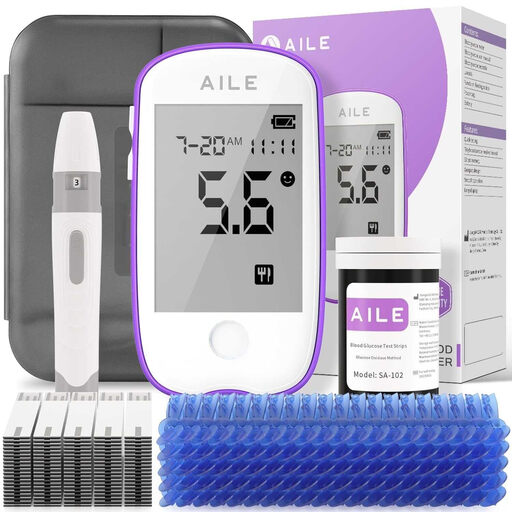
Why this product suits this profile: The set contains a meter, 50 test strips, 50 lancets, a lancing device and a storage case. According to the product description, the display can be set to mg/dl or mmol/l.
The complete package contents reduce the risk of needing additional components immediately after purchase. The no-code design avoids manual code entry.
Five-second testing according to the product information; five adjustment levels on the lancing device and memory functions for 7-, 14- and 30-day average values.
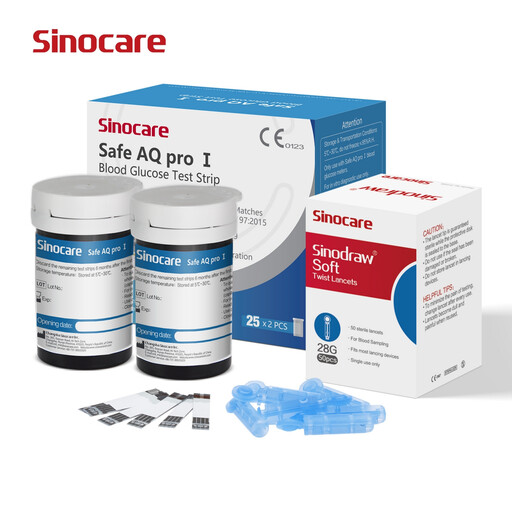
Why this product suits this profile: The pack contains 50 test strips and 50 lancets. According to the product description, the system uses FAD-GDH technology, a five-electrode design and automatic coding.
The clear allocation to the Safe AQ Pro I prevents buyers from purchasing based on the general brand name without checking the device model.
Stated sample volume of 1 μl and a stated testing time of 5 seconds; supplied in separate vials containing 25 strips each.
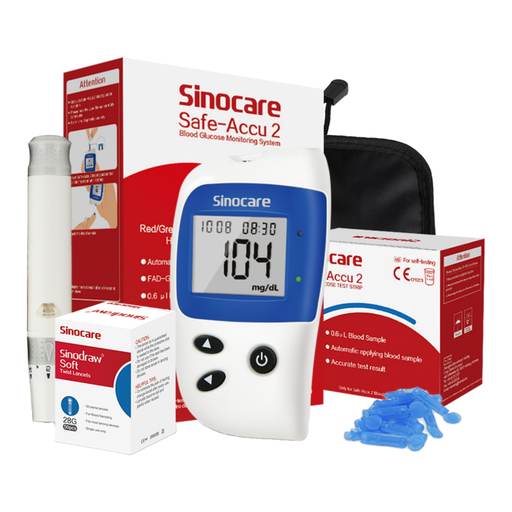
Why this product suits this profile: The set combines a meter, lancing device, 50 test strips and 50 lancets. According to the product description, the device stores up to 200 time-stamped test results.
The clearly stated complete package contents mean that the meter, lancing device and consumables do not need to be sourced separately.
Stated blood volume of 0.6 μl and results displayed after 10 seconds; large display with date and time information.
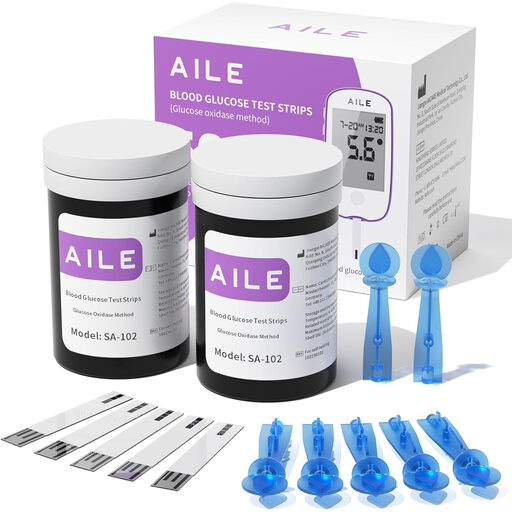
Why this product suits this profile: This refill pack is intended for users of a compatible AILE meter who already own a lancing device and only need new test strips.
The product description explicitly lists the compatible AILE models. This makes it easy to check the model specifically before buying.
50 strips per pack; according to the product information, no-code operation and automatic blood sample collection at the edge of the strip.
We have put together a complete, regularly updated list of products that fully meet these strict selection criteria and the safety regulations applicable in the EU.
The printed expiry date and the instructions for use after opening are decisive. With vials, the lid should be closed immediately and fully after every strip is removed. Do not use strips from damaged packaging or after the stated expiry date.
This depends on your personal testing routine and medical requirements. For regular use, a pack of 50 strips can be a practical quantity. Actual consumption should be based on your individual testing plan and the recommendations of your healthcare professional.
No. Test strips must be compatible with the relevant meter and model. Therefore, check the exact model name before placing your order. Similar product names, such as Safe Accu2 and Safe AQ Pro I, should not be treated as interchangeable without checking compatibility.