
Lieferung heute & morgen

Qualitätsgarantie

Willkommens-Angebote freischalten: KOSTENLOSE Lieferung | Bis zu 80 % RABATT | Kostenlose 30-Tage-JoyPlus-Testphase
App herunterladen
A Bluetooth kitchen scale can do more than display ingredients digitally: it can also transmit measurements to an app. This is useful for people who count calories, record nutritional values or keep track of portion sizes when meal prepping. However, traditional criteria remain important for keen cooks and baking enthusiasts too: weighing range, readability, cleaning and ease of use.
Anyone who focuses only on terms such as “smart” or “highly accurate” may overlook important details. The following points will help you choose a suitable digital kitchen scale for everyday use.
A display in 1 g increments initially means that the scale shows measurements in steps of 1 g. This does not automatically guarantee an absolute measurement deviation of exactly 1 g. You should also check the specified minimum weighing range. With small quantities, measurements may fluctuate more than they do with larger portions.
For spices or very small baking ingredients, it is therefore important to check whether the manufacturer states not only the increments but also a minimum weighing range and other technical specifications.
A kitchen scale with an app generally requires a suitable application and a compatible smartphone. Before buying, users should check:
The Bluetooth connection also does not replace a nutritional database. Calorie and nutritional information depends on the foods, brands and portion sizes stored in the app.
A 10 kg kitchen scale is practical if you want to weigh large bowls, quantities of dough or food supplies. If you mainly measure coffee, spices or small baking ingredients, you may not need this capacity. What matters is a balanced combination of minimum weight, increments, platform size and maximum capacity.
For a scale for baking and cooking, an easy-to-read display and a tare function are particularly useful. Tare lets you reset the weight of the container, so you can weigh ingredients one after another.
Look out for:
Displaying millilitres can be helpful, but it is not equally meaningful for every liquid. Volume depends on the density of the contents. For precise recipe measurements, weighing in grams is usually the clearer method.
A smooth surface made from toughened glass can usually be cleaned with a soft, damp cloth. However, it should not be immersed in water. Stainless steel surfaces can also be easy to maintain. A fingerprint-resistant coating is practical for everyday use, but should not be treated with harsh cleaning products.
The following features are also important:
Many models use AAA batteries. Check whether these are included. Bluetooth models also require app setup and pairing with your smartphone. For occasional baking, a simple digital kitchen scale may be sufficient. For regular nutritional tracking, app connectivity provides an additional way to record information.
The following selection categorises specific models according to their intended use. Technical specifications refer to the relevant product information.
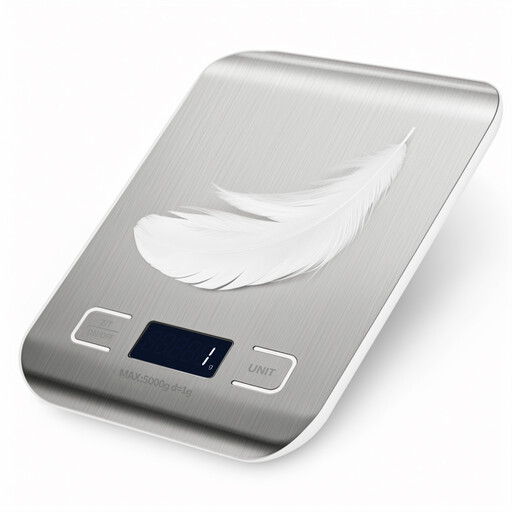
Why this product suits this profile: This model offers a 5 kg capacity, 1 g increments and several units of measurement. It is suitable for everyday cooking, baking and portion control without the need for additional app setup.
The technical specifications state both the weighing range and the increments. Automatic shut-off, overload protection and a low-battery warning are also listed.
5 kg capacity, 1 g increments, g/ml/oz/lb:oz/lb and a compact stainless steel platform.

Why this product suits this profile: This Bluetooth kitchen scale combines a 10 kg capacity with stated 1 g increments. It is designed for users who want to record ingredients and portion data digitally.
The minimum weighing range of 3 g is clearly specified. This makes it easier to assess which small quantities the scale is designed for.
Bluetooth connectivity, 10 kg capacity, 1 g/1 ml increments, five units and a 3 mm glass surface.
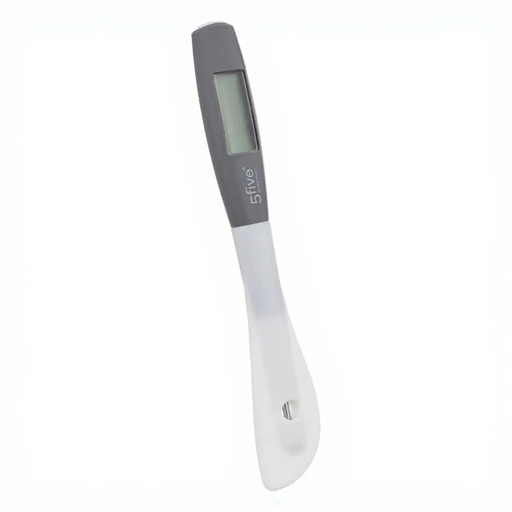
Why this product suits this profile: This kitchen accessory is not a scale, but it complements one for frequent cooking, frying or preparing temperature-sensitive foods.
Its function is clearly defined: the device measures temperatures and does not replace a digital kitchen scale for weighing or nutritional tracking.
A combination of digital thermometer and spatula for stirring, turning and temperature control.
We have put together a complete, regularly updated list of products that fully meet these strict selection criteria and the safety regulations applicable in the EU.
Place the scale on a level, stable surface, insert the batteries and activate Bluetooth on your smartphone. Then open the accompanying app and pair the scale according to the manufacturer’s instructions. Check the tare function before using the scale for the first time. If you experience connection problems, restarting the app, ensuring Bluetooth is switched on and moving away from other devices will often help.
Its lifespan depends on use, cleaning, battery replacement and storage. A glass or stainless steel platform should be cleaned with a soft, damp cloth and should not be immersed in water. Overloading, liquid entering the housing and hard impacts can affect the sensors. The scale should also not be left under the constant load of a heavy object.
In addition to the purchase price, you may need to buy batteries. The Bluetooth connection itself normally does not incur mobile data charges. Whether an app is free or offers additional paid features depends on the provider. Check the app description and available functions before buying.