
Lieferung heute & morgen

Qualitätsgarantie

Willkommens-Angebote freischalten: KOSTENLOSE Lieferung | Bis zu 80 % RABATT | Kostenlose 30-Tage-JoyPlus-Testphase
App herunterladen
A Bluetooth speaker should play music, podcasts or phone calls effortlessly – at home, while travelling or outdoors. In practice, however, unclear product specifications often lead to disappointing purchases. A high wattage does not automatically mean balanced sound, and the term “waterproof” is not very meaningful without an IP rating.
This guide explains which technical specifications really matter and which model is suitable for different usage profiles.
The output power in watts initially indicates how much electrical power a speaker can handle. On its own, it says little about sound tuning, speech clarity or bass reproduction. When choosing a wireless speaker, you should therefore also consider the drivers, cabinet, frequency range and available equaliser settings.
A Hi-Res Audio speaker can process high-resolution audio signals. Whether this makes an audible difference in everyday use depends, among other things, on the audio source, transmission method and your personal listening environment.
The rating consists of two digits, or a digit and an “X”. The first figure indicates protection against dust, while the second refers to water:
An outdoor speaker with IP67 is therefore generally better suited to the beach, camping or use near a swimming pool than a model with IPX4. Even so, charging ports should be kept closed and the manufacturer’s instructions followed.
Claims such as “up to 25 hours” generally do not apply at maximum volume. According to the product specifications, actual battery life depends on volume, audio content, connection type and features. You should therefore also check:
Several specifications are relevant to sound quality. A 2-way system with a woofer and tweeter can reproduce different frequency ranges more precisely. Passive bass radiators support low-frequency reproduction, but require a suitably tuned cabinet.
The rated RMS power is more meaningful than peak power figures alone. A 360-degree design can be useful when several people are sitting around the speaker. For directional sound while cycling or hiking, however, an angled design may offer better sound projection.
Weight and dimensions determine whether a portable Bluetooth speaker is genuinely suitable for taking on the go. A handle, carrying strap or clip makes transport easier. For a rucksack, 330 grams is considerably more practical than a device weighing several kilograms.
With a retro Bluetooth speaker featuring a wooden cabinet, interior design and connectivity are often the main priorities. Such models are not automatically designed for rain or damp environments.
Bluetooth 5.3 or Bluetooth 5.4 describes the wireless generation used. For everyday use, however, range, multipoint connectivity and app support are also important. Multipoint functionality, for example, allows the speaker to connect to two devices.
If you want to play music without a smartphone, look for AUX, USB or a TF/Micro-SD card slot. For karaoke or streaming applications, a microphone input, USB-C OTG and separate sound modes may also be important.
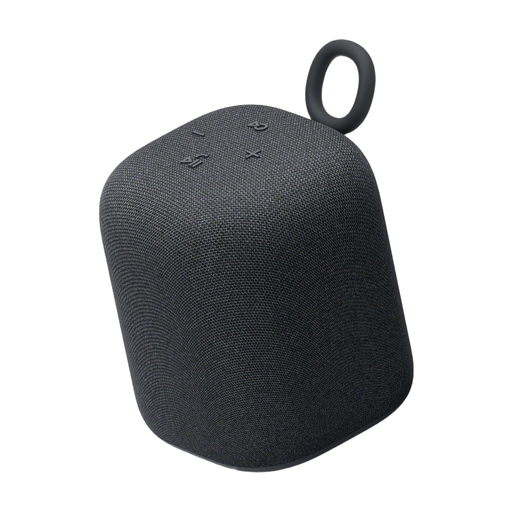
Why this product suits the profile: This compact model is designed for indoor use, travelling and light outdoor activities. Its stated battery life of up to 25 hours and included charging dock reduce the need for frequent charging in everyday use.
The IPX4 rating makes it clear that splashing water is permitted, but the device must not be submerged. The battery life is stated as “up to” a certain figure and should not be interpreted as the runtime at full volume.
Up to 25 hours of battery life according to the product specifications, multipoint connectivity, microphone with echo cancellation and fast charging.
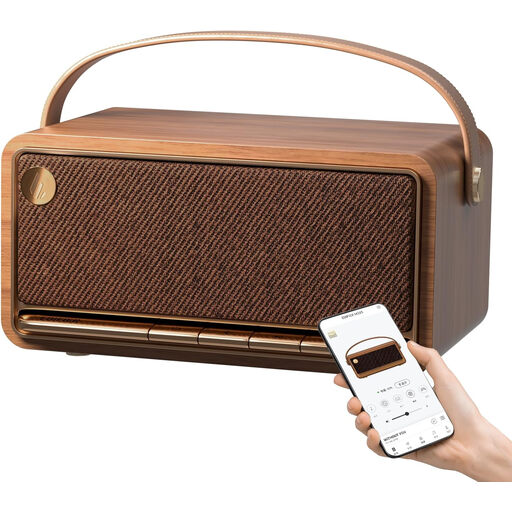
Why this product suits the profile: The wooden cabinet, leather handle and range of inputs appeal to users looking for a speaker that can be used as a stationary unit while still being portable for the living room, office or patio.
The choice is based on more than power alone: the specifications include 24-bit/96 kHz support, several input types and an app with EQ adjustment. According to the available data, this model is not rated for wet conditions.
40 W RMS, Hi-Res Audio certification according to the product description, Bluetooth 5.4, AUX, USB-C, TF card and up to 19 hours of playback at 50 per cent volume.

Why this product suits the profile: This model is aimed at campers and beach and pool users. Its stated floating design, IPX7 water resistance and IP67 dust protection make it suitable for more demanding outdoor conditions.
The protection ratings are clearly specified rather than being described simply as “suitable for outdoor use”. Nevertheless, the battery life of up to 12 hours depends on volume and content.
30 W RMS, Bluetooth 5.3, Micro-SD playback, PartyAdd connectivity and 5000-mAh battery according to the product specifications.
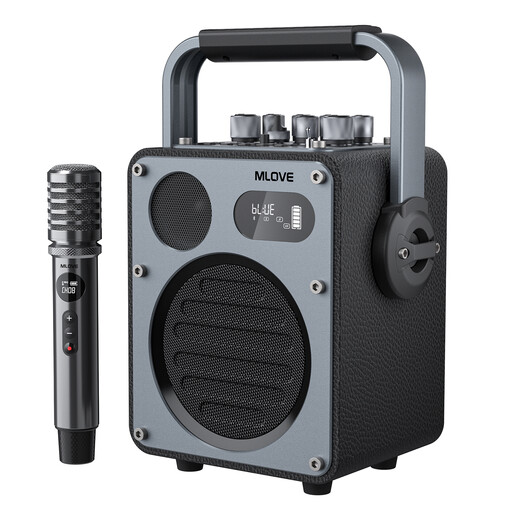
Why this product suits the profile: For families, party guests, singers and content creators, this karaoke system offers features that an ordinary Bluetooth speaker may not necessarily have.
Its intended use is clearly defined: the microphone, EQ modes and USB-C OTG are central features. If you only want to listen to music, you may not need these additional functions.
4-inch mid-bass driver, 2-inch tweeter, Bluetooth 5.4, wireless microphone and up to 12 hours of playback in karaoke mode according to the product specifications.
We have put together a complete, regularly updated list of products that fully meet these strict selection criteria and the safety regulations applicable in the EU.
Before playing audio for the first time, the battery should be fully charged and the instruction manual checked. For a stable connection, keep your smartphone within range and avoid placing several wireless sources directly next to the speaker. If two devices are connected, playback may switch automatically, depending on the multipoint implementation.
After contact with sand or water, an outdoor speaker should be cleaned according to the manufacturer’s instructions and dried before charging. Charging ports must not be damp. For longer-term storage, choose a dry place away from extreme temperatures.
Battery lifespan depends on charging cycles, temperature, volume and storage conditions. The playback time stated by the manufacturer describes runtime per charge, not the battery’s total service life. High volume and frequent fast charging can affect practical battery longevity.
This depends on the protection rating and the manufacturer’s specifications. A model with IPX4 is suitable for splashing water, but should not be stored in the rain or in a damp place. Even a waterproof Bluetooth speaker with IP67 or IPX7 should be dried after use and protected from frost, heat and direct sunlight.
Power consumption is primarily determined by charging power, charging frequency and battery capacity. A battery-powered device draws energy from the mains only while it is charging. An exact cost estimate is not possible without knowing the charging power, charging time and electricity tariff. In the long term, you should also consider the battery, charging accessories and availability of replacement parts.