
Lieferung heute & morgen

Qualitätsgarantie

Willkommens-Angebote freischalten: KOSTENLOSE Lieferung | Bis zu 80 % RABATT | Kostenlose 30-Tage-JoyPlus-Testphase
App herunterladen
A blood glucose meter is part of the daily routine for many people with diabetes. Carers and anyone who wants to check their blood glucose regularly at home also need a solution that’s easy to use and offers suitable consumables over the long term.
However, buying a meter can often lead to unnecessary costs. A cheap meter is of little use if the right blood glucose test strips are hard to find or only available in small packs. Similarly, a comprehensive blood glucose meter kit may include features you don’t need in everyday use. This guide compares the key buying criteria and suitable product profiles to help you choose.
The meter and test strips are designed to work as a system. Test strips from different brands or model ranges are generally not interchangeable. Before buying, check:
If you test regularly, the cost of test strips can exceed the one-off price of the meter.
A blood glucose meter in mmol/L displays different readings from a blood glucose meter in mg/dL. Some meters, including the Medisana MediTouch 2 Dual, let you switch between the two units. Other versions are set to just one unit.
The important thing is not to switch units yourself out of habit. The reading should match the units used in your records and the guidance from your healthcare practice. If you’re unsure, ask your healthcare team.
Terms such as ‘fast’, ‘painless’ or ‘high accuracy’ don’t automatically mean a meter is suitable for everyone. Instead, look for specific details such as testing time, required blood sample size, memory, display size and compatibility. Readings from a blood glucose meter are for self-monitoring and are not a substitute for medical diagnosis or treatment.
Depending on the model, a fast blood glucose meter gives you a result in around five to ten seconds. The amount of blood required is also important for everyday use. The product information provided lists amounts ranging from 0.6 to 1.0 μl, depending on the model. A smaller sample may make testing easier, but it doesn’t replace proper preparation:
If you test regularly, you’ll benefit from a meter with enough memory to store your results. The selected models offer 200, 480 or 500 memory slots. Averages over different time periods and markers for before and after meals can make it easier to keep track of your readings.
A blood glucose meter with an app can also store your readings digitally. According to the product information, the Medisana MediTouch 2 Dual can transfer data to the VitaDock app via Bluetooth. USB data transfer is available with certain MediTouch 2 versions. Before buying, check that your smartphone and preferred software are compatible.
For older people or anyone with impaired vision, a large, high-contrast display may be more important than an app. A complete blood glucose meter kit with lancets should include at least the meter, a lancing device, lancets and test strips. Depending on the version, it may also include a case, batteries, control solution or an alternative lancing device.
The product page should also say whether the test strips are fed in automatically, whether the meter detects an insufficient sample and whether manual coding is required.
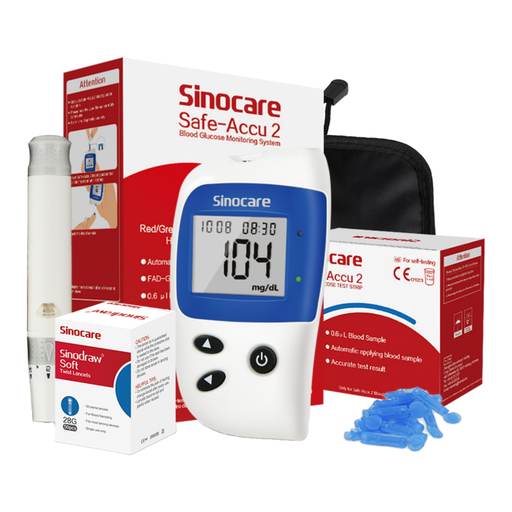
Why this product suits this profile: The kit includes a meter, lancing device, 50 test strips, 50 lancets and a case. The large display and simple button controls can make it easier to get started.
The contents list clearly shows how many consumables are included. Safe-Accu2 test strips must only be used with the corresponding meter.
According to the product information: a 0.6 μl blood sample, results in around ten seconds and memory for 200 readings.
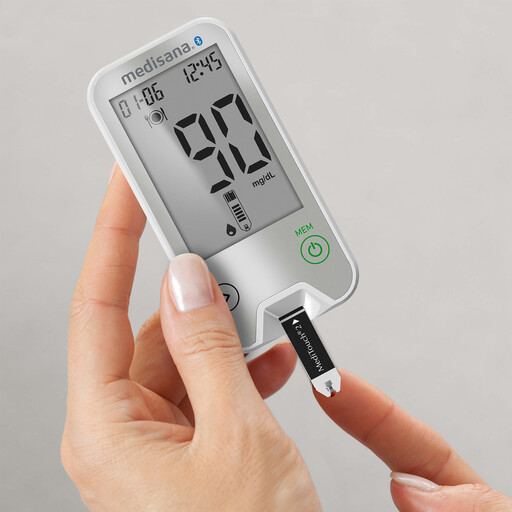
Why this product suits this profile: The switchable mg/dL and mmol/L display, along with digital data transfer options, suits users who want to keep their readings organised.
The product description gives specific technical details rather than relying on general marketing claims: GDH-FAD test strip technology, underfill detection and 480 memory slots.
According to the manufacturer: readings in five seconds, a 0.6 μl blood sample, Bluetooth compatibility and average calculations across several time periods.
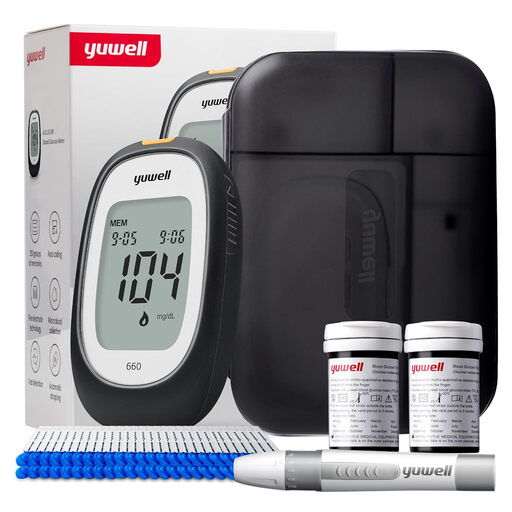
Why this product suits this profile: The kit is designed for regular testing and, according to the product description, can store up to 500 results and provide averages over specific time periods.
The compatibility restriction is clearly stated: the meter only accepts the specified model of yuwell test strips. This makes it easier to avoid ordering the wrong ones.
50 test strips, 50 lancets, five adjustable lancing depths and automatic test strip recognition, according to the product description.
We’ve put together a complete, regularly updated list of products that meet these strict selection criteria and fully comply with the safety regulations in force in the EU.
Wash and dry your hands, fit a new lancet, insert the test strip as instructed and apply a small blood sample. Refer to the relevant instructions for the exact procedure, suitable lancing depth and disposal guidance.
The expiry date is shown on the packaging or container. Some product information also specifies a limited usable life once opened, for example three or six months. Keep the container closed and store it in a dry place. Don’t use test strips that have expired, are damaged or have become damp.
As well as the purchase price, you’ll need to allow for the regular cost of test strips and lancets. To compare costs realistically, work out how many tests you do each week and factor in the pack size and price. Batteries, replacement lancing devices and any app or software requirements may also be relevant.
If your readings are unusual, you have symptoms or you’re unsure how to interpret your results, always seek medical advice. A blood glucose meter is intended for in vitro diagnostics and self-monitoring; it is not a substitute for professional treatment.